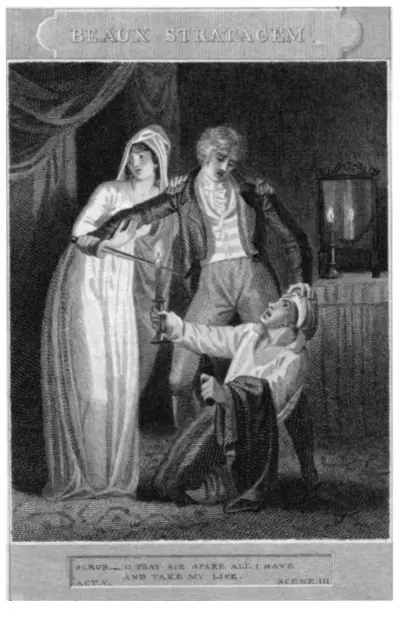
The Beaux-Stratagem: A comedy in five acts
George Farquhar
THE CLASSIC COLLECTION · 1706
"The Recruiting Officer" by George Farquhar is a play written in 1706. It follows two English Army officers—the womanizing Captain Plume and the cowardly Captain Brazen—as they recruit soldiers in Shrewsbury. Their military mission becomes entangled with romantic pursuits and social schemes. Sylvia disguises herself as a male recruit to be near Plume, while Worthy attempts to win back the now-wealthy Melinda. Through mistaken identities, dubious recruiting tactics, and romantic rivalries, the play weaves together the complications of love and ambition in this Restoration comedy.
Introduction adapted from the source catalogue; source summaries may be automatically generated.
Free to read · English · 21,284 words · No account needed
MAKE TIME FOR A GOOD BOOK
On by default. Untick to stop anonymous reading totals. Each page counts after 10 seconds in view. How this works.
Anonymous counting is on unless you have switched it off.
Wor. I hope, sir, you are under no apprehensions of wrong from any
body.
Bal. You know I ought to be.
Wor. You wrong my honour, in believing I could know any thing to your prejudice, without resenting it as much as you should.
Bal. This letter, sir, which I tear in pieces, to conceal the person that sent it, informs me that Plume has a design upon Sylvia, and that you are privy to it.
Wor. Nay, then, sir, I must do myself justice, and endeavour to find out the author. [Takes up a Bit.]--Sir, I know the hand, and if you refuse to discover the contents, Melinda shall tell me. [Going.
Bal. Hold, sir; the contents I have told you already; only with this circumstance--that her intimacy with Mr. Worthy had drawn the secret from him.
Wor. Her intimacy with me! Dear sir! let me pick up the pieces of this letter, 'twill give me such a power over her pride to have her own an intimacy under her hand.--This was the luckiest accident! [Gathering up the Letter.] The aspersion, sir, was nothing but malice; the effect of a little quarrel between her and Mrs. Sylvia.
Bal. Are you sure of that, sir?
Wor. Her maid gave me the history of part of the battle just now, as she overheard it: but I hope, sir, your daughter has suffered nothing upon the account.
Bal. No, no, poor girl! she's so afflicted with the news of her brother's death, that, to avoid company, she begged leave to go into the country.
Wor. And is she gone?
Bal. I could not refuse her, she was so pressing; the coach went from the door the minute before you came.
Wor. So pressing to be gone, sir?--I find her fortune will give her
the same airs with Melinda, and then Plume and I may laugh at one
another.
Bal. Like enough; women are as subject to pride as men are; and why mayn't great women as well as great men forget their old acquaintance? But come, where's this young fellow? I love him so well, it would break the heart of me to think him a rascal.--I am glad my daughter's gone fairly off though.--[Aside.] Where does the captain quarter?
Wor. At Horton's; I am to meet him there two hours hence, and we should be glad of your company.
Bal. Your pardon, dear Worthy! I must allow a day or two to the death of my son. The decorum of mourning is what we owe the world, because they pay it to us; afterwards I'm yours over a bottle, or how you will.
Your reading position is saved on this browser. Take it to another device with a library code. Reading pages adapt to text, rather than matching a printed edition.
BEHIND THE BOOK
This eBook is for the use of anyone anywhere in the United States and most other parts of the world at no cost and with almost no restrictions whatsoever. You may copy it, give it away or re-use it under the terms of the Project Gutenberg License included with this eBook or online at www.gutenberg.org. If you are not located in the United States, you will have to check the laws of the country where you are located before using this eBook. Read the source licence.
The original source file, including credits and licence, is retained by this library. Request an original-format copy at no charge. Please include the book title and Project Gutenberg identifier #37012.
KEEP YOUR CURIOSITY GOING
Maurice Baring
W. B. (William Butler) Yeats
Edward Martyn

John Brougham & Charlotte Brontë
Marguerite Merington
Leonid Andreyev