THE CLASSIC COLLECTION✦An outlaw’s diary: the CommuneCLASSIC FREE BOOKS
An outlaw’s diary: the Commune
Cécile Tormay
THE CLASSIC COLLECTION · 1881
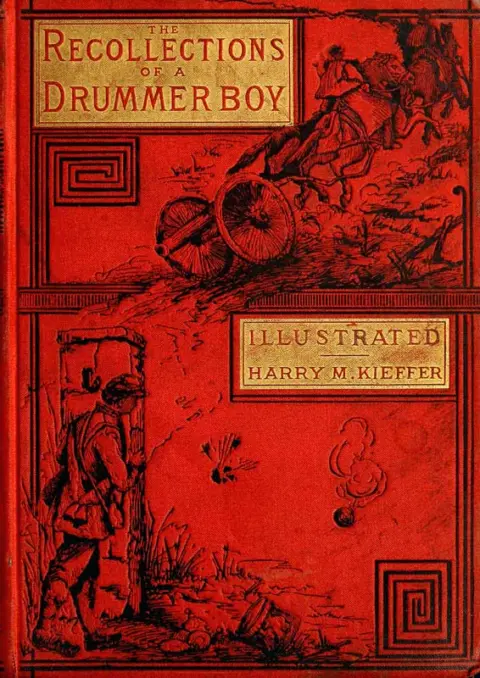
"The Recollections of a Drummer-Boy" by Henry Martyn Kieffer is a historical account written in the late 19th century. The book details the personal experiences of a young drummer boy, Harry M. Kieffer, who served in the Civil War, recounting his journey from enlistment through various military campaigns. It aims to depict life in the army through the eyes of a child, highlighting both the nobility and the harsh realities of war. At the start of the narrative, Kieffer introduces Harry, a restless schoolboy who longs to join the war effort as the Civil War unfolds around him. The opening passages describe his conversations with friends reflecting on the absence of older boys in school, indicating their enlistment. Eventually, Harry, fueled by excitement and the influence of peers, finds himself determined to join the army, despite his father’s hesitations. Before long, he receives permission to enlist as a drummer boy, setting the stage for his adventures, trials, and growth throughout his military journey.
Introduction adapted from the source catalogue; source summaries may be automatically generated.
Free to read · English · 61,671 words · No account needed
MAKE TIME FOR A GOOD BOOK
On by default. Untick to stop anonymous reading totals. Each page counts after 10 seconds in view. How this works.
Anonymous counting is on unless you have switched it off.
"And now, Doctor, there's something else, you see, the matter with me, and something more serious too, I'm afraid. You see, I can't use my right arm. The way was this: we were having a big fight out there in the woods. In the bayonet-charge I got hold of one of your flags, and was waving it, when all on a sudden I got an ugly clip in the arm here, as you see."
"Never mind, Johnny. We shall treat you just the same as our own boys, and though you are dressed in gray, you shall be cared for as faithfully as if you were dressed in blue, until you are well and strong again."
Never did I see a more delighted or grateful man than he, when, awakened from his deep chloroform sleep, he was asked whether he did not think his arm had better come off now?
"Just as you think best, Doctor."
"Look at your arm once, Johnny."
What was his glad surprise to find that the operation had been
already performed, and that a neat bandage was wound about his
shoulder!
The most striking illustration of the power of religion to sustain a man in distress and trial, I saw there in that field-hospital.
We had carried Stannard into a tent, and laid him on a pile of pine-boughs, where, had he only been able to keep quiet, he would have done well enough. But he was not able to keep quiet. A more restless man I never saw. Although his wound was not considered necessarily dangerous, yet he was evidently in great fear of death, and for death, I grieve to say, he was not at all prepared. He had been a wild, wayward man, and now that he thought the end was approaching, he was full of alarm. As I bent over him, trying my best, but in vain, to comfort and quiet him, my attention was called to a man on the other side of the tent, whose face I thought I knew, in spite of its unearthly pallor.
"Why, Smith," said I, "is this you? Where are you hurt?"
"Come turn me around and see," he said.
Rolling him over carefully on his side, I saw a great, cruel wound
in his back.
My countenance must have expressed alarm when I asked him, as quietly as I could, whether he knew that he was very seriously wounded, and might die.
Never shall I forget the look that man gave me, as, with a strange
light in his eye, he said:
"I am in God's hands; I am not afraid to die."
Your reading position is saved on this browser. Take it to another device with a library code. Reading pages adapt to text, rather than matching a printed edition.
BEHIND THE BOOK
This eBook is for the use of anyone anywhere in the United States and most other parts of the world at no cost and with almost no restrictions whatsoever. You may copy it, give it away or re-use it under the terms of the Project Gutenberg License included with this eBook or online at www.gutenberg.org. If you are not located in the United States, you will have to check the laws of the country where you are located before using this eBook. Read the source licence.
The original source file, including credits and licence, is retained by this library. Request an original-format copy at no charge. Please include the book title and Project Gutenberg identifier #44970.
KEEP YOUR CURIOSITY GOING
Cécile Tormay

Moritz Busch
John L. Ransom
Frances Wright
Cécile Tormay

Mabel Potter Daggett