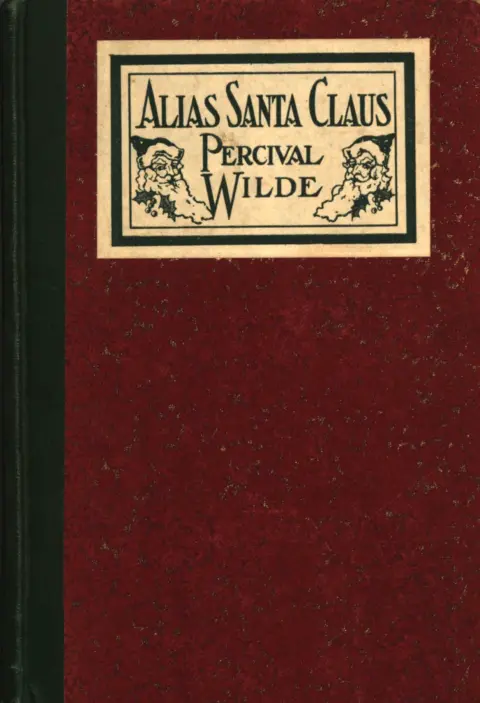
Alias Santa Claus
Percival Wilde
THE CLASSIC COLLECTION · 1922
"The Reckoning: A Play in One Act" by Percival Wilde is a one-act play written in the early 20th century. The story is set in a barber shop and revolves around a tense encounter between a barber and his customer. Thematically, the play grapples with issues of accountability, morality, and the psychological consequences of one's past actions. In this gripping play, the barber, Kilburn, is confronted with a customer, John, whom he has been following for twelve years after a traumatic event involving Kilburn's daughter, Jennie. Kilburn seizes the opportunity to exact a reckoning from John, who is now at his mercy while getting shaved. The barber highlights John's betrayal and abandonment of Jennie, who has since died. As the barber prepares to take violent action, the situation escalates with John pleading for his life and desperately trying to convince Kilburn to let him go. In a twist, it is revealed that John is not as pressed for time as he claimed, as the meeting he feared missing does not start until later. The play concludes with Kilburn's act of mercy, leaving John alive but emotionally broken, thus exploring the themes of revenge and the fragility of life.
Introduction adapted from the source catalogue; source summaries may be automatically generated.
Free to read · English · 2,725 words · No account needed
MAKE TIME FOR A GOOD BOOK
On by default. Untick to stop anonymous reading totals. Each page counts after 10 seconds in view. How this works.
Anonymous counting is on unless you have switched it off.
THE BARBER. Oh, I believe you. Don't let that trouble you. In fact, I know all about the meeting. There's going to be an auction, and unless you bid, it will be all up with you.
THE CUSTOMER. Then you'll let me go there?
THE BARBER. I'm afraid I won't, sir.
THE CUSTOMER. But--
THE BARBER. If I may use your own words, sir, I don't give a damn
about your meeting.
THE CUSTOMER. (Angrily) Who the devil do you think
THE BARBER. (Interrupting him by running the lather brush into his mouth) Oh, shut up! (There is a pause.)
THE CUSTOMER. I'll-I'll give you ten dollars to let me go.
THE BARBER. (Acting as if he did not hear) Beg pardon, sir?
THE CUSTOMER. (Taking the scarf-pin from the edge of his vest.) This scarf-pin--it's worth five hundred dollars--I'll give--
THE BARBER. (Raises his hand to his ear, knocking the pin out of
THE CUSTOMER's hand) I don't hear well on this side. Try the
other.
THE CUSTOMER. A thousand dollars! I'll give you a thousand
dollars!
THE BARBER. I'm afraid it won't do, sir. You see, the young lady who runs the news stand up-stairs says--you won't interrupt me this time will you?--she says it's important to keep customers in sight. There's nothing so bad for trade as an empty shop.
THE CUSTOMER. Oh, have you no heart? It's almost too late now! Every second is worth a dollar to me!
THE BARBER. Well, sir, it will console you to know that my time
is worth very little.
THE CUSTOMER. Please let me up! If I wait two minutes longer, I
might as well shoot myself.
THE BARBER. I shan't object, sir.
THE CUSTOMER. Oh! Oh! Oh!
THE BARBER. So you are beginning to feel some regrets? I'm glad to see it. I always thought you'd regret sooner or later. (Shaving.) By the way, sir, haven't you recognized me yet?
THE CUSTOMER. Recognized you?
THE BARBER. Oh, I see. You thought I was just a lunatic. Well, I'm not. Look at me. Look at me closely.
THE CUSTOMER. I don't know you!
THE BARBER. No? Well, just say to yourself, "Twelve years ago this man's hair was not so gray. Twelve years ago this man's face didn't show so many lines of care. Twelve years ago this man lived--well, in a little town near Savannah, and--"
THE CUSTOMER. (Beginning to recognize him) You-you can't be--
THE BARBER. Say it.
THE CUSTOMER. Kilburn!
THE BARBER. Yes, Kilburn!
THE CUSTOMER. (Hoarsely) And you followed me about!
THE BARBER. For twelve years!
THF CUSTOMER. From town to town!
THE BARBER. I was never more than a week behind you.
Your reading position is saved on this browser. Take it to another device with a library code. Reading pages adapt to text, rather than matching a printed edition.
Percival Wilde
BEHIND THE BOOK
This eBook is for the use of anyone anywhere in the United States and most other parts of the world at no cost and with almost no restrictions whatsoever. You may copy it, give it away or re-use it under the terms of the Project Gutenberg License included with this eBook or online at www.gutenberg.org. If you are not located in the United States, you will have to check the laws of the country where you are located before using this eBook. Read the source licence.
The original source file, including credits and licence, is retained by this library. Request an original-format copy at no charge. Please include the book title and Project Gutenberg identifier #19931.
KEEP YOUR CURIOSITY GOING
Maurice Baring
W. B. (William Butler) Yeats
Edward Martyn

John Brougham & Charlotte Brontë
Marguerite Merington
Leonid Andreyev