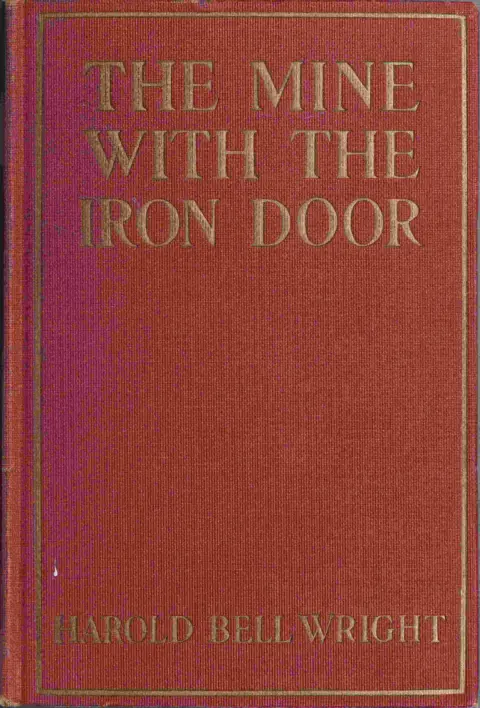
The Mine with the Iron Door
Harold Bell Wright
THE CLASSIC COLLECTION · 1919
"The Re-Creation of Brian Kent" by Harold Bell Wright is a novel likely written in the early 20th century. The story revolves around the themes of redemption, the complexities of human nature, and the healing power of love, primarily through the experiences of the main characters, Auntie Sue and Brian Kent. The opening of the book introduces Auntie Sue, a remarkable old schoolteacher living in the picturesque Ozarks, who dedicates her life to nurturing and empowering those around her. As we dive into her world, we learn about her warmth, kindness, and the comforting atmosphere of her home. Simultaneously, the narrative shifts to Brian Kent, who is introduced amid his troubling circumstances, marked by addiction and a troubled past as a fugitive from the law. The beginning of the story captures a poignant moment as Auntie Sue finds Brian washed up in a boat and decides to protect him from the authorities, setting off a series of events that explore themes of forgiveness, identity, and the meaning of true redemption. Through the connections forged between these two unlikely characters, the narrative lays the groundwork for a profound exploration of life’s unpredictability and the hope of re-creation.
Introduction adapted from the source catalogue; source summaries may be automatically generated.
Free to read · English · 67,793 words · No account needed
MAKE TIME FOR A GOOD BOOK
On by default. Untick to stop anonymous reading totals. Each page counts after 10 seconds in view. How this works.
Anonymous counting is on unless you have switched it off.
“You'll be all right, though, Ross,” the Sheriff continued, “as long as you're with me. Auntie Sue and me have been friends for about twenty year, now. I always stop to see her whenever I'm passing through the Elbow Rock neighborhood, if I ain't in too big a hurry. Stayed with her a week, once, five years ago, when we was after that Lewis gang. She knows I'd jail any man on earth that would even touch one of her sunsets.”
Then, as if the jesting allusion to his office reminded him of his professional duties, he added: “I plumb forgot, Auntie Sue, this gentleman is Mr. Ross. He is one of William J. Burns's crack detectives. Don't be scared, though, he ain't after you.”
Auntie Sue, while joining in the laughter, and acknowledging the introduction, regarded the business-looking gentleman by the window with intense interest.
“I think,” she said, slowly,--and the sweetness of her low, cultured voice was very marked in contrast to the Sheriff's thundering tones,--“I think, sir, that this is the first time in my life that I ever saw a real detective. I have read about them, of course.”
Mr. Ross was captivated by the charm of this beautiful old gentlewoman, who regarded him with such child-like interest, and who spoke with such sweet frankness and dignity. Smilingly, he returned:
“I fear, madam, that you would find me very disappointing. No one that I ever knew in my profession could hope to live up to the reputation given us by the story-books. No secret service man living can remotely approximate the deeds performed by the detectives of fiction. We are very, very human, I can assure you.”
“I am sure that you, at least, must be very kind,” returned Auntie Sue, gently. And the cheeks of the experienced officer flushed like the cheeks of a schoolboy.
“Mr. Ross, Auntie Sue,” said the Sheriff, “is, as I was telling you, one of William J. Burns's big men.”
Auntie Sue gave her attention to her big friend: “Yes?”
The Sheriff continued: “Now, the Burns people, you see, protect the banks all over the country.”
“Yes?” came, again, in a tone so low and gentle that the monosyllable
was scarcely heard.
The officer's loud voice went on: “And Mr. Ross, here, works most of his time on these bank cases. Just now, he is trailing a fellow that got away with a lot of money from the Empire Consolidated Savings Bank, of Chicago, about a month ago;--that is, the man disappeared about a month ago. He had been stealing along from the bank for about a year,--worked, for them, you see.”
Your reading position is saved on this browser. Take it to another device with a library code. Reading pages adapt to text, rather than matching a printed edition.
Harold Bell Wright
Harold Bell Wright
Harold Bell Wright
Harold Bell Wright
BEHIND THE BOOK
This eBook is for the use of anyone anywhere in the United States and most other parts of the world at no cost and with almost no restrictions whatsoever. You may copy it, give it away or re-use it under the terms of the Project Gutenberg License included with this eBook or online at www.gutenberg.org. If you are not located in the United States, you will have to check the laws of the country where you are located before using this eBook. Read the source licence.
The original source file, including credits and licence, is retained by this library. Request an original-format copy at no charge. Please include the book title and Project Gutenberg identifier #3265.
KEEP YOUR CURIOSITY GOING
Coulson Kernahan

Maurice Baring
Frances Wright
Cécile Tormay

Frederic Jesup Stimson

W. H. P. (William Henry Pope) Jarvis