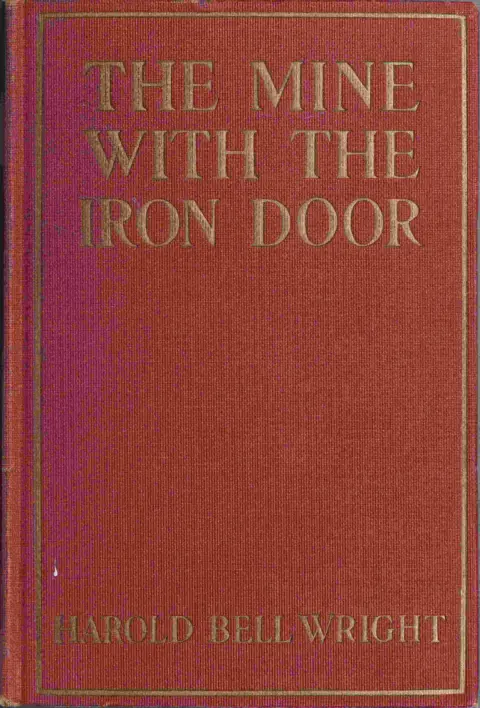
The Mine with the Iron Door
Harold Bell Wright
THE CLASSIC COLLECTION · 1919
"The Re-Creation of Brian Kent" by Harold Bell Wright is a novel likely written in the early 20th century. The story revolves around the themes of redemption, the complexities of human nature, and the healing power of love, primarily through the experiences of the main characters, Auntie Sue and Brian Kent. The opening of the book introduces Auntie Sue, a remarkable old schoolteacher living in the picturesque Ozarks, who dedicates her life to nurturing and empowering those around her. As we dive into her world, we learn about her warmth, kindness, and the comforting atmosphere of her home. Simultaneously, the narrative shifts to Brian Kent, who is introduced amid his troubling circumstances, marked by addiction and a troubled past as a fugitive from the law. The beginning of the story captures a poignant moment as Auntie Sue finds Brian washed up in a boat and decides to protect him from the authorities, setting off a series of events that explore themes of forgiveness, identity, and the meaning of true redemption. Through the connections forged between these two unlikely characters, the narrative lays the groundwork for a profound exploration of life’s unpredictability and the hope of re-creation.
Introduction adapted from the source catalogue; source summaries may be automatically generated.
Free to read · English · 67,793 words · No account needed
MAKE TIME FOR A GOOD BOOK
On by default. Untick to stop anonymous reading totals. Each page counts after 10 seconds in view. How this works.
Anonymous counting is on unless you have switched it off.
And even as the river gave back the light of the sky and the color of the mountains, so the gentle face of the gray-haired woman, who watched with such loving reverence, reflected the beauty of the scene. The peace and quiet of the evening of her life was as the still loveliness of that twilight hour.
And, yet, there was a suggestion of pathos in the loneliness of the slender figure standing there. Now and again, she clasped her delicate hands to her breast as if moved by emotions of a too-poignant sweetness, while in her eyes shone the soft light of fondest memories and dearest dreams. Several times she turned her head to look about, as if wishing for some one to share with her the beauty that moved her so. At last, she called; and her voice, low and pure-toned, had in it the quality that was in the light of her eyes.
“Judy! Judy, dear! Do come and see this wonderful, wonderful sky!”
From within the house, a shrill, querulous, drawling voice, so characteristic of the Southern “poor-white” mountaineer, answered: “Wha-a-t?”
A quick little smile deepened the crows'-feet at the corners of Auntie Sue's eyes, as she called again with gentle patience: “Do come and see the sunset, Judy, dear! It is so beautiful!” And, this time, in answer, Judy appeared in the doorway.
From appearances, the poor creature's age might have been anywhere from fifteen to thirty-five; for the twisted and misshapen body, angular and hard; the scrawny, wry neck; the old-young face, thin and sallow, with furtive, beady-black eyes, gave no hint of her years. As a matter of fact, I happened to know that Judith Taylor, daughter of the notorious Ozark moonshiner, Jap Taylor, was just past twenty the year she went to live with Auntie Sue.
Looking obliquely at the old gentlewoman, with a curious expression of mingled defiance, suspicion, and affection on her almost vicious face, Judy drawled, “Was you-all a-yellin' for me?”
“Yes, Judy; I want you to help me watch the sunset,” Auntie Sue answered, with bright animation; and, turning, she pointed toward the glowing west,--“Look!”
Judy's sly, evasive eyes did not cease to regard the illumined face of her old companion as she returned, in her dry, high-pitched monotone: “I don't reckon as how you-all are a-needin' much help, seein' as how you are allus a-watchin' hit. A body'd think you-all was mighty nigh old 'nough, by now, ter look at hit alone.”
Your reading position is saved on this browser. Take it to another device with a library code. Reading pages adapt to text, rather than matching a printed edition.
Harold Bell Wright
Harold Bell Wright
Harold Bell Wright
Harold Bell Wright
BEHIND THE BOOK
This eBook is for the use of anyone anywhere in the United States and most other parts of the world at no cost and with almost no restrictions whatsoever. You may copy it, give it away or re-use it under the terms of the Project Gutenberg License included with this eBook or online at www.gutenberg.org. If you are not located in the United States, you will have to check the laws of the country where you are located before using this eBook. Read the source licence.
The original source file, including credits and licence, is retained by this library. Request an original-format copy at no charge. Please include the book title and Project Gutenberg identifier #3265.
KEEP YOUR CURIOSITY GOING
Coulson Kernahan

Maurice Baring
Frances Wright
Cécile Tormay

Frederic Jesup Stimson

W. H. P. (William Henry Pope) Jarvis