THE CLASSIC COLLECTION✦The Countess FannyCLASSIC FREE BOOKS
The Countess Fanny
Marjorie Bowen
THE CLASSIC COLLECTION · 1912
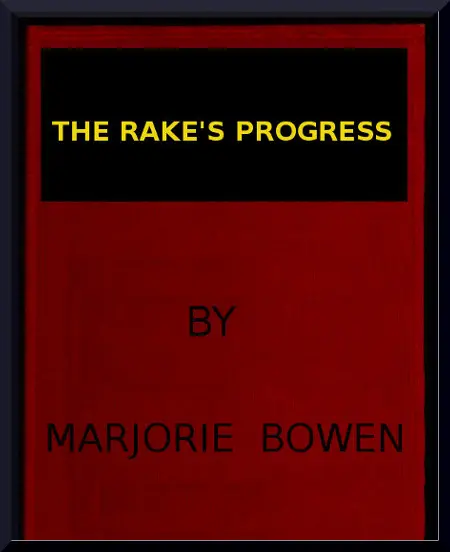
"The Rake's Progress" by Marjorie Bowen is a novel written in the early 20th century. The story seems to revolve around the lives of the Lyndwood family, particularly focusing on Lord Rose Lyndwood and the implications of his lifestyle choices on his fortunes and relationships. Central characters mentioned include Lord Lyndwood, his younger brother Marius, and their cousin, Susannah Chressham. The narrative explores themes of love, duty, and the consequences of one's actions, particularly against the backdrop of societal expectations. At the start of the narrative, Miss Susannah Chressham reflects on the lives of the Lyndwoods, particularly her sense of worry for her cousin Rose and his cousin Marius, who are both involved in financial difficulties. As Susannah writes letters and prepares for Marius's return, she expresses concern about the rumors surrounding Rose and his lifestyle in London. The opening sets the stage for a dramatic unveiling of Rose's life choices, including his potential estrangement from those he loves due to impending financial ruin. Conversations between characters hint at a rich tapestry of family dynamics, entangled fates, and the looming specter of scandal while establishing a sense of foreboding about what life changes may come with the return of the two brothers.
Introduction adapted from the source catalogue; source summaries may be automatically generated.
Free to read · English · 84,472 words · No account needed
MAKE TIME FOR A GOOD BOOK
On by default. Untick to stop anonymous reading totals. Each page counts after 10 seconds in view. How this works.
Anonymous counting is on unless you have switched it off.
He was utterly out of harmony with his surroundings. It might be that he was aware of this, for when he saw his image in the ostentatious mirrors he very slightly smiled, and not pleasantly.
The sunlight entered by the tall bare window and lay in a great square on the highly coloured carpet, dazzling in its passage on the flaunting gold of furniture and pictures.
Lord Lyndwood paced to and fro, glancing, when he reached the window, at the green chariot below, with its idle admirers, and at the empty street beyond, and when he reached the great glass the other end of the chamber at the reflection of his own superb person with that slight and sneering smile.
He was by the window when the heavy-carved door quickly opened, and a
man stepped into the room.
Lord Lyndwood stood where he was.
"Good morning, Mr. Hilton," he said.
The new-comer advanced.
"I have kept you waiting, my lord," he said. "A domestic matter
detained me."
He looked at the Earl gravely, yet intently, and came nearer. He was a middle-aged man, heavy in build, with a commonplace countenance imparted by ambitions satisfied and a prosperity hardly attained and keenly relished.
He was dressed in plum-coloured velvet. Across his waistcoat was a watch-chain set with rubies that he fingered with his coarse left hand, as if he could not forget it; he wore a large, old-fashioned peruke heavily powdered, that, flowing on to his shoulders, gave a touch of remote dignity to his person, belied by his shrewd, alert face.
"Your lordship must excuse the disorder of my house," he said. "We are but newly arrived in London."
"I observe no disorder," answered the Earl. His slow glance rested on the owner of the mansion. "It appears to me prodigious neat."
Mr. Hilton bowed.
"Will you be seated, my lord?"
Rose Lyndwood moved to one of the stiff, awkward-looking sofas, and seated himself there, with his back to the light.
"You received my letter?" he asked, placing his hat beside him.
"I had that honour, my lord."
Mr. Hilton placed himself in one of the covered chairs, sat erect in unconscious discomfort, and gazed at the Earl with narrowed eager eyes.
"Then there is the less for me to say," answered Rose Lyndwood.
He sat carelessly, and his voice was languid, as if it were no great matter that he discussed; but his face was pale above the black stock, and his lips had the look of disdain that came to them when against his will he forced himself to touch affairs he wished to spurn.
Your reading position is saved on this browser. Take it to another device with a library code. Reading pages adapt to text, rather than matching a printed edition.
Marjorie Bowen
Marjorie Bowen
Marjorie Bowen
Marjorie Bowen
BEHIND THE BOOK
This eBook is for the use of anyone anywhere in the United States and most other parts of the world at no cost and with almost no restrictions whatsoever. You may copy it, give it away or re-use it under the terms of the Project Gutenberg License included with this eBook or online at www.gutenberg.org. If you are not located in the United States, you will have to check the laws of the country where you are located before using this eBook. Read the source licence.
The original source file, including credits and licence, is retained by this library. Request an original-format copy at no charge. Please include the book title and Project Gutenberg identifier #48200.
KEEP YOUR CURIOSITY GOING
Coulson Kernahan

Maurice Baring
Frances Wright
Cécile Tormay

Frederic Jesup Stimson

W. H. P. (William Henry Pope) Jarvis