Where Your Treasure Is: Being the Personal Narrative of Ross Sidney, Diver
Holman Day
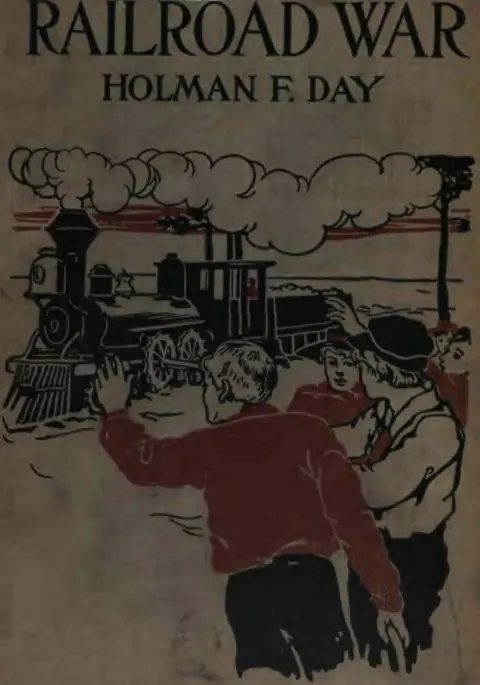
THE CLASSIC COLLECTION · 1906
"The Rainy Day Railroad War" by Holman Day is a novel written in the early 20th century. The story follows Rodney Parker, a young assistant engineer who finds himself embroiled in conflicts over labor rights and the construction of a railroad through a tumultuous wilderness. As Parker grapples with the challenges posed by the oppressive local timber magnate, Colonel Gideon Ward, he not only faces physical threats but also navigates the complexities of ethics, justice, and corporate interests in a rapidly changing world. The opening of this engaging tale introduces readers to Parker and his role in the railroad construction project, set against the rugged backdrop of a new work site populated by immigrant laborers. The tensions escalate quickly when Parker stands up for the rights of the Italian workers in a restaurant who are mistreated by their padrone, Dominick. The situation spirals into chaos with accusations, physical confrontations, and the urgent need for Parker to prove himself as a leader. As the story unfolds, readers are drawn into a gritty, dynamic conflict that intertwines social justice with personal ambition, setting the stage for Parker's upcoming challenges against both Ward and the elements of the wild.
Introduction adapted from the source catalogue; source summaries may be automatically generated.
Free to read · English · 38,945 words · No account needed
MAKE TIME FOR A GOOD BOOK
On by default. Untick to stop anonymous reading totals. Each page counts after 10 seconds in view. How this works.
Anonymous counting is on unless you have switched it off.
“Ye'd better go!” bellowed Connick. “Understand? I said ye'd better go. Go an' mind your business, an' if ye do that, not a man in my crew will step a foot on the Sunk-haze shore. But if ye stay here and meddle, then down come your houses and out go your cook-stoves. You know me! Get back on shore.”
A tremendous roar from his men emphasized his demand.
“If ye want these hearties loose up there, ye can have 'em in about two minutes!” he cried, threateningly.
The Sunkhaze contingent rubbed elbows significantly, mumbled in conference, and scuffled slowly toward the shore.
“Are you going to back down, men?” Parker shouted.
“We've got wives an' children an' houses up there, mister,” said a voice from the crowd, “an' it's a cold night to be turned out-o'-doors. We know these fellers better'n what you do.”
“But, men,” persisted Parker, “they won't dare to sack your village. Such things are not done in these days. The law--”
“Law!” burst from Connick, jeeringly. “Law! Law!” echoed his men, with
mocking laughter.
“Why,” yelled Connick, “there ain't deputy sheriffs enough in this county to round us up once we get acrost the Poquette divide! There ain't a deputy sheriff that will dare to poke his nose within ten miles of our camps.”
“That's right, Mr. Parker,” agreed one of the Sunkhaze crowd. “Once a crew burnt a smokin'-car when they were comin' up from--”
“No yarns now, no yarns now!” Connick thrust himself against the Sunkhaze men and roughly elbowed them back. “Get on shore an' stay there.”
Parker was left standing alone on the ice. His supporters scuffled away, muttering angry complaints, but offering no resistance. When the giant woodsman returned after hastening their departure, he was faced by the young man, still defiant. Connick cocked his head humorously and looked down on the engineer. Under all the big man's apparent fierceness there had been a flash of rough jocoseness in his tones at times. Parker saw plainly that he and his followers viewed the whole thing as a “lark,” and entertained little respect for their adversaries.
“Connick, I warn you--” Parker began; but the giant chuckled, and said,
tauntingly:
“'Cluck, cluck!' said the bear.
“I want to say to you, sir, that you are dealing with a large proposition if you propose to interfere with this railroad property. My backers--”
“'Bow-wow!' said the fish.” The woodsman cried the taunt more insolently, and yet with a jeering joviality that irritated Parker more than downright abuse would have done.
He started toward his engine, but Connick put out his big arm to
interpose.
Your reading position is saved on this browser. Take it to another device with a library code. Reading pages adapt to text, rather than matching a printed edition.
Holman Day
Holman Day
Holman Day
Holman Day
BEHIND THE BOOK
This eBook is for the use of anyone anywhere in the United States and most other parts of the world at no cost and with almost no restrictions whatsoever. You may copy it, give it away or re-use it under the terms of the Project Gutenberg License included with this eBook or online at www.gutenberg.org. If you are not located in the United States, you will have to check the laws of the country where you are located before using this eBook. Read the source licence.
The original source file, including credits and licence, is retained by this library. Request an original-format copy at no charge. Please include the book title and Project Gutenberg identifier #22666.
KEEP YOUR CURIOSITY GOING
Coulson Kernahan

Maurice Baring
Frances Wright
Cécile Tormay

Frederic Jesup Stimson

W. H. P. (William Henry Pope) Jarvis