Reflections on the death of a porcupine and other essays
D. H. (David Herbert) Lawrence
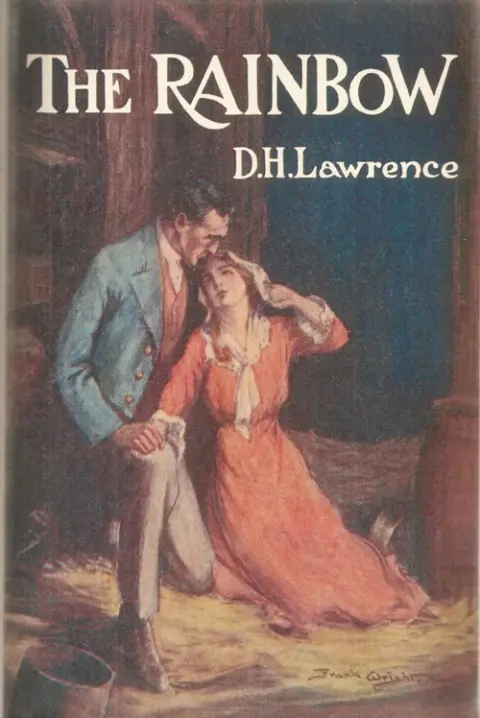
THE CLASSIC COLLECTION · 1915
"The Rainbow" by D. H. Lawrence is a novel published in 1915. It follows three generations of the Brangwen family in Nottinghamshire as they navigate love, desire, and personal fulfillment against the backdrop of England's industrial transformation. From farmer Tom Brangwen in the 1840s to his granddaughter Ursula in 1905, each generation struggles between passionate inner life and society's confining structures. Lawrence's frank treatment of sexuality sparked an obscenity trial, resulting in copies being seized and burned, banning the book in Britain for eleven years.
Introduction adapted from the source catalogue; source summaries may be automatically generated.
Free to read · English · 187,983 words · No account needed
MAKE TIME FOR A GOOD BOOK
On by default. Untick to stop anonymous reading totals. Each page counts after 10 seconds in view. How this works.
Anonymous counting is on unless you have switched it off.
“What were you laughing about, our Anna?” asked Fred, the moment they were out of the church.
“Oh, I couldn’t help it,” she said, in her careless, half-mocking fashion. “I don’t know why Cousin Will’s singing set me off.”
“What was there in my singing to make you laugh?” he asked.
“It was so loud,” she said.
They did not look at each other, but they both laughed again, both
reddening.
“What were you snorting and laughing for, our Anna?” asked Tom, the elder brother, at the dinner table, his hazel eyes bright with joy. “Everybody stopped to look at you.” Tom was in the choir.
She was aware of Will’s eyes shining steadily upon her, waiting for her
to speak.
“It was Cousin Will’s singing,” she said.
At which her cousin burst into a suppressed, chuckling laugh, suddenly showing all his small, regular, rather sharp teeth, and just as quickly closing his mouth again.
“Has he got such a remarkable voice on him then?” asked Brangwen.
“No, it’s not that,” said Anna. “Only it tickled me—I couldn’t tell you
why.”
And again a ripple of laughter went down the table.
Will Brangwen thrust forward his dark face, his eyes dancing, and said:
“I’m in the choir of St. Nicholas.”
“Oh, you go to church then!” said Brangwen.
“Mother does—father doesn’t,” replied the youth.
It was the little things, his movement, the funny tones of his voice, that showed up big to Anna. The matter-of-fact things he said were absurd in contrast. The things her father said seemed meaningless and neutral.
During the afternoon they sat in the parlour, that smelled of geranium, and they ate cherries, and talked. Will Brangwen was called on to give himself forth. And soon he was drawn out.
He was interested in churches, in church architecture. The influence of Ruskin had stimulated him to a pleasure in the mediæval forms. His talk was fragmentary, he was only half articulate. But listening to him, as he spoke of church after church, of nave and chancel and transept, of rood-screen and font, of hatchet-carving and moulding and tracery, speaking always with close passion of particular things, particular places, there gathered in her heart a pregnant hush of churches, a mystery, a ponderous significance of bowed stone, a dim-coloured light through which something took place obscurely, passing into darkness: a high, delighted framework of the mystic screen, and beyond, in the furthest beyond, the altar. It was a very real experience. She was carried away. And the land seemed to be covered with a vast, mystic church, reserved in gloom, thrilled with an unknown Presence.
Your reading position is saved on this browser. Take it to another device with a library code. Reading pages adapt to text, rather than matching a printed edition.
D. H. (David Herbert) Lawrence
D. H. (David Herbert) Lawrence
D. H. (David Herbert) Lawrence
D. H. (David Herbert) Lawrence
BEHIND THE BOOK
This eBook is for the use of anyone anywhere in the United States and most other parts of the world at no cost and with almost no restrictions whatsoever. You may copy it, give it away or re-use it under the terms of the Project Gutenberg License included with this eBook or online at www.gutenberg.org. If you are not located in the United States, you will have to check the laws of the country where you are located before using this eBook. Read the source licence.
The original source file, including credits and licence, is retained by this library. Request an original-format copy at no charge. Please include the book title and Project Gutenberg identifier #28948.
KEEP YOUR CURIOSITY GOING
Coulson Kernahan

Maurice Baring
Frances Wright
Cécile Tormay

Frederic Jesup Stimson

W. H. P. (William Henry Pope) Jarvis