Reflections on the death of a porcupine and other essays
D. H. (David Herbert) Lawrence
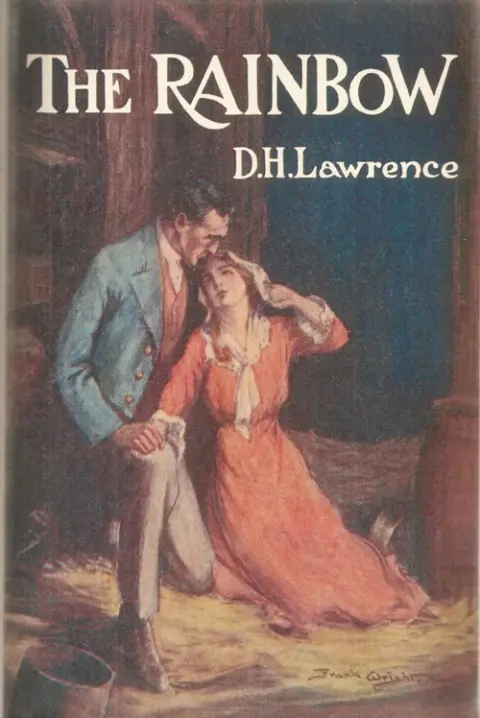
THE CLASSIC COLLECTION · 1915
"The Rainbow" by D. H. Lawrence is a novel published in 1915. It follows three generations of the Brangwen family in Nottinghamshire as they navigate love, desire, and personal fulfillment against the backdrop of England's industrial transformation. From farmer Tom Brangwen in the 1840s to his granddaughter Ursula in 1905, each generation struggles between passionate inner life and society's confining structures. Lawrence's frank treatment of sexuality sparked an obscenity trial, resulting in copies being seized and burned, banning the book in Britain for eleven years.
Introduction adapted from the source catalogue; source summaries may be automatically generated.
Free to read · English · 187,983 words · No account needed
MAKE TIME FOR A GOOD BOOK
On by default. Untick to stop anonymous reading totals. Each page counts after 10 seconds in view. How this works.
Anonymous counting is on unless you have switched it off.
The evening came on, he played with Anna, and then sat alone with his own wife. She was sewing. He sat very still, smoking, perturbed. He was aware of his wife’s quiet figure, and quiet dark head bent over her needle. It was too quiet for him. It was too peaceful. He wanted to smash the walls down, and let the night in, so that his wife should not be so secure and quiet, sitting there. He wished the air were not so close and narrow. His wife was obliterated from him, she was in her own world, quiet, secure, unnoticed, unnoticing. He was shut down by her.
He rose to go out. He could not sit still any longer. He must get out of this oppressive, shut-down, woman-haunt.
His wife lifted her head and looked at him.
“Are you going out?” she asked.
He looked down and met her eyes. They were darker than darkness, and gave deeper space. He felt himself retreating before her, defensive, whilst her eyes followed and tracked him down.
“I was just going up to Cossethay,” he said.
She remained watching him.
“Why do you go?” she said.
His heart beat fast, and he sat down, slowly.
“No reason particular,” he said, beginning to fill his pipe again,
mechanically.
“Why do you go away so often?” she said.
“But you don’t want me,” he replied.
She was silent for a while.
“You do not want to be with me any more,” she said.
It startled him. How did she know this truth? He thought it was his
secret.
“Yi,” he said.
“You want to find something else,” she said.
He did not answer. “Did he?” he asked himself.
“You should not want so much attention,” she said. “You are not a
baby.”
“I’m not grumbling,” he said. Yet he knew he was.
“You think you have not enough,” she said.
“How enough?”
“You think you have not enough in me. But how do you know me? What do you do to make me love you?”
He was flabbergasted.
“I never said I hadn’t enough in you,” he replied. “I didn’t know you wanted making to love me. What do you want?”
“You don’t make it good between us any more, you are not interested. You do not make me want you.”
“And you don’t make me want you, do you now?” There was a silence. They were such strangers.
“Would you like to have another woman?” she asked.
Your reading position is saved on this browser. Take it to another device with a library code. Reading pages adapt to text, rather than matching a printed edition.
D. H. (David Herbert) Lawrence
D. H. (David Herbert) Lawrence
D. H. (David Herbert) Lawrence
D. H. (David Herbert) Lawrence
BEHIND THE BOOK
This eBook is for the use of anyone anywhere in the United States and most other parts of the world at no cost and with almost no restrictions whatsoever. You may copy it, give it away or re-use it under the terms of the Project Gutenberg License included with this eBook or online at www.gutenberg.org. If you are not located in the United States, you will have to check the laws of the country where you are located before using this eBook. Read the source licence.
The original source file, including credits and licence, is retained by this library. Request an original-format copy at no charge. Please include the book title and Project Gutenberg identifier #28948.
KEEP YOUR CURIOSITY GOING
Coulson Kernahan

Maurice Baring
Frances Wright
Cécile Tormay

Frederic Jesup Stimson

W. H. P. (William Henry Pope) Jarvis