Reflections on the death of a porcupine and other essays
D. H. (David Herbert) Lawrence
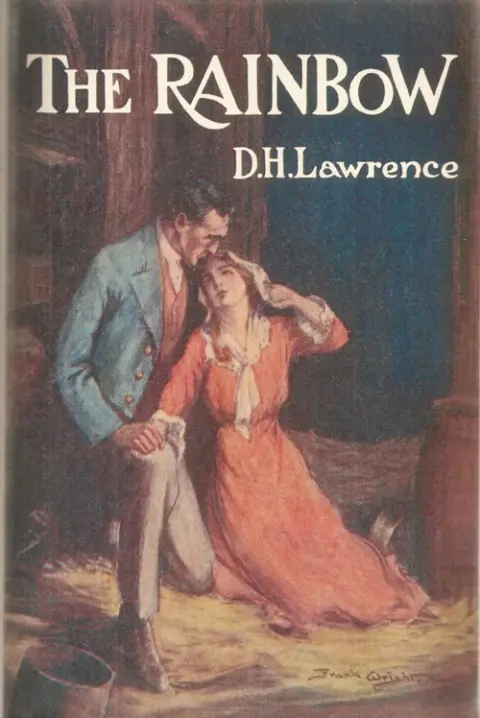
THE CLASSIC COLLECTION · 1915
"The Rainbow" by D. H. Lawrence is a novel published in 1915. It follows three generations of the Brangwen family in Nottinghamshire as they navigate love, desire, and personal fulfillment against the backdrop of England's industrial transformation. From farmer Tom Brangwen in the 1840s to his granddaughter Ursula in 1905, each generation struggles between passionate inner life and society's confining structures. Lawrence's frank treatment of sexuality sparked an obscenity trial, resulting in copies being seized and burned, banning the book in Britain for eleven years.
Introduction adapted from the source catalogue; source summaries may be automatically generated.
Free to read · English · 187,983 words · No account needed
MAKE TIME FOR A GOOD BOOK
On by default. Untick to stop anonymous reading totals. Each page counts after 10 seconds in view. How this works.
Anonymous counting is on unless you have switched it off.
And the ground beneath lay so still, so peaceful. Only now and again a cock crew. Otherwise, from the distant yellow hills to the pine trees at the foot of the downs, everything was newly washed into being, in a flood of new, golden creation.
It was so unutterably still and perfect with promise, the golden-lighted, distinct land, that Ursula’s soul rocked and wept. Suddenly he glanced at her. The tears were running over her cheeks, her mouth was working strangely.
“What is the matter?” he asked.
After a moment’s struggle with her voice.
“It is so beautiful,” she said, looking at the glowing, beautiful land. It was so beautiful, so perfect, and so unsullied.
He too realized what England would be in a few hours’ time—a blind, sordid, strenuous activity, all for nothing, fuming with dirty smoke and running trains and groping in the bowels of the earth, all for nothing. A ghastliness came over him.
He looked at Ursula. Her face was wet with tears, very bright, like a transfiguration in the refulgent light. Nor was his the hand to wipe away the burning, bright tears. He stood apart, overcome by a cruel ineffectuality.
Gradually a great, helpless sorrow was rising in him. But as yet he was fighting it away, he was struggling for his own life. He became very quiet and unaware of the things about him, awaiting, as it were, her judgment on him.
They returned to Nottingham, the time of her examination came. She must go to London. But she would not stay with him in an hotel. She would go to a quiet little pension near the British Museum.
Those quiet residential squares of London made a great impression on her mind. They were very complete. Her mind seemed imprisoned in their quietness. Who was going to liberate her?
In the evening, her practical examinations being over, he went with her to dinner at one of the hotels down the river, near Richmond. It was golden and beautiful, with yellow water and white and scarlet-striped boat-awnings, and blue shadows under the trees.
“When shall we be married?” he asked her, quietly, simply, as if it were a mere question of comfort.
She watched the changing pleasure-traffic of the river. He looked at her golden, puzzled museau. The knot gathered in his throat.
“I don’t know,” she said.
A hot grief gripped his throat.
“Why don’t you know—don’t you want to be married?” he asked her.
Your reading position is saved on this browser. Take it to another device with a library code. Reading pages adapt to text, rather than matching a printed edition.
D. H. (David Herbert) Lawrence
D. H. (David Herbert) Lawrence
D. H. (David Herbert) Lawrence
D. H. (David Herbert) Lawrence
BEHIND THE BOOK
This eBook is for the use of anyone anywhere in the United States and most other parts of the world at no cost and with almost no restrictions whatsoever. You may copy it, give it away or re-use it under the terms of the Project Gutenberg License included with this eBook or online at www.gutenberg.org. If you are not located in the United States, you will have to check the laws of the country where you are located before using this eBook. Read the source licence.
The original source file, including credits and licence, is retained by this library. Request an original-format copy at no charge. Please include the book title and Project Gutenberg identifier #28948.
KEEP YOUR CURIOSITY GOING
Coulson Kernahan

Maurice Baring
Frances Wright
Cécile Tormay

Frederic Jesup Stimson

W. H. P. (William Henry Pope) Jarvis