
Reflections on the death of a porcupine and other essays
D. H. (David Herbert) Lawrence
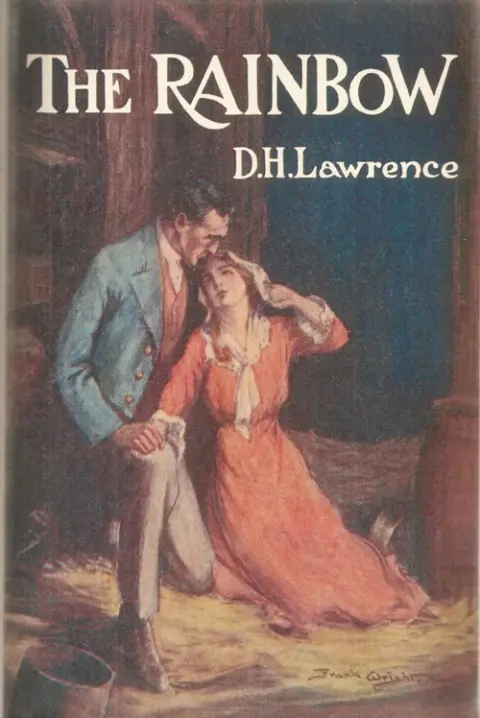
THE CLASSIC COLLECTION · 1915
"The Rainbow" by D. H. Lawrence is a novel published in 1915. It follows three generations of the Brangwen family in Nottinghamshire as they navigate love, desire, and personal fulfillment against the backdrop of England's industrial transformation. From farmer Tom Brangwen in the 1840s to his granddaughter Ursula in 1905, each generation struggles between passionate inner life and society's confining structures. Lawrence's frank treatment of sexuality sparked an obscenity trial, resulting in copies being seized and burned, banning the book in Britain for eleven years.
Introduction adapted from the source catalogue; source summaries may be automatically generated.
Free to read · English · 187,983 words · No account needed
MAKE TIME FOR A GOOD BOOK
On by default. Untick to stop anonymous reading totals. Each page counts after 10 seconds in view. How this works.
Anonymous counting is on unless you have switched it off.
His manner was polite, almost foreign, and rather cold. He still laughed in his curious, animal fashion, suddenly wrinkling up his wide nose, and showing his sharp teeth. The fine beauty of his skin and his complexion, some almost waxen quality, hid the strange, repellent grossness of him, the slight sense of putrescence, the commonness which revealed itself in his rather fat thighs and loins.
Winifred saw at once the deferential, slightly servile, slightly cunning regard he had for Ursula, which made the girl at once so proud and so perplexed.
“But is this place as awful as it looks?” the young girl asked, a
strain in her eyes.
“It is just what it looks,” he said. “It hides nothing.”
“Why are the men so sad?”
“Are they sad?” he replied.
“They seem unutterably, unutterably sad,” said Ursula, out of a
passionate throat.
“I don’t think they are that. They just take it for granted.”
“What do they take for granted?”
“This—the pits and the place altogether.”
“Why don’t they alter it?” she passionately protested.
“They believe they must alter themselves to fit the pits and the place, rather than alter the pits and the place to fit themselves. It is easier,” he said.
“And you agree with them,” burst out his niece, unable to bear it. “You think like they do—that living human beings must be taken and adapted to all kinds of horrors. We could easily do without the pits.”
He smiled, uncomfortably, cynically. Ursula felt again the revolt of
hatred from him.
“I suppose their lives are not really so bad,” said Winifred Inger, superior to the Zolaesque tragedy.
He turned with his polite, distant attention.
“Yes, they are pretty bad. The pits are very deep, and hot, and in some places wet. The men die of consumption fairly often. But they earn good wages.”
“How gruesome!” said Winifred Inger.
“Yes,” he replied gravely. It was his grave, solid, self-contained manner which made him so much respected as a colliery manager.
The servant came in to ask where they would have tea.
“Put it in the summer-house, Mrs. Smith,” he said.
The fair-haired, good-looking young woman went out.
“Is she married and in service?” asked Ursula.
Your reading position is saved on this browser. Take it to another device with a library code. Reading pages adapt to text, rather than matching a printed edition.
D. H. (David Herbert) Lawrence
D. H. (David Herbert) Lawrence
D. H. (David Herbert) Lawrence
D. H. (David Herbert) Lawrence
BEHIND THE BOOK
This eBook is for the use of anyone anywhere in the United States and most other parts of the world at no cost and with almost no restrictions whatsoever. You may copy it, give it away or re-use it under the terms of the Project Gutenberg License included with this eBook or online at www.gutenberg.org. If you are not located in the United States, you will have to check the laws of the country where you are located before using this eBook. Read the source licence.
The original source file, including credits and licence, is retained by this library. Request an original-format copy at no charge. Please include the book title and Project Gutenberg identifier #28948.
KEEP YOUR CURIOSITY GOING
Coulson Kernahan

Maurice Baring
Frances Wright
Cécile Tormay

Frederic Jesup Stimson

W. H. P. (William Henry Pope) Jarvis