Reflections on the death of a porcupine and other essays
D. H. (David Herbert) Lawrence
THE CLASSIC COLLECTION · 1915
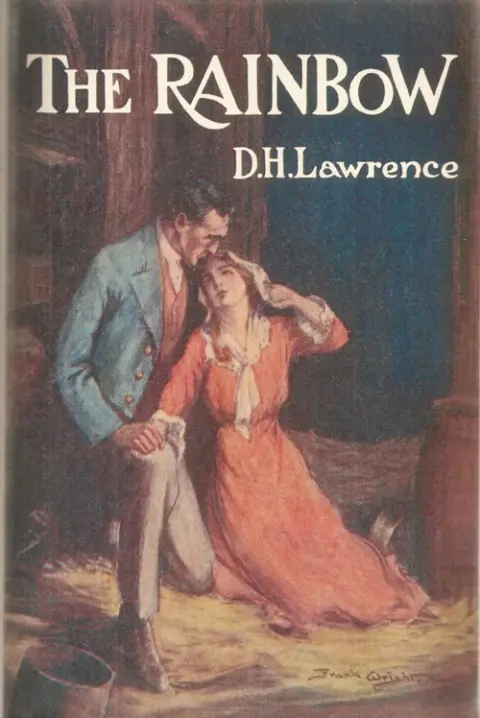
"The Rainbow" by D. H. Lawrence is a novel published in 1915. It follows three generations of the Brangwen family in Nottinghamshire as they navigate love, desire, and personal fulfillment against the backdrop of England's industrial transformation. From farmer Tom Brangwen in the 1840s to his granddaughter Ursula in 1905, each generation struggles between passionate inner life and society's confining structures. Lawrence's frank treatment of sexuality sparked an obscenity trial, resulting in copies being seized and burned, banning the book in Britain for eleven years.
Introduction adapted from the source catalogue; source summaries may be automatically generated.
Free to read · English · 187,983 words · No account needed
MAKE TIME FOR A GOOD BOOK
On by default. Untick to stop anonymous reading totals. Each page counts after 10 seconds in view. How this works.
Anonymous counting is on unless you have switched it off.
There was a moment of suspense. Ursula’s heart was beating so fast, she clung to the rail, and could not move. Her dilated, warm, unfolded, glowing face turned to the mistress, as if to her very sun.
“Good-bye,” said Miss Inger, and she swam away to the other pupils, taking professional interest in them.
Ursula was dazed. She could still feel the touch of the mistress’s body against her own—only this, only this. The rest of the swimming time passed like a trance. When the call was given to leave the water, Miss Inger walked down the bath towards Ursula. Her rust-red, thin tunic was clinging to her, the whole body was defined, firm and magnificent, as it seemed to the girl.
“I enjoyed our race, Ursula, did you?” said Miss Inger.
The girl could only laugh with revealed, open, glowing face.
The love was now tacitly confessed. But it was some time before any
further progress was made. Ursula continued in suspense, in inflamed
bliss.
Then one day, when she was alone, the mistress came near to her, and touching her cheek with her fingers, said with some difficulty.
“Would you like to come to tea with me on Saturday, Ursula?”
The girl flushed all gratitude.
“We’ll go to a lovely little bungalow on the Soar, shall we? I stay the week-ends there sometimes.”
Ursula was beside herself. She could not endure till the Saturday came, her thoughts burned up like a fire. If only it were Saturday, if only it were Saturday.
Then Saturday came, and she set out. Miss Inger met her in Sawley, and they walked about three miles to the bungalow. It was a moist, warm cloudy day.
The bungalow was a tiny, two-roomed shanty set on a steep bank. Everything in it was exquisite. In delicious privacy, the two girls made tea, and then they talked. Ursula need not be home till about ten o’clock.
The talk was led, by a kind of spell, to love. Miss Inger was telling Ursula of a friend, how she had died in childbirth, and what she had suffered; then she told of a prostitute, and of some of her experiences with men.
As they talked thus, on the little verandah of the bungalow, the night fell, there was a little warm rain.
“It is really stifling,” said Miss Inger.
They watched a train, whose lights were pale in the lingering twilight, rushing across the distance.
“It will thunder,” said Ursula.
The electric suspense continued, the darkness sank, they were eclipsed.
“I think I shall go and bathe,” said Miss Inger, out of the cloud-black
darkness.
“At night?” said Ursula.
Your reading position is saved on this browser. Take it to another device with a library code. Reading pages adapt to text, rather than matching a printed edition.
D. H. (David Herbert) Lawrence
D. H. (David Herbert) Lawrence
D. H. (David Herbert) Lawrence
D. H. (David Herbert) Lawrence
BEHIND THE BOOK
This eBook is for the use of anyone anywhere in the United States and most other parts of the world at no cost and with almost no restrictions whatsoever. You may copy it, give it away or re-use it under the terms of the Project Gutenberg License included with this eBook or online at www.gutenberg.org. If you are not located in the United States, you will have to check the laws of the country where you are located before using this eBook. Read the source licence.
The original source file, including credits and licence, is retained by this library. Request an original-format copy at no charge. Please include the book title and Project Gutenberg identifier #28948.
KEEP YOUR CURIOSITY GOING
Coulson Kernahan

Maurice Baring
Frances Wright
Cécile Tormay

Frederic Jesup Stimson

W. H. P. (William Henry Pope) Jarvis