Reflections on the death of a porcupine and other essays
D. H. (David Herbert) Lawrence
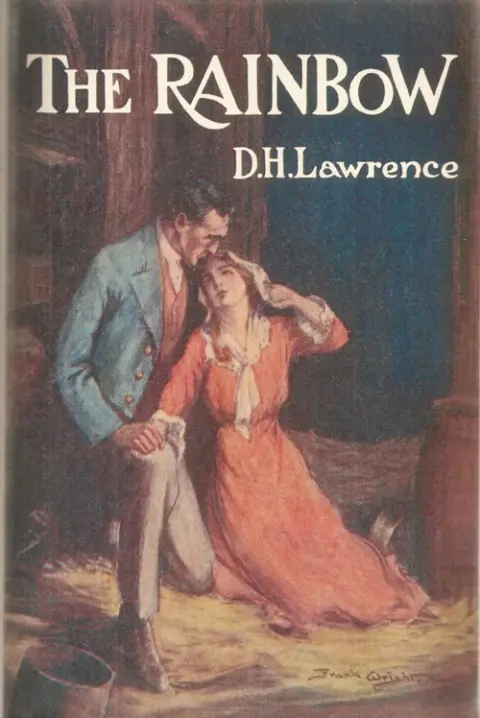
THE CLASSIC COLLECTION · 1915
"The Rainbow" by D. H. Lawrence is a novel published in 1915. It follows three generations of the Brangwen family in Nottinghamshire as they navigate love, desire, and personal fulfillment against the backdrop of England's industrial transformation. From farmer Tom Brangwen in the 1840s to his granddaughter Ursula in 1905, each generation struggles between passionate inner life and society's confining structures. Lawrence's frank treatment of sexuality sparked an obscenity trial, resulting in copies being seized and burned, banning the book in Britain for eleven years.
Introduction adapted from the source catalogue; source summaries may be automatically generated.
Free to read · English · 187,983 words · No account needed
MAKE TIME FOR A GOOD BOOK
On by default. Untick to stop anonymous reading totals. Each page counts after 10 seconds in view. How this works.
Anonymous counting is on unless you have switched it off.
“For all that, you aren’t the nation. What would you do for yourself?”
“I belong to the nation and must do my duty by the nation.”
“But when it didn’t need your services in particular—when there is no fighting? What would you do then?”
He was irritated.
“I would do what everybody else does.”
“What?”
“Nothing. I would be in readiness for when I was needed.”
The answer came in exasperation.
“It seems to me,” she answered, “as if you weren’t anybody—as if there weren’t anybody there, where you are. Are you anybody, really? You seem like nothing to me.”
They had walked till they had reached a wharf, just above a lock. There an empty barge, painted with a red and yellow cabin hood, but with a long, coal-black hold, was lying moored. A man, lean and grimy, was sitting on a box against the cabin-side by the door, smoking, and nursing a baby that was wrapped in a drab shawl, and looking into the glow of evening. A woman bustled out, sent a pail dashing into the canal, drew her water, and bustled in again. Children’s voices were heard. A thin blue smoke ascended from the cabin chimney, there was a smell of cooking.
Ursula, white as a moth, lingered to look. Skrebensky lingered by her.
The man glanced up.
“Good evening,” he called, half impudent, half attracted. He had blue eyes which glanced impudently from his grimy face.
“Good evening,” said Ursula, delighted. “Isn’t it nice now?”
“Ay,” said the man, “very nice.”
His mouth was red under his ragged, sandy moustache. His teeth were
white as he laughed.
“Oh, but—” stammered Ursula, laughing, “it is. Why do you say it as if it weren’t?”
“’Appen for them as is childt-nursin’ it’s none so rosy.”
“May I look inside your barge?” asked Ursula.
“There’s nobody’ll stop you; you come if you like.”
The barge lay at the opposite bank, at the wharf. It was the Annabel, belonging to J. Ruth of Loughborough. The man watched Ursula closely from his keen, twinkling eyes. His fair hair was wispy on his grimed forehead. Two dirty children appeared to see who was talking.
Ursula glanced at the great lock gates. They were shut, and the water was sounding, spurting and trickling down in the gloom beyond. On this side the bright water was almost to the top of the gate. She went boldly across, and round to the wharf.
Stooping from the bank, she peeped into the cabin, where was a red glow of fire and the shadowy figure of a woman. She did want to go down.
Your reading position is saved on this browser. Take it to another device with a library code. Reading pages adapt to text, rather than matching a printed edition.
D. H. (David Herbert) Lawrence
D. H. (David Herbert) Lawrence
D. H. (David Herbert) Lawrence
D. H. (David Herbert) Lawrence
BEHIND THE BOOK
This eBook is for the use of anyone anywhere in the United States and most other parts of the world at no cost and with almost no restrictions whatsoever. You may copy it, give it away or re-use it under the terms of the Project Gutenberg License included with this eBook or online at www.gutenberg.org. If you are not located in the United States, you will have to check the laws of the country where you are located before using this eBook. Read the source licence.
The original source file, including credits and licence, is retained by this library. Request an original-format copy at no charge. Please include the book title and Project Gutenberg identifier #28948.
KEEP YOUR CURIOSITY GOING
Coulson Kernahan

Maurice Baring
Frances Wright
Cécile Tormay

Frederic Jesup Stimson

W. H. P. (William Henry Pope) Jarvis