Reflections on the death of a porcupine and other essays
D. H. (David Herbert) Lawrence
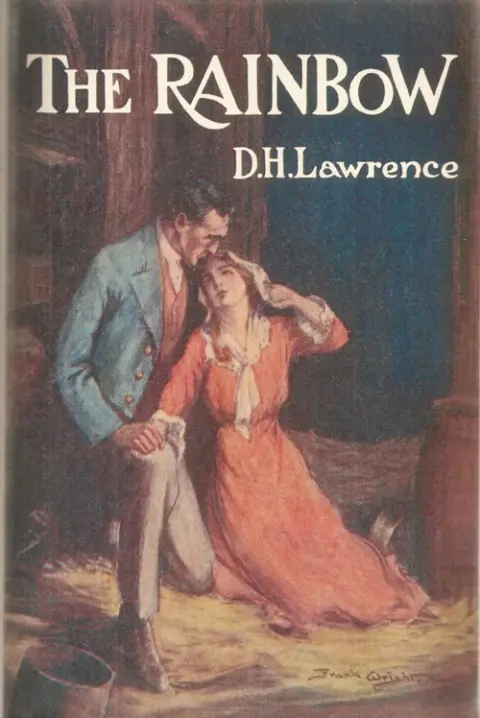
THE CLASSIC COLLECTION · 1915
"The Rainbow" by D. H. Lawrence is a novel published in 1915. It follows three generations of the Brangwen family in Nottinghamshire as they navigate love, desire, and personal fulfillment against the backdrop of England's industrial transformation. From farmer Tom Brangwen in the 1840s to his granddaughter Ursula in 1905, each generation struggles between passionate inner life and society's confining structures. Lawrence's frank treatment of sexuality sparked an obscenity trial, resulting in copies being seized and burned, banning the book in Britain for eleven years.
Introduction adapted from the source catalogue; source summaries may be automatically generated.
Free to read · English · 187,983 words · No account needed
MAKE TIME FOR A GOOD BOOK
On by default. Untick to stop anonymous reading totals. Each page counts after 10 seconds in view. How this works.
Anonymous counting is on unless you have switched it off.
And then, quite calmly, even a little surprised, she was in the
present, and was saying:
“I am dying with hunger.”
“So am I,” he said calmly, as if it were of not the slightest significance. And they relapsed into the warm, golden stillness. And the minutes flowed unheeded past the window outside.
Then suddenly she stirred against him.
“My dear, I am dying of hunger,” she said.
It was a slight pain to him to be brought to.
“We’ll get up,” he said, unmoving.
And she sank her head on to him again, and they lay still, lapsing. Half consciously, he heard the clock chime the hour. She did not hear.
“Do get up,” she murmured at length, “and give me something to eat.”
“Yes,” he said, and he put his arms round her, and she lay with her face on him. They were faintly astonished that they did not move. The minutes rustled louder at the window.
“Let me go then,” he said.
She lifted her head from him, relinquishingly. With a little breaking away, he moved out of bed, and was taking his clothes. She stretched out her hand to him.
“You are so nice,” she said, and he went back for a moment or two.
Then actually he did slip into some clothes, and, looking round quickly at her, was gone out of the room. She lay translated again into a pale, clearer peace. As if she were a spirit, she listened to the noise of him downstairs, as if she were no longer of the material world.
It was half-past one. He looked at the silent kitchen, untouched from last night, dim with the drawn blind. And he hastened to draw up the blind, so people should know they were not in bed any later. Well, it was his own house, it did not matter. Hastily he put wood in the grate and made a fire. He exulted in himself, like an adventurer on an undiscovered island. The fire blazed up, he put on the kettle. How happy he felt! How still and secluded the house was! There were only he and she in the world.
But when he unbolted the door, and, half-dressed, looked out, he felt furtive and guilty. The world was there, after all. And he had felt so secure, as though this house were the Ark in the flood, and all the rest was drowned. The world was there: and it was afternoon. The morning had vanished and gone by, the day was growing old. Where was the bright, fresh morning? He was accused. Was the morning gone, and he had lain with blinds drawn, let it pass by unnoticed?
Your reading position is saved on this browser. Take it to another device with a library code. Reading pages adapt to text, rather than matching a printed edition.
D. H. (David Herbert) Lawrence
D. H. (David Herbert) Lawrence
D. H. (David Herbert) Lawrence
D. H. (David Herbert) Lawrence
BEHIND THE BOOK
This eBook is for the use of anyone anywhere in the United States and most other parts of the world at no cost and with almost no restrictions whatsoever. You may copy it, give it away or re-use it under the terms of the Project Gutenberg License included with this eBook or online at www.gutenberg.org. If you are not located in the United States, you will have to check the laws of the country where you are located before using this eBook. Read the source licence.
The original source file, including credits and licence, is retained by this library. Request an original-format copy at no charge. Please include the book title and Project Gutenberg identifier #28948.
KEEP YOUR CURIOSITY GOING
Coulson Kernahan

Maurice Baring
Frances Wright
Cécile Tormay

Frederic Jesup Stimson

W. H. P. (William Henry Pope) Jarvis