THE CLASSIC COLLECTION✦An outlaw’s diary: the CommuneCLASSIC FREE BOOKS
An outlaw’s diary: the Commune
Cécile Tormay
THE CLASSIC COLLECTION · 1882
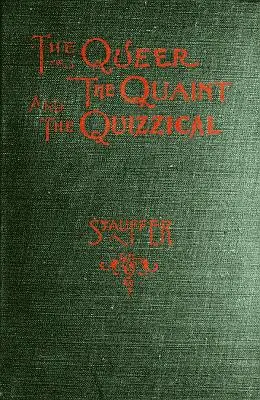
"The Queer, the Quaint and the Quizzical: A Cabinet for the Curious" by Frank H. Stauffer is a collection of curiosities and oddities compiled during the late 19th century. This work explores a diverse range of quirky historical anecdotes, strange customs, and unique literary treasures, and it invites the reader to ponder the peculiarities and often whimsical nature of human history and culture. The opening of the book sets the tone for the delightful eccentricities that follow, showcasing a variety of fascinating tidbits about unusual books and antiquities. It mentions peculiar literary creations with amusing titles, rare artifacts like an intricate manuscript that captivated collectors, and unique incidents surrounding curiosities in history. These snippets lead the reader into a world of the bizarre and fascinating, establishing a playful and inquisitive atmosphere that hints at the intriguing explorations yet to come.
Introduction adapted from the source catalogue; source summaries may be automatically generated.
Free to read · English · 97,701 words · No account needed
MAKE TIME FOR A GOOD BOOK
On by default. Untick to stop anonymous reading totals. Each page counts after 10 seconds in view. How this works.
Anonymous counting is on unless you have switched it off.
The Passing Bell was so named from being tolled when any one was passing from life. Hence it was sometimes called the Soul Bell, and was rung that those who heard it might pray for the person dying, and who was not yet dead. We have a remarkable mention of the practice in the narrative of the last moments of the Lady Katherine Grey (sister of Lady Jane Grey), who died a prisoner in the Tower of London, in 1567. Sir Owen Hopton, constable of the tower, "perceiving her to draw toward her end, said to Mr. Bockeham, 'Were it not best to send to the church, that the bell may be rung?' and she herself, hearing him, said: 'Good Sir Owen, be it so;' and almost immediately died."—Ellis's Original Letters.
Bell-ringing in Holland.
The Hollanders exhibit the most enthusiastic fondness for bells. Every church and public building is hung round with them in endless variety. In Amsterdam not less than a thousand bells are kept constantly ringing, which creates a din that is almost intolerable to strangers.
Babes of Bethlehem.
It is an ancient custom at Norton, Worcestershire, England, on the 28th of December (Innocents' Day) to ring a muffled peal in token of sorrow for the slaughter of the hapless "babes of Bethlehem," and, immediately afterwards, an unmuffled peal, in manifestation of joy for the deliverance and escape of the infant Saviour.
Ringing the Changes.
It is curious to note the number of changes which may be rung on different peals. The changes on seven bells are 5040; on twelve, 479,001,600, which it would take ninety-one years to ring, at the rate of two strokes in a second. The changes on fourteen bells could not be rung through at the same rate in less than 16,575 years, and upon four-and-twenty they would require more than 117,000 billions of years.—E. F. King.
Bell Inscriptions.
Epigraphs or legends on bells were quite common in England. We subjoin
specimens—
On the Six Bells of the Ancient Abbey of Hexham.
Even at our earliest sound,
The light of God is spread around.
At the echo of my voice,
Ocean, earth and air rejoice.
Blend thy mellow tones with mine,
Silver voice of Catherine!
Till time on ruin's lap shall nod,
John shall sound the praise of God.
With John in heavenly harmony,
Andrew, pour thy melody.
Be mine to chant Jehovah's fame,
While Maria is my name.
A not uncommon epigraph is—
Come when I call,
To serve God all.
At Aldbourne, on the first bell, we read: "The gift of Jos. Pizzie and
Wm. Gwynn.
Music and ringing we like so well,
And for that reason we gave this bell."
Your reading position is saved on this browser. Take it to another device with a library code. Reading pages adapt to text, rather than matching a printed edition.
BEHIND THE BOOK
This eBook is for the use of anyone anywhere in the United States and most other parts of the world at no cost and with almost no restrictions whatsoever. You may copy it, give it away or re-use it under the terms of the Project Gutenberg License included with this eBook or online at www.gutenberg.org. If you are not located in the United States, you will have to check the laws of the country where you are located before using this eBook. Read the source licence.
The original source file, including credits and licence, is retained by this library. Request an original-format copy at no charge. Please include the book title and Project Gutenberg identifier #41762.
KEEP YOUR CURIOSITY GOING
Cécile Tormay

Moritz Busch
John L. Ransom
Frances Wright
Cécile Tormay

Mabel Potter Daggett