THE CLASSIC COLLECTION✦An outlaw’s diary: the CommuneCLASSIC FREE BOOKS
An outlaw’s diary: the Commune
Cécile Tormay
THE CLASSIC COLLECTION · 1882
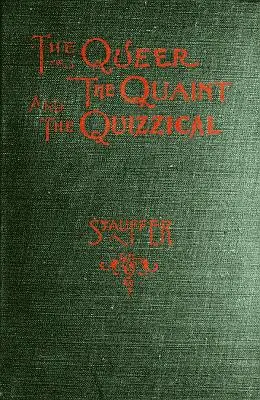
"The Queer, the Quaint and the Quizzical: A Cabinet for the Curious" by Frank H. Stauffer is a collection of curiosities and oddities compiled during the late 19th century. This work explores a diverse range of quirky historical anecdotes, strange customs, and unique literary treasures, and it invites the reader to ponder the peculiarities and often whimsical nature of human history and culture. The opening of the book sets the tone for the delightful eccentricities that follow, showcasing a variety of fascinating tidbits about unusual books and antiquities. It mentions peculiar literary creations with amusing titles, rare artifacts like an intricate manuscript that captivated collectors, and unique incidents surrounding curiosities in history. These snippets lead the reader into a world of the bizarre and fascinating, establishing a playful and inquisitive atmosphere that hints at the intriguing explorations yet to come.
Introduction adapted from the source catalogue; source summaries may be automatically generated.
Free to read · English · 97,701 words · No account needed
MAKE TIME FOR A GOOD BOOK
On by default. Untick to stop anonymous reading totals. Each page counts after 10 seconds in view. How this works.
Anonymous counting is on unless you have switched it off.
"Fair lady, whoso'er thou art,
Turn this poor leaf with tenderest care,
And hush, Oh hush, thy breathing heart—
The one thou lovest will be there."
On turning the "poor leaf" there was found a one dollar bill with the
subjoined verse—
"Fair lady, lift thine eyes and tell
If this is not a truthful letter?
This is the one (1) thou lovest well,
And nought (0) can make thee love it better."
Confectionery Decorations.
Probably the ancients exceeded us in the art of decorating confectionery. After each course in solemn feasts there was a "subtilty." Subtilties were representations of castles, giants, saints, knights, ladies and beasts, all raised in pastry, upon which legends and coat-armor were painted in their proper colors. At the festival, on the coronation of Henry VI., in 1429, there was a "subtilty" of St. Edward and St. Louis, "armed, and upon either his coat-armor, holding between them a figure of King Henry, standing also in his coat-armor, and an inscription passing from both, saying, 'Beholde twoe perfecte kynges vnder one coate-armoure.'"—Fabyan-Dallaway's Heraldic Inq.
Superscription to a Letter.
A letter upon which the following was written, passed through the
Atlanta (Ga.) post-office:—
"Steal not this for fear of shame—
There is no money in the same;
True, it does a check contain,
But 'tis for baggage on a train."
In Search of a Looking-Glass.
"When I was last in Lisbon, a nun made her escape from the nunnery. The first thing for which she inquired, when she reached the house in which she was to be secreted, was a looking-glass. She had entered the convent when only five years old, and from that time had never seen her own face."—Southey.
Bleeding for Nothing.
"Whereas, the majority of Apothecaries in Boston have agreed to pull down the price of Bleeding to sixpence, let these certifie that Mr. Richard Clarke, Apothecary, will bleed anybody at his shop, gratis."—Stamford Mercury, March 28th, 1716.
An Astonished Lawyer.
A curious instance occurred of a witness confounding a counsel, at Gloucester, England, some years ago. The witness, on being asked his name, gave it as Ottiwell Woodd. The learned counsel did not seem to catch it, though it was several times pronounced. "Spell it, sir, if you please," he said, somewhat angrily. The witness complied as follows: "O-double t-i-double you-e-double l-double you-double o-double d." The spelling confounded the lawyer more than ever, and in his confusion, amid the laughter of the court, he took the witness aside to help him to spell it after him.
Duels Fought by Clergymen.
Your reading position is saved on this browser. Take it to another device with a library code. Reading pages adapt to text, rather than matching a printed edition.
BEHIND THE BOOK
This eBook is for the use of anyone anywhere in the United States and most other parts of the world at no cost and with almost no restrictions whatsoever. You may copy it, give it away or re-use it under the terms of the Project Gutenberg License included with this eBook or online at www.gutenberg.org. If you are not located in the United States, you will have to check the laws of the country where you are located before using this eBook. Read the source licence.
The original source file, including credits and licence, is retained by this library. Request an original-format copy at no charge. Please include the book title and Project Gutenberg identifier #41762.
KEEP YOUR CURIOSITY GOING
Cécile Tormay

Moritz Busch
John L. Ransom
Frances Wright
Cécile Tormay

Mabel Potter Daggett