THE CLASSIC COLLECTION✦An outlaw’s diary: the CommuneCLASSIC FREE BOOKS
An outlaw’s diary: the Commune
Cécile Tormay
THE CLASSIC COLLECTION · 1882
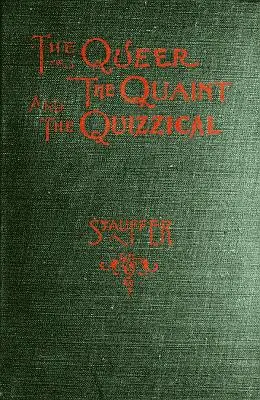
"The Queer, the Quaint and the Quizzical: A Cabinet for the Curious" by Frank H. Stauffer is a collection of curiosities and oddities compiled during the late 19th century. This work explores a diverse range of quirky historical anecdotes, strange customs, and unique literary treasures, and it invites the reader to ponder the peculiarities and often whimsical nature of human history and culture. The opening of the book sets the tone for the delightful eccentricities that follow, showcasing a variety of fascinating tidbits about unusual books and antiquities. It mentions peculiar literary creations with amusing titles, rare artifacts like an intricate manuscript that captivated collectors, and unique incidents surrounding curiosities in history. These snippets lead the reader into a world of the bizarre and fascinating, establishing a playful and inquisitive atmosphere that hints at the intriguing explorations yet to come.
Introduction adapted from the source catalogue; source summaries may be automatically generated.
Free to read · English · 97,701 words · No account needed
MAKE TIME FOR A GOOD BOOK
On by default. Untick to stop anonymous reading totals. Each page counts after 10 seconds in view. How this works.
Anonymous counting is on unless you have switched it off.
The meaning of the word wretch is one not generally understood. It was originally, and is now, in some parts of England, used as a term of fondest tenderness. This is not the only instance in which words in their present general acceptation bear a very opposite meaning to what they did in other times. The word wench, formerly, was not used in the low and vulgar acceptation that it now is.
Don Quixote's Sheep.
Don Quixote's mistaking two flocks of sheep for two armies is not without parallel. In Ariosto's Orlando Furioso, written 1516, the hero, in his madness, falls foul of a flock of sheep.
Still more ancient is "Ajax Mad," a tragedy founded on the madness of Ajax, because of the armor of Hector being awarded to Ulysses instead of himself. In his insanity, Ajax fell upon a flock of sheep, driven at night into the camp, supposing it to be an army led by Ulysses and the sons of Atreus. On discovering his mistake he stabs himself.
The Oldest Ballad.
The earliest English ballad is supposed to be the "Cuckoo Song," which commences in the following style:—
"Sumer is incumen in
Lhude sing cuccu,
Groweth sed, and bloweth med,
And sprigth ye wede nu,
Singe cuccu."
Two Certificates of Gretna-Green Marriages.
"This is to sartfay all persons that may be consern'd, that A. B., from the parish of C. in the county of D., and E. F., from the parish of G., in the county of H., and both comes before me and declares themselves both to be single persons, and now mayried by the form of the Kirk of Scotland, and agreible to the Church of England, and givine ondre my hand, this 18th day of March 1793."
"Kingdom of Scotland,
"County of Dumfries,
"Parish of Gretna:
"These are to certify, to all whom it may concern, that John N——, from the parish of Chatham, in the County of Kent, and Rosa H——, from the parish of St. Maries, in the County of Nottingham, being both here now present, and having declared to me that they are single persons, but having now been married conformable to the Laws of the Church of England, and agreeable to the Kirk of Scotland. As witness our hands at Springfield, this 4th day of October, 1822.
"Witness me,
"Witness, David Lang.
Jane Rae. John N——.
John Ainsle. Rosa H——."
Swift's Latin Puns.
Among the nugæ of Dean Swift are his celebrated Latin puns. They consist entirely of Latin words, but, by allowing for false spelling, and running the words into each other, the sentences make good sense in English. The subjoined is one of his best—
Your reading position is saved on this browser. Take it to another device with a library code. Reading pages adapt to text, rather than matching a printed edition.
BEHIND THE BOOK
This eBook is for the use of anyone anywhere in the United States and most other parts of the world at no cost and with almost no restrictions whatsoever. You may copy it, give it away or re-use it under the terms of the Project Gutenberg License included with this eBook or online at www.gutenberg.org. If you are not located in the United States, you will have to check the laws of the country where you are located before using this eBook. Read the source licence.
The original source file, including credits and licence, is retained by this library. Request an original-format copy at no charge. Please include the book title and Project Gutenberg identifier #41762.
KEEP YOUR CURIOSITY GOING
Cécile Tormay

Moritz Busch
John L. Ransom
Frances Wright
Cécile Tormay

Mabel Potter Daggett