THE CLASSIC COLLECTION✦A dead man’s diaryCLASSIC FREE BOOKS
A dead man’s diary
Coulson Kernahan
THE CLASSIC COLLECTION · 1897
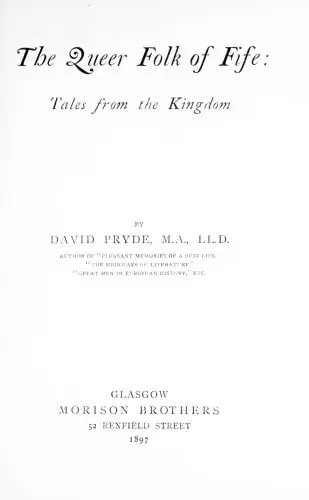
"The Queer Folk of Fife: Tales from the Kingdom" by David Pryde is a collection of short stories written in the late 19th century. It characteristically portrays life in a small Scottish community, focusing on the eccentric and colorful inhabitants of Sandyriggs and their interactions. The stories delve into themes of social dynamics, human emotions, and local folklore, providing a vivid snapshot of rural Scottish life. At the start of the narrative, the author introduces Sandyriggs, which is depicted as a tranquil and uneventful burgh where the residents lead simple lives and often rely on storytelling to entertain themselves. The opening portion highlights the lives of characters such as the Steedman couple, who reminiscence about the past, and a newcomer family, the Callendars, whose mystery captivates the local gossips. The tale of "The Breach of Promise" begins with the arrival of Mr. Callendar and his daughters, particularly focusing on the beautiful Phoebe Callendar. The fascination and infatuations her presence ignites among the townsfolk set the stage for a scandalous twist involving broken promises and heartbreak, leaving the community abuzz with speculation.
Introduction adapted from the source catalogue; source summaries may be automatically generated.
Free to read · English · 53,587 words · No account needed
MAKE TIME FOR A GOOD BOOK
On by default. Untick to stop anonymous reading totals. Each page counts after 10 seconds in view. How this works.
Anonymous counting is on unless you have switched it off.
But, horror of horrors! who should be announced and ushered in but Mrs and Miss Bourhill, the mother and daughter who had been such familiar figures in his nightmare of the past. As the terrible significance of this reappearance dawned upon him, it seemed to strike him to the heart, and he fell back in a swoon.
When he recovered consciousness, he found himself propped up in an easy chair, and saw four women standing round him in a state of silent excitement. Miss Singleton, pale and pensive, was gazing intently at him; the two Bourhills were staring at Miss Singleton with an expression of indignant surprise; and his mother, full of keenest anxiety, divided her attention between him and the others.
Miss Singleton broke the silence by saying--"I must go. We strangers had better leave the invalid to quiet and the care of his mother."
"Thank you, my dear lady," said his mother, "for that sensible remark."
"But," said Miss Bourhill, "that remark does not apply to me, his
betrothed."
"Nor to me," added Mrs Bourhill, "his mother-in-law to be."
"Dear me," said Mrs Blair to Miss Bourhill, "you are married, you know. We saw it in the papers."
"A mistake," replied Miss Bourhill, "a cousin of the same name, not me."
"But," pleaded Mrs Blair, "the engagement fell to the ground. The correspondence stopped years ago."
"Malcolm's fault," replied Miss Bourhill quietly. "I wrote last."
"A promise," added Mrs Bourhill, "can't be broken but by the consent of both parties. A bargain's a bargain."
These replies, curt and remorseless, sounded in the young minister's ears like his death-knell, and he lay back in his chair and closed his eyes in mute agony.
But Malcolm Blair, enfeebled though he was, was too brave to be crushed at once. In a few days his mind had regained its strength, and was calmly looking the difficulty in the face. He had, he saw, just two alternatives. One was to hold himself bound by his blindfold engagement, to marry Miss Bourhill, and so to blight his whole future career: the other was to break his promise and bravely take the consequences--a law suit, a public exposure of all his private affairs, the payment of heavy damages, and the resignation of the position to which he had just been appointed. The latter course was the one which he was inclined to take. But before definitely deciding, he wrote to Miss Singleton stating his resolution, and giving his reasons for it. The engagement between him and Miss Bourhill, he argued, was made in a moment of excitement, and when they were both young and thoughtless. Any affection they might have had for each other was a mere fancy, and very soon vanished. By a tacit agreement they ceased to write to each other, and for years there had been no correspondence between them. To go through the solemn and binding rite of marriage under these circumstances would be to lay the crime of perjury upon their souls. This argument seemed to Malcolm to be so unanswerable, that he felt sure of the approval of Miss Singleton.
Your reading position is saved on this browser. Take it to another device with a library code. Reading pages adapt to text, rather than matching a printed edition.
BEHIND THE BOOK
This eBook is for the use of anyone anywhere in the United States and most other parts of the world at no cost and with almost no restrictions whatsoever. You may copy it, give it away or re-use it under the terms of the Project Gutenberg License included with this eBook or online at www.gutenberg.org. If you are not located in the United States, you will have to check the laws of the country where you are located before using this eBook. Read the source licence.
The original source file, including credits and licence, is retained by this library. Request an original-format copy at no charge. Please include the book title and Project Gutenberg identifier #59829.
KEEP YOUR CURIOSITY GOING
Coulson Kernahan

Maurice Baring
Frances Wright
Cécile Tormay

Frederic Jesup Stimson

W. H. P. (William Henry Pope) Jarvis