THE CLASSIC COLLECTION✦A dead man’s diaryCLASSIC FREE BOOKS
A dead man’s diary
Coulson Kernahan
THE CLASSIC COLLECTION · 1897
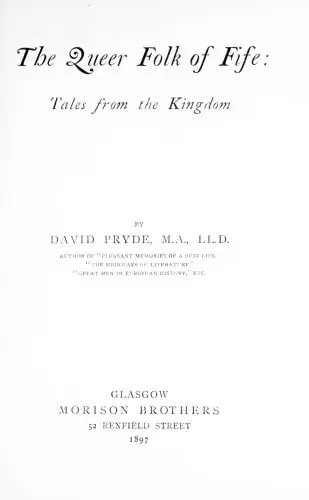
"The Queer Folk of Fife: Tales from the Kingdom" by David Pryde is a collection of short stories written in the late 19th century. It characteristically portrays life in a small Scottish community, focusing on the eccentric and colorful inhabitants of Sandyriggs and their interactions. The stories delve into themes of social dynamics, human emotions, and local folklore, providing a vivid snapshot of rural Scottish life. At the start of the narrative, the author introduces Sandyriggs, which is depicted as a tranquil and uneventful burgh where the residents lead simple lives and often rely on storytelling to entertain themselves. The opening portion highlights the lives of characters such as the Steedman couple, who reminiscence about the past, and a newcomer family, the Callendars, whose mystery captivates the local gossips. The tale of "The Breach of Promise" begins with the arrival of Mr. Callendar and his daughters, particularly focusing on the beautiful Phoebe Callendar. The fascination and infatuations her presence ignites among the townsfolk set the stage for a scandalous twist involving broken promises and heartbreak, leaving the community abuzz with speculation.
Introduction adapted from the source catalogue; source summaries may be automatically generated.
Free to read · English · 53,587 words · No account needed
MAKE TIME FOR A GOOD BOOK
On by default. Untick to stop anonymous reading totals. Each page counts after 10 seconds in view. How this works.
Anonymous counting is on unless you have switched it off.
"In this way I had staved off an ugly question; but in my own room, before going to bed that night, I ran over in my mind what I had learnt and what I had not learnt at school. I had learnt to play cricket and football, to run, to leap, to box, to smoke, to drink beer, and make bets. I had not learnt to write a good hand, to spell correctly, to count correctly, and to know something of the history and geography of my native country.
"My mother came to have some notion of the true state of matters. She had asked me to write to the minister, inviting him to our house on a certain night to meet some friends, and unfortunately I had spelt meet with an a. The minister was a great humorist, and this was an occasion for a joke which he could not neglect. Consequently, he called next morning, with my letter in his hand, to ask what kind of meat he would bring--beef, or mutton, or pork. My mother, when she understood the mistake, felt it keenly. So, one evening at the fireside, while the Earl and my father were having their game of draughts, she said:
"'Well, Ben, I hope you will get on at Oxford, and correct all your deficiencies, and come out a perfect scholar.'
"'My dear madam,' said the Earl, 'if any place can make him a scholar Oxford is that place. It has got all the means; it has the most money, the best teachers, and the greatest reputation.'
"My mother, however, although she knew it not, was cruelly deceived. To men who were in love with learning, Oxford gave every facility for maturing their scholarship. But to those who had no such love she could do nothing. Into this latter class I was unfortunate enough to fall. Lord Gulpington was there before me, and introduced me to his set, which consisted of the sons of the aristocratic and the wealthy. These youths, though passing through the curriculum of the University, were students merely in name. They did almost everything but study. Bless you! how could you expect them to do otherwise? What charms could they find in musty, out-of-date Latin and Greek works? They were young, healthy, spirited, and rich; and the bright and breathing world lay around them. Everything within them and without them called upon them to enjoy themselves. They, indeed, went through the farce of attending chapel in the morning, and lectures in the forenoon. But everyone, their teachers as well as themselves, knew it to be a farce. As soon as they went back to their rooms, they tossed their gowns aside, donned their sporting habiliments, and were off to the river, or the road, or the hunting-field, or the racecourse. Then back they came in the evening with a keen relish for other kinds of enjoyment. They feasted, they caroused, they gamboled, they sang jovial glees and choruses, and in fact rattled on as if life were to be a perpetual feast, without any such thing as duty, or trial, or suffering. In all these frolics I mingled. The jolly fellows, though they knew my origin, and called me by no other name than 'Balls,' were free and easy with me, played practical jokes upon me, borrowed my money, smoked my cigars, drank my wine, and even used my rooms for their parties.
Your reading position is saved on this browser. Take it to another device with a library code. Reading pages adapt to text, rather than matching a printed edition.
BEHIND THE BOOK
This eBook is for the use of anyone anywhere in the United States and most other parts of the world at no cost and with almost no restrictions whatsoever. You may copy it, give it away or re-use it under the terms of the Project Gutenberg License included with this eBook or online at www.gutenberg.org. If you are not located in the United States, you will have to check the laws of the country where you are located before using this eBook. Read the source licence.
The original source file, including credits and licence, is retained by this library. Request an original-format copy at no charge. Please include the book title and Project Gutenberg identifier #59829.
KEEP YOUR CURIOSITY GOING
Coulson Kernahan

Maurice Baring
Frances Wright
Cécile Tormay

Frederic Jesup Stimson

W. H. P. (William Henry Pope) Jarvis