THE CLASSIC COLLECTION✦A lovers’ taleCLASSIC FREE BOOKS
A lovers’ tale
Maurice Hewlett
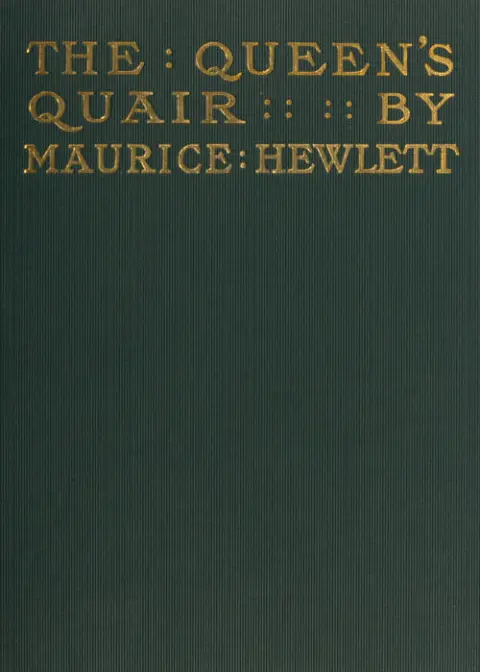
THE CLASSIC COLLECTION · 1903
"The Queen's Quair; or, The Six Years' Tragedy" by Maurice Hewlett is a historical novel written in the early 20th century. The book centers on the life and struggles of Mary Stuart, Queen of Scots, as she navigates the complex political landscape of her time, marked by love, betrayal, and the quest for power. The narrative aims to explore her emotional tumult and the circumstances that shaped her tragic fate. At the start of the novel, readers are introduced to Queen Mary, who is currently mourning the death of her husband, King Francis. The opening scenes depict the tension between her and the influential figures surrounding her, particularly the Cardinal of Lorraine, who wishes to control her political destiny. As she grapples with her desires and her precarious position, the allegiances and rivalries among her maids of honor and relatives become apparent. Mary then resolves to take charge of her future, leading her to contemplate marriage to various suitors who can help reclaim her standing. The opening sets the stage for a tale steeped in intrigue and the heavy burdens of royal expectations.
Introduction adapted from the source catalogue; source summaries may be automatically generated.
Free to read · English · 183,379 words · No account needed
MAKE TIME FOR A GOOD BOOK
On by default. Untick to stop anonymous reading totals. Each page counts after 10 seconds in view. How this works.
Anonymous counting is on unless you have switched it off.
She was not so sure: she wondered. Then she found that she was frowning and pinching her lip, so broke into a new line.
‘Let us take the south, Monsieur de Lethington. Who prevails in those
parts?’
He told her that there were many great men to be considered there: my Lord Herries, my Lord Hume, the Earl of Bothwell. This name interested her, but she was careful not to single it out.
‘And is Mr. Knox the master of these?’
‘Not so, madam. My Lord Herries is of the old religion; and my Lord of
Bothwell——’
‘Does he laugh?’
‘I fear, madam, it is a mocking spirit.’
‘Why,’ says she, ‘does he laugh at Mr. Knox?’
Mr. Secretary detected the malice. ‘Alas! your Majesty is pleased to
laugh at her servant.’
‘Well, let us leave M. de Boduel to his laughter. Who rules the north?’
‘The Earl of Huntly is powerful there, madam.’
‘I have had intelligence of him. He is a Catholic. Well, well! And now you shall tell me, Mr. Secretary, where my own kingdom is.’
‘Oh, madam, it is in the hearts of your people. You have all Scotland at
your feet.’
‘Let us take a case. Have I, for example, your Mr. Knox at my feet?’
‘Surely, madam.’
‘We shall see. I tell you fairly that I do not choose to be at his. He has written against women, I hear. Is he wed?’
‘Madam, he is twice a widower.’
‘He is severe. But he should be instructed in his theme. He may have reason. Where is my brother?’
‘The Lord James is at his prayers, madam.’
‘I hope he will remember me there. I see that I shall need advocacy.’
Her head ached, her eyes were stiff with watching. She said her good-night and retired. At that hour there was a great shouting and crying in the courtyard, and out of the midst there spired a wild music of rebecks, fiddles, scrannel-pipes, and a monstrous drum out of tune. The French lords said, ‘Tenez, on s’amuse!’ and raised their eyebrows. The Queen shivered over a sea-coal fire. Now at last she remembered all fair France, saw it in one poignant, long look inwards, and began to cry. ‘I am a fool, a fool—but, oh me! I am wretched,’ she said, and rocked herself about. The comfort of women—kisses, strokings, mothering arms—was applied; they put her to bed, and Mary Livingstone sat by her. This young woman was in high feather, surveyed the prospect with calmness, not at all afraid. Her father, she said, had put before her the desires of all those gentry: he had never had such court paid him in his long life. This it was to be father to a maid of honour. The Duke had taken him apart before dinner, urging the suit of his son Arran for the Queen’s hand. The Lord James had spoken of an earldom; Lethington could not see enough of him. ‘Hey, my lamb,’ she ended, stroking the Queen’s hot face, ‘we will have them all at your feet ere this time seven days; and a lass in her teens shall sway wild Scotland!’ The Queen sighed, and snuggled her cheek into the open hand.
Your reading position is saved on this browser. Take it to another device with a library code. Reading pages adapt to text, rather than matching a printed edition.
Maurice Hewlett
Maurice Hewlett
Maurice Hewlett
Maurice Hewlett
BEHIND THE BOOK
This eBook is for the use of anyone anywhere in the United States and most other parts of the world at no cost and with almost no restrictions whatsoever. You may copy it, give it away or re-use it under the terms of the Project Gutenberg License included with this eBook or online at www.gutenberg.org. If you are not located in the United States, you will have to check the laws of the country where you are located before using this eBook. Read the source licence.
The original source file, including credits and licence, is retained by this library. Request an original-format copy at no charge. Please include the book title and Project Gutenberg identifier #61466.
KEEP YOUR CURIOSITY GOING
Cécile Tormay

Moritz Busch
Coulson Kernahan
John L. Ransom

Maurice Baring
Frances Wright