THE CLASSIC COLLECTION✦A lovers’ taleCLASSIC FREE BOOKS
A lovers’ tale
Maurice Hewlett
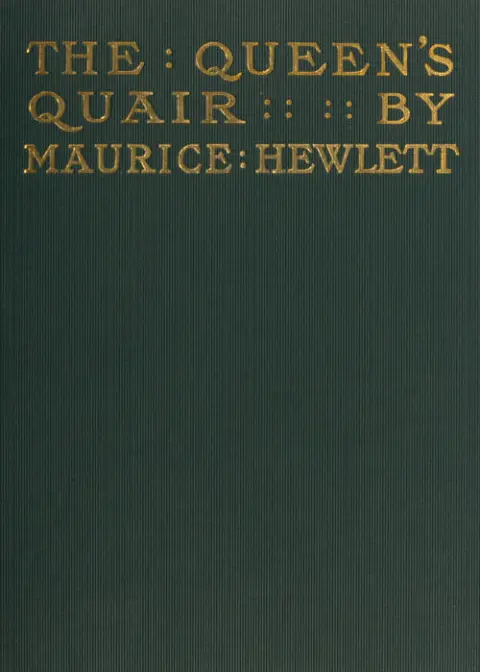
THE CLASSIC COLLECTION · 1903
"The Queen's Quair; or, The Six Years' Tragedy" by Maurice Hewlett is a historical novel written in the early 20th century. The book centers on the life and struggles of Mary Stuart, Queen of Scots, as she navigates the complex political landscape of her time, marked by love, betrayal, and the quest for power. The narrative aims to explore her emotional tumult and the circumstances that shaped her tragic fate. At the start of the novel, readers are introduced to Queen Mary, who is currently mourning the death of her husband, King Francis. The opening scenes depict the tension between her and the influential figures surrounding her, particularly the Cardinal of Lorraine, who wishes to control her political destiny. As she grapples with her desires and her precarious position, the allegiances and rivalries among her maids of honor and relatives become apparent. Mary then resolves to take charge of her future, leading her to contemplate marriage to various suitors who can help reclaim her standing. The opening sets the stage for a tale steeped in intrigue and the heavy burdens of royal expectations.
Introduction adapted from the source catalogue; source summaries may be automatically generated.
Free to read · English · 183,379 words · No account needed
MAKE TIME FOR A GOOD BOOK
On by default. Untick to stop anonymous reading totals. Each page counts after 10 seconds in view. How this works.
Anonymous counting is on unless you have switched it off.
He went off, muttering, ‘What’s in the wind just now?’ and as he went by the great entry saw the guard running, and heard a shout: ‘Room for the Prince’s grace!’ He could see the plumes of the riders and the press about them. ‘It’ll be a new cry before long, I’m thinking,’ he said to himself, and went upstairs.
Entering that silent room, he bent his knee to the Queen. She did not notice his reverence, but said at once: ‘My Lord Chancellor, I shall not sit at the Council to-day. You will direct the clerk to add a postill[3] to the name of my Lord of Moray here.’
‘Madam, with good will. What shall his postill be?’
‘You shall write against his name, Last time he sits. I know that your business is heavy. Farewell, my lords.’
Morton and Moray went out together. At the end of the corridor and head of the stair, Morton stopped.
‘Man, my Lord of Moray, what is this?’
For answer, the Earl of Moray looked steadily at him for a moment: then, ‘Come, come,’ he said, ‘we must go to our work, you and I.’
They said no more; but went through the hall, and heard the Prince’s ringing voice, high above all the others, calling for ‘that black thief Ruthven.’ They saluted a few and received many salutations. Lord John Stuart passed them, his arm round the neck of his Spanish page, and stared at his brother without greeting. These two hated each other, as all the world knew. That same night the Earl of Moray left Edinburgh, and went into Argyll, where all his friends were. It was to be nine months before he could lay his head down in his own house again.
Very little passed between the Queen and her Secretary. She sat quite still, staring and glooming; he moved about, touching a thing here and there, like a house-servant who, by habit, dusts the clean furniture. This brought him by degrees close to her chair. Then he said quickly, ‘Madam, let me speak.’
‘Ay, speak, David.’
‘Madam,’ he said, ‘this is not likely to be work for fair ladies, though they be brave as they are fair. I have seen it growing—this disturbance—a many days. He is not alone by any means, my lord your brother. Madam, send a messenger into France. Send your little Jean-Marie.’
She looked up. ‘Into France?’
‘Madam, yes. Send a messenger into France. Let him fetch home the Earl of
Bothwell.’
She started. ‘Him?’
Riccio nodded his head quickly.
Whereupon she said, ‘He is not in France.’
Your reading position is saved on this browser. Take it to another device with a library code. Reading pages adapt to text, rather than matching a printed edition.
Maurice Hewlett
Maurice Hewlett
Maurice Hewlett
Maurice Hewlett
BEHIND THE BOOK
This eBook is for the use of anyone anywhere in the United States and most other parts of the world at no cost and with almost no restrictions whatsoever. You may copy it, give it away or re-use it under the terms of the Project Gutenberg License included with this eBook or online at www.gutenberg.org. If you are not located in the United States, you will have to check the laws of the country where you are located before using this eBook. Read the source licence.
The original source file, including credits and licence, is retained by this library. Request an original-format copy at no charge. Please include the book title and Project Gutenberg identifier #61466.
KEEP YOUR CURIOSITY GOING
Cécile Tormay

Moritz Busch
Coulson Kernahan
John L. Ransom

Maurice Baring
Frances Wright