THE CLASSIC COLLECTION✦Peeps at People Being Certain Papers from the Writings of Anne Warrington WitherupCLASSIC FREE BOOKS
Peeps at People Being Certain Papers from the Writings of Anne Warrington Witherup
John Kendrick Bangs
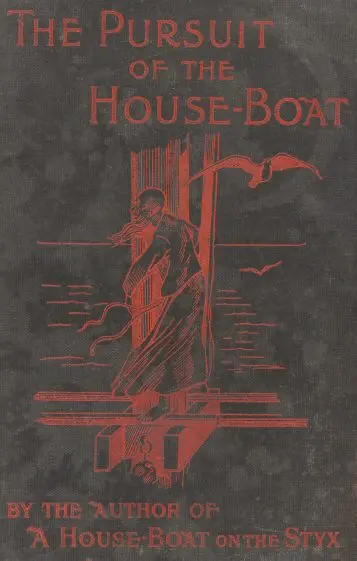
THE CLASSIC COLLECTION · 1897
"The Pursuit of the House-Boat" by John Kendrick Bangs is a humorous literary work written in the early 20th century. This book serves as a satirical sequel to Bangs' earlier story, "A House-Boat on the Styx," and features the comedic adventures of a club of literary and historical figures who are now shades in the afterlife. The central crisis revolves around the theft of their beloved house-boat by the infamous pirate Captain Kidd, leading to a quest to rescue both their floating clubhouse and the women who have also been taken. The opening of the narrative introduces the members of the Associated Shades—such figures as Sir Walter Raleigh, Socrates, and Cleopatra—gathered to discuss the alarming abduction of their house-boat and its inhabitants. As panic sets in, the characters exhibit their distinct personalities and engage in witty banter while deciding on actions to retrieve what is rightfully theirs. The arrival of a mysterious stranger, later revealed to be Sherlock Holmes, adds intrigue to their deliberations as he proposes a well-reasoned approach to track down Kidd and recover their property. The tone is lighthearted, filled with clever dialogue and comedic misunderstandings, setting the stage for an entertaining tale of pursuit and adventure.
Introduction adapted from the source catalogue; source summaries may be automatically generated.
Free to read · English · 33,680 words · No account needed
MAKE TIME FOR A GOOD BOOK
On by default. Untick to stop anonymous reading totals. Each page counts after 10 seconds in view. How this works.
Anonymous counting is on unless you have switched it off.
“You forget,” said Kidd, “two essential features of the situation. These women are at present—or shortly will be, when they realize their situation—in distress, and a true gentleman may always fly to the rescue of a distressed female; and, the second point, we shall soon be on the seas, and I understand that on the fashionable transatlantic lines it is now considered de rigueur to speak to anybody you choose to. The introduction business isn’t going to stand in my way.”
“Well, may I ask,” put in Abeuchapeta, “just what it is that is worrying you? You said something about feeding them, and dressing them, and keeping them in bonnets. I fancy there’s fish enough in the sea to feed ’em; and as for their gowns and hats, they can make ’em themselves. Every woman is a milliner at heart.”
“Exactly, and we’ll have to pay the milliners. That is what bothers me. I was going to lead this expedition to London, Paris, and New York, admiral. That is where the money is, and to get it you’ve got to go ashore, to headquarters. You cannot nowadays find it on the high seas. Modern civilization,” said Kidd, “has ruined the pirate’s business. The latest news from the other world has really opened my eyes to certain facts that I never dreamed of. The conditions of the day of which I speak are interestingly shown in the experience of our friend Hawkins here. Captain Hawkins, would you have any objection to stating to these gentlemen the condition of affairs which led you to give up piracy on the high seas?”
“Not the slightest, Captain Kidd,” returned Captain Hawkins, who was a recent arrival in Hades. “It is a sad little story, and it gives me a pain for to think on it, but none the less I’ll tell it, since you ask me. When I were a mere boy, fellow-pirates, I had but one ambition, due to my readin’, which was confined to stories of a Sunday-school nater—to become somethin’ different from the little Willies an’ the clever Tommies what I read about therein. They was all good, an’ they went to their reward too soon in life for me, who even in them days regarded death as a stuffy an’ unpleasant diversion. Learnin’ at an early period that virtue was its only reward, an’ a-wish-in’ others, I says to myself: ‘Jim,’ says I, ‘if you wishes to become a magnet in this village, be sinful. If so be as you are a good boy, an’ kind to your sister an’ all other animals, you’ll end up as a prosperous father with fifteen hundred a year sure, with never no hope for no public preferment beyond bein’ made the super-intendent of the Sunday-school; but if so be as how you’re bad, you may become famous, an’ go to Congress, an’ have your picture in the Sunday noospapers.’ So I looks around for books tellin’ how to get ‘Famous in Fifty Ways,’ an’ after due reflection I settles in my mind that to be a pirate’s just the thing for me, seein’ as how it’s both profitable an’ healthy. Pass-in’ over details, let me tell you that I became a pirate. I ran away to sea, an’ by dint of perseverance, as the Sunday-school book useter say, in my badness I soon became the centre of a evil lot; an’ when I says to ’em, ‘Boys, I wants to be a pirate chief,’ they hollers back, loud like, ‘Jim, we’re with you,’ an’ they was. For years I was the terror of the Venezuelan Gulf, the Spanish Main, an’ the Pacific seas, but there was precious little money into it. The best pay I got was from a Sunday noospaper which paid me well to sign an article on ‘Modern Piracy’ which I didn’t write. Finally business got so bad the crew began to murmur, an’ I was at my wits’ ends to please ’em; when one mornin’, havin’ passed a restless night, I picks up a noospaper and sees in it that ‘Next Saturday’s steamer is a weritable treasure-ship, takin’ out twelve million dollars, and the jewels of a certain prima donna valued at five hundred thousand.’ ‘Here’s my chance,’ says I, an’ I goes to sea and lies in wait for the steamer. I captures her easy, my crew bein’ hungry, an’ fightin according like. We steals the box a-hold-in’ the jewels an’ the bag containin’ the millions, hustles back to our own ship, an’ makes for our rondyvoo, me with two bullets in my leg, four o’ my crew killed, and one engin’ of my ship disabled by a shot—but happy. Twelve an’ a half millions at one break is enough to make anybody happy.”
Your reading position is saved on this browser. Take it to another device with a library code. Reading pages adapt to text, rather than matching a printed edition.
John Kendrick Bangs
John Kendrick Bangs
John Kendrick Bangs
John Kendrick Bangs
BEHIND THE BOOK
This eBook is for the use of anyone anywhere in the United States and most other parts of the world at no cost and with almost no restrictions whatsoever. You may copy it, give it away or re-use it under the terms of the Project Gutenberg License included with this eBook or online at www.gutenberg.org. If you are not located in the United States, you will have to check the laws of the country where you are located before using this eBook. Read the source licence.
The original source file, including credits and licence, is retained by this library. Request an original-format copy at no charge. Please include the book title and Project Gutenberg identifier #3169.
KEEP YOUR CURIOSITY GOING
Coulson Kernahan

Maurice Baring
Frances Wright
Cécile Tormay
Francis Greenleaf Allinson & Anne C. E. (Anne Crosby Emery) Allinson

Frederic Jesup Stimson