
Merely the patient
Henry Howard Harper
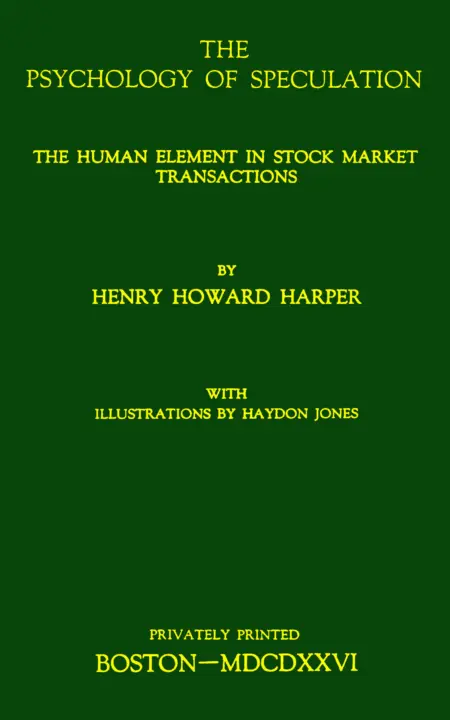
THE CLASSIC COLLECTION · 1926
"The Psychology of Speculation: The Human Element in Stock Market Transactions" by Henry Howard Harper is a scientific publication that delves into the psychological factors influencing stock market behaviors. Written in the early 20th century, the book explores the relationship between human emotions, decision-making, and trading activities within the financial markets. Harper emphasizes that understanding one's own psychology is crucial for achieving success in stock trading. In the book, Harper discusses various aspects of stock market speculation and the intrinsic human tendencies that lead to poor decision-making. Through anecdotes and examples, he illustrates how impulsive behaviors—such as succumbing to market hysteria, overconfidence after profitable trades, and the fear of loss—can drastically affect an investor's judgment. By analyzing the actions of experienced and novice traders alike, Harper suggests that true success in the stock market hinges not only on knowledge of the market but also on mastering psychological discipline and emotional control. Ultimately, the book serves as a cautionary guide for traders and investors, highlighting the need to be aware of the human elements at play in financial transactions.
Introduction adapted from the source catalogue; source summaries may be automatically generated.
Free to read · English · 18,451 words · No account needed
MAKE TIME FOR A GOOD BOOK
On by default. Untick to stop anonymous reading totals. Each page counts after 10 seconds in view. How this works.
Anonymous counting is on unless you have switched it off.
Retired business men suffering from ennui, have often had recourse to the stock market as a means of stimulating their emotions and expanding their fortunes; with the result, in the first of these purposes they have usually succeeded beyond their expectations, while in the second they have met with uncharted obstacles. Some years ago when many of the great trusts were in process of formation a well known Pittsburgh magnate sold out his business to the United States Steel Corporation and later bought a home in New York and turned his attention to stock speculation. After plunging into a boiling market and buying thousands of shares at top prices, the trend eventually changed and he found himself on the crest of a tobogganing market with more than a hundred thousand shares of speculative stocks. At length when the pace threatened both his fortune and his peace of mind, in a fit of disgust he dumped his holdings overboard and proceeded to damn the market, the broker and everything else, including himself for being such an unlucky simpleton.
“My dear Mr. Blank,” said his broker, “you are possibly quite justified in all your abuse, except that of yourself, to whom you really should apologize, since you do yourself a great injustice. You have had six months’ experience in this game at an expense of a little less than two millions of dollars, whereas at the pace you began you were due to lose at least five times that amount but for your rare judgment and cool-headedness.”
“But why in hell didn’t you tell me all this before?” inquired the irate customer. To which the broker calmly replied, “It’s my business to take orders; not to give directions to a man of your understanding.”
When the American Hide and Leather Company was formed a number of years ago, a prominent Boston leather merchant of my acquaintance, sold his business to the new organization for a round million dollars in preferred stock and bonds, and in the course of the next few years of more or less restless inoccupation he devoted himself to a systematic study of investment securities and general stock market conditions. The panic of 1907, when values were almost entirely lost sight of in the mad scramble to liquidate stocks, afforded a rare opportunity to view the follies of reckless speculation, and our astute leather merchant was quick to observe the importance of this salutary lesson. The recovery that followed was almost magical, and many who bought stocks at the low prices doubled their money in a few months. Then following this sharp recovery there was the natural setback when speculators undertook to convert their new wealth into cash. And this too proved a wholesome lesson to our new apprentice in the game of high finance. For some years he had held to the conservative practice of investing only in non-speculative bonds, but this proved to be a slow and monotonous process of enlarging his fortune; furthermore it was devoid of the exciting thrills experienced by those who make fortunes overnight. He thought the funds of widows and orphans ought properly to be invested in gilt edge bonds and mortgages, but for a man of his business sagacity, in the prime of life, to content himself with merely cashing his coupons every six months was to decline into a state of innocuous desuetude--a condition into which he was determined not to retrograde. To launch one’s bark into the rapidly shifting currents of fortune in the stock market and attempt to steer an even course is one of the surest preventives of ennui, and after deliberately weighing and analysing conditions from every conceivable angle our erstwhile leather merchant concluded that cutting a few coupons now and then was too tame an occupation for a man of his acumen and ambition. He informed his friends that after years of careful study of the “game,” he was convinced that the reason why people lost, was that while in theory they all had the right ideas, they all used wrong formulas in practice. He declared that the “public,” so-called, always “bought at the top and sold at the bottom”--a commonplace in stock market parlance, though not necessarily true. Also that the inclination of all speculators is to venture out beyond their depth, i. e., to buy more stocks than they can pay for, or protect by ample margin. This indiscretion he thought to be especially characteristic of those with but small capital, whose eagerness for large gains outstripped their conservatism and exposed them to the perils of abrupt and unexpected reactions and panics. He had never bought more hides and leather than he could pay for, either with his own funds or with money easily borrowed from banks; he would never buy more stocks or bonds than he could pay for, or protect with sufficient margin to carry them through the severest depression.
Your reading position is saved on this browser. Take it to another device with a library code. Reading pages adapt to text, rather than matching a printed edition.
Henry Howard Harper
Henry Howard Harper
Henry Howard Harper
BEHIND THE BOOK
This eBook is for the use of anyone anywhere in the United States and most other parts of the world at no cost and with almost no restrictions whatsoever. You may copy it, give it away or re-use it under the terms of the Project Gutenberg License included with this eBook or online at www.gutenberg.org. If you are not located in the United States, you will have to check the laws of the country where you are located before using this eBook. Read the source licence.
The original source file, including credits and licence, is retained by this library. Request an original-format copy at no charge. Please include the book title and Project Gutenberg identifier #73647.
KEEP YOUR CURIOSITY GOING

Charles G. (Charles Griffith) Ross
Hannah Webster Foster

Emily Lawless
Edwin Hamlin Carr

Charles De Lano Hine
Andrew Ure