
Merely the patient
Henry Howard Harper
THE CLASSIC COLLECTION · 1926
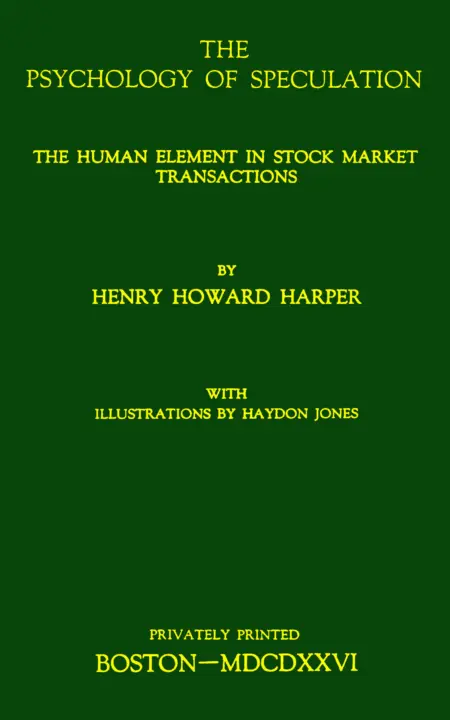
"The Psychology of Speculation: The Human Element in Stock Market Transactions" by Henry Howard Harper is a scientific publication that delves into the psychological factors influencing stock market behaviors. Written in the early 20th century, the book explores the relationship between human emotions, decision-making, and trading activities within the financial markets. Harper emphasizes that understanding one's own psychology is crucial for achieving success in stock trading. In the book, Harper discusses various aspects of stock market speculation and the intrinsic human tendencies that lead to poor decision-making. Through anecdotes and examples, he illustrates how impulsive behaviors—such as succumbing to market hysteria, overconfidence after profitable trades, and the fear of loss—can drastically affect an investor's judgment. By analyzing the actions of experienced and novice traders alike, Harper suggests that true success in the stock market hinges not only on knowledge of the market but also on mastering psychological discipline and emotional control. Ultimately, the book serves as a cautionary guide for traders and investors, highlighting the need to be aware of the human elements at play in financial transactions.
Introduction adapted from the source catalogue; source summaries may be automatically generated.
Free to read · English · 18,451 words · No account needed
MAKE TIME FOR A GOOD BOOK
On by default. Untick to stop anonymous reading totals. Each page counts after 10 seconds in view. How this works.
Anonymous counting is on unless you have switched it off.
I recall a particular instance, a few years ago, when there were some tremendous pool operations in the common stock of one of America’s largest industrial corporations, and after the stock had been bid up ten or a dozen points it was reported that a “managing director” of the company had assured one of the pool members that it had been tacitly agreed among the directors to declare a fifty per cent. stock dividend at the next board meeting. The public instantly took the bit in its teeth, and inside of a week the stock advanced fifteen points more, which doubtless afforded the clique an auspicious occasion for unloading its holdings, bought at much lower figures. About that time I happened to be in New York, and while lunching one day with the chairman of the board of directors at his club he told me that the matter of a stock dividend had not even been discussed among the directors, and that in his opinion there was no likelihood of any change in the dividend policy for at least a year,--which proved to be true.
A matter of present and future importance in connection with many investment and speculative stocks, involving as it does questions on which there is a wide diversity of opinion, is the modern practice of increasing the outstanding shares of corporations by splitting them up into fractions, or by declaring liberal stock dividends. Many of the large companies have recently doubled and quadrupled their shares, and some have issued as high as nine new shares for one, on somewhat the same principle as the Government will issue ten one dollar notes in exchange for a ten dollar bill. And in several instances the fractional shares have been split a second, and even a third time. In past years when there were only a few listed securities it was possible for any well informed person in financial circles to tell the par value and the approximate book value of all the leading stocks, but the good old-fashioned methods are no longer in vogue; there are now 1,045 stocks listed on the New York Stock Exchange alone, representing almost every imaginable industry, from steam locomotives to lunch counters, and under the new capital readjustment process it takes a professional statistician to keep up with the changes and determine what stocks are actually worth. But whatever their value may be, it is at least certain that there is not enough money in the world to cash them all in at anywhere near their present market price. Nowadays it is not unusual for industrial companies to have from five to ten million or more shares outstanding. The lately devised and much over-worked practice of splitting stocks up into small fractions, avowedly for the convenience of traders, savors strongly of the old worn-out custom of “baiting” the public with low-priced issues, ranging from $1 a share upward. As long as we are riding on the crest of the wave of prosperity there appears to be no imminent danger in such inflation, but when business slackens, as it always has periodically in the past---- However, the optimists contend that these problems are too far in the future to worry about. Furthermore it is not the design of this article to criticise abuses, or to prognosticate future difficulties that seem likely to grow out of them. It is true that some of the companies, notwithstanding the tremendous increase in their capital structures, have not weakened their resources by increasing their cash disbursements. In 1921 the stock of the Standard Oil Company of New Jersey was paying $5 a year in dividends and selling at $124.50 per share. In 1922 it was boosted up to $250.50 a share on the report that shareholders were to receive four new shares for one. After this split-up was accomplished and the authorized common stock increased to 25,000,000 shares,--not dollars, but shares!--more than 20,000,000 of which have been issued, in addition to $200,000,000 of preferred stock, the same conservative dividend policy was continued, and the new stock received, and still receives, only one dollar a share annually in dividends. The market price of the new stock went down to a fraction below $31, whence it afterwards recovered to about $46, at which figure it pays a trifle over 2%, or about one half the net return on U. S. Government bonds; and the only visible change in the stockholder’s position is that if he wishes to sell his stock it costs about five times what it did before; in other words, to buy and sell the equivalent of one hundred shares of the old stock it now costs $154 in commission and tax--more than eighteen months’ income on a hundred shares of the present stock. Possibly there are mathematicians who can figure out some sort of compensating advantage to the stockholder, but I never could.
Your reading position is saved on this browser. Take it to another device with a library code. Reading pages adapt to text, rather than matching a printed edition.
Henry Howard Harper
Henry Howard Harper
Henry Howard Harper
BEHIND THE BOOK
This eBook is for the use of anyone anywhere in the United States and most other parts of the world at no cost and with almost no restrictions whatsoever. You may copy it, give it away or re-use it under the terms of the Project Gutenberg License included with this eBook or online at www.gutenberg.org. If you are not located in the United States, you will have to check the laws of the country where you are located before using this eBook. Read the source licence.
The original source file, including credits and licence, is retained by this library. Request an original-format copy at no charge. Please include the book title and Project Gutenberg identifier #73647.
KEEP YOUR CURIOSITY GOING

Charles G. (Charles Griffith) Ross
Hannah Webster Foster

Emily Lawless
Edwin Hamlin Carr

Charles De Lano Hine
Andrew Ure