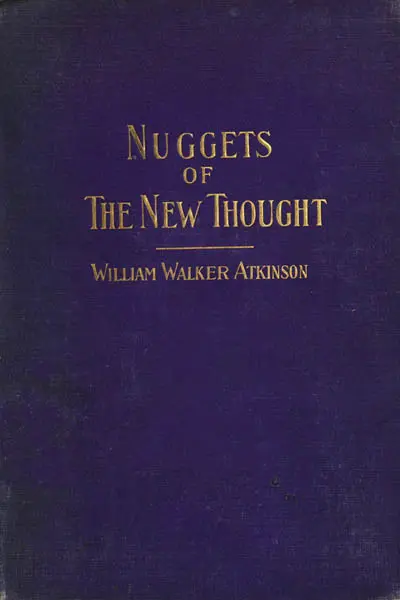
Nuggets of the New Thought: Several Things That Have Helped People
William Walker Atkinson
THE CLASSIC COLLECTION · 1912
"The Psychology of Salesmanship" by William Walker Atkinson is a scientific publication written in the early 20th century. The book explores the psychological principles that underpin sales techniques and practices, emphasizing the importance of understanding both the salesperson's and the buyer's mindset in facilitating successful transactions. Atkinson aims to fuse psychology with effective salesmanship, arguing that the mental processes involved in selling are critical to achieving success in the business world. The opening of the text presents a discussion on the evolution of the perception of psychology within the business realm. Atkinson notes that, traditionally, business people regarded psychology with skepticism, associating it with abstract theorizing rather than practical application. However, he asserts that psychology—the science of the mind—is integral to effective sales techniques, fundamentally influencing how goods are marketed, sold, and purchased. He highlights the importance of understanding mental states that sellers can induce in consumers, such as attention and desire, and suggests that mastering these psychological principles can lead to greater success in sales. Through various examples, he sets the stage for a deeper exploration of salesmanship as it relates to human behavior and mental processes.
Introduction adapted from the source catalogue; source summaries may be automatically generated.
Free to read · English · 44,314 words · No account needed
MAKE TIME FOR A GOOD BOOK
On by default. Untick to stop anonymous reading totals. Each page counts after 10 seconds in view. How this works.
Anonymous counting is on unless you have switched it off.
The Salesman should thoroughly acquaint himself with the characteristics of each of the three temperaments, and should also learn to analyze them when found blended and in combination. An understanding of a man's temperament will often give one the key to his general character and disposition, which will be of the greatest advantage to the Salesman. Many students of human nature devote their entire attention to a study of the several faculties of the mind, ignoring the force and effect of the temperaments. We consider this to be a mistake, for a thorough knowledge of the temperaments gives one a general key to character, and, as a fact, it is generally found that given a certain temperament or combination of the same, a good phrenologist will be able to indicate just what faculties are apt to be found in the ascendency in such a character. And as the average Salesman cannot spare the time to become an expert phrenologist, it will be seen that a correct knowledge of the temperaments gives him his best working knowledge of the subject of character reading.
Let us now consider the various groups of mental faculties which are manifested by the buyer in his business, and which should be understood by the Salesman in order that he may successfully meet the impulses arising therefrom in the mind of the buyer. Our consideration of these groups of faculties must necessarily be brief, but we shall include the essential features.
The Social Faculties. This group of faculties includes Amativeness or Sexuality; Conjugality or Marital Inclination; Parental Love or Love of Offspring; Friendship or Love of Companionship; Inhabitiveness or Love of Home. Phrenology teaches that this group of organs occupies the lower back portion of the head, giving the appearance of bulging behind the ears. Amativeness or Sexuality when highly developed causes one to be at the mercy of the attraction of the opposite sex. While normally developed it plays a worthy part in life, its excessive development manifests in licentiousness, and when deficient manifests in an aversion to the opposite sex or a coldness and reserve. Persons in whom this faculty is in excess will neglect business for sex attraction, and will allow themselves to be "sidetracked" by reason thereof. In selling a man of this kind, keep him away from this particular subject, or he will not give you his attention. Conjugality or Marital Inclination when highly developed causes one to be largely influenced by one's companion in marriage. A man of this kind will be largely governed by his wife's wishes, tastes and desires, consequently if his wife "says so" the battle is won. Some men, however, while having Amativeness largely developed, have but small Conjugality, and if one love is not found satisfactory, another is substituted--an "affinity" takes the wife's place. Parental Love or Love of Offspring when highly developed causes one to idolize his children and to be capable of influence through them. Such men are prone to relate anecdotes regarding their children and to bore listeners with recitals of infantile brightness and precocity. They generally have photographs of their children about their desks. An appeal to the interests of the children always reaches the attention and interest of these people. Friendship, or Love of Companionship, when highly developed causes one to seek society, form attachments of friendship, enjoy social pleasures, do favors for those whom they like, enjoy entertaining and being entertained. Such a man will be more apt to base his business dealings upon likes and acquaintance rather than upon reason or judgment, and are comparatively easily persuaded by those whom they like. An appearance of sociability generally attracts them to those manifesting it. The quality of "good fellowship" appeals to this class. Inhabitiveness or Love of Home when highly developed causes one to become attached to places, localities and associations. Such a man will be full of patriotism, local pride and prejudice and provincialism. He will resent any apparent "slur" upon his locality, and will appreciate any favorable comment on his home place and locality. These people are like cats who are attached to places rather than to people. Their township is usually their idea of "my country."
Your reading position is saved on this browser. Take it to another device with a library code. Reading pages adapt to text, rather than matching a printed edition.
William Walker Atkinson
William Walker Atkinson
William Walker Atkinson
William Walker Atkinson
BEHIND THE BOOK
This eBook is for the use of anyone anywhere in the United States and most other parts of the world at no cost and with almost no restrictions whatsoever. You may copy it, give it away or re-use it under the terms of the Project Gutenberg License included with this eBook or online at www.gutenberg.org. If you are not located in the United States, you will have to check the laws of the country where you are located before using this eBook. Read the source licence.
The original source file, including credits and licence, is retained by this library. Request an original-format copy at no charge. Please include the book title and Project Gutenberg identifier #41510.
KEEP YOUR CURIOSITY GOING

Charles G. (Charles Griffith) Ross
Hannah Webster Foster

Emily Lawless
Edwin Hamlin Carr

Charles De Lano Hine
Andrew Ure