Martin Valliant
Warwick Deeping
THE CLASSIC COLLECTION · 1928
The prophetic marriage by Warwick Deeping. Explore this classic work in a free online edition. Subjects include Bildungsromans; Man-woman relationships -- Fiction; England -- Social life and customs -- Fiction; Marriage -- Fiction; World War, 1914-1918 -- France -- Fiction. Read the locally hosted text below, adjust the reading display, and continue where you left off.
Introduction adapted from the source catalogue; source summaries may be automatically generated.
Free to read · English · 117,622 words · No account needed
MAKE TIME FOR A GOOD BOOK
On by default. Untick to stop anonymous reading totals. Each page counts after 10 seconds in view. How this works.
Anonymous counting is on unless you have switched it off.
Suddenly Tod stood up. She had come in by the orchard gate and was crossing the yard, the Claire of a year ago, in her daintily shabby black dress, and her hair like a pale brown wreath touched with sunlight. It was the same calm, frank-faced Claire, with her mouth and her grey eyes, more serious, perhaps a little sad. She looked quite innocent and unsuspecting, just a woman who had her work to do, a woman who had come to speak with some casual friend.
A pair of clean shoes were standing against the wall. Claire picked them up, entered the kitchen, and saw Tod.
She dropped the shoes on a chair, and stood looking at him with round
grey eyes.
“Monsieur—you!”
And Tod, the man, did not move, for he saw something that his dream had never shown him. Claire was afraid.
Chapter Forty-two
She sat down suddenly at the table, her elbows resting upon it, her little fists clenched under her chin. Her eyes looked straight at Tod.
“Why have you come back?”
There was a fierceness in her voice, an attack in the abrupt words she
threw at him.
Tod took his chair and sat down opposite her, his elbows also on the
table.
“Because I have a right to come back.”
“Why?”
“I am free. I am no longer married.”
The eyes opposite him gave a kind of flicker, like a light blown by the wind. She did not say anything, but sat there, waiting.
Tod felt in his coat pocket, brought out the little brown Testament and laid it on the table between them.
“You remember?” he asked.
She bowed her head slightly.
“I remember, monsieur.”
“I have carried it—always. I thought I should never come back, that I should never see you again. I was very unhappy then; I knew things that I could not tell you. It would not have been fair. Was I wrong?”
“You were never wrong.”
The words were almost inaudible. Her fists had unclenched themselves, and her hands were curved against her cheeks. She was looking at the table now, and not at Tod, and her eyes were heavy with something deeper than fear.
“I thought I should never come back,” he went on. “Then life changed for me. And yet—I had to wait. The woman I had married had given herself to another man. It had happened before I met you, but I had only guessed it then.”
She stretched out a hand and fingered the little brown book.
“You did not—not love her, monsieur?”
“I did not love her.”
“Never?”
“Once, when I was a boy and did not know.”
Your reading position is saved on this browser. Take it to another device with a library code. Reading pages adapt to text, rather than matching a printed edition.
Warwick Deeping
Warwick Deeping
Warwick Deeping
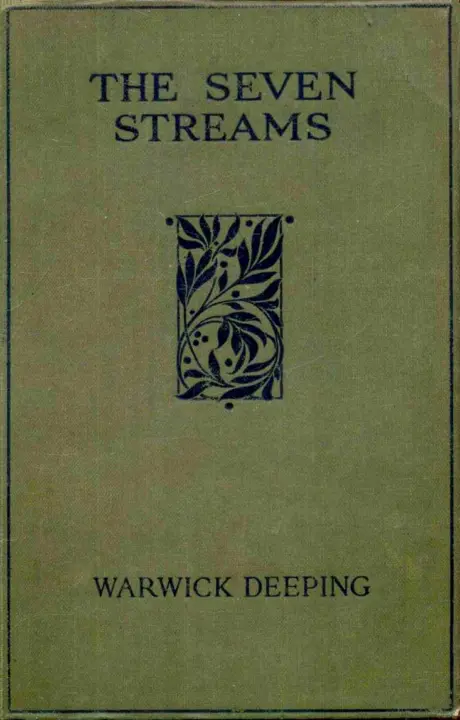
Warwick Deeping
BEHIND THE BOOK
This eBook is for the use of anyone anywhere in the United States and most other parts of the world at no cost and with almost no restrictions whatsoever. You may copy it, give it away or re-use it under the terms of the Project Gutenberg License included with this eBook or online at www.gutenberg.org. If you are not located in the United States, you will have to check the laws of the country where you are located before using this eBook. Read the source licence.
The original source file, including credits and licence, is retained by this library. Request an original-format copy at no charge. Please include the book title and Project Gutenberg identifier #79530.
KEEP YOUR CURIOSITY GOING
Coulson Kernahan

Maurice Baring
Frances Wright
Cécile Tormay

Frederic Jesup Stimson

W. H. P. (William Henry Pope) Jarvis