THE CLASSIC COLLECTION✦An outlaw’s diary: the CommuneCLASSIC FREE BOOKS
An outlaw’s diary: the Commune
Cécile Tormay
THE CLASSIC COLLECTION · 1900
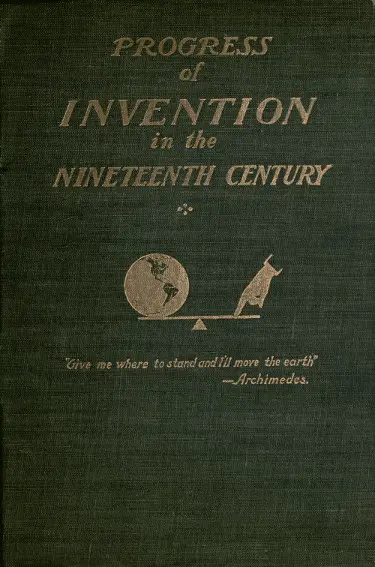
"The Progress of Invention in the Nineteenth Century" by Edward W. Byrn is a historical account written in the late 19th century. The work presents an overview of the significant inventions and technological advancements that characterized the 1800s, emphasizing the profound impact of human ingenuity on society. With a focus on patents, the author aims to provide a comprehensive perspective on how these innovations have contributed to modern life and shaped the world we live in today. At the start of the book, Byrn reflects on the explosive progress of invention during the 19th century, contrasting it with previous periods where such developments were slow and incremental. He describes the era as a remarkable climax of creative thought, resulting in labor-saving devices and modernization that benefitted human life. The opening chapters introduce the foundational works and inventors, signaling the beginning of a transformative century that shifted society towards a more technological and efficient future. Byrn acknowledges the challenges faced by inventors, including societal resistance and prejudice against new technologies, but ultimately highlights the advancements that ring true to an age characterized by creativity and innovation.
Introduction adapted from the source catalogue; source summaries may be automatically generated.
Free to read · English · 139,360 words · No account needed
MAKE TIME FOR A GOOD BOOK
On by default. Untick to stop anonymous reading totals. Each page counts after 10 seconds in view. How this works.
Anonymous counting is on unless you have switched it off.
White gunpowder, or wood powder, was invented by Captain Schultz, of the Prussian army. It is made by treating granulated wood with a mixture of nitric and sulphuric acids, which, acting upon the cellulose of the wood, convert it into an explosive something of the nature of gun cotton. The grains are afterward saturated with saltpetre. This was patented in the United States June 2, 1863, No. 38,789, and in Great Britain, No. 900, of 1864. Dittmar’s powder is another of the same general nature, covered by United States patents No. 98,854, January 18, 1870; No. 99,069, January 25, 1870, and No. 145,403, December 9, 1873.
Among the high explosives of more recent date may be mentioned:
Tonite (gun cotton and barium nitrate), British patents No. 3,612, of 1874, and No. 2,742, of 1876.
Rack-a-rock (potassium chlorate and nitro-benzene), United States patent No. 243,432, June 28, 1881; British patent No. 5,584, of 1881.
Bellite (ammonium nitrate and nitro-benzene), United States
patent No. 455,217, June 30, 1891; British patent No. 13,690, of
1885.
Melinite (picric acid and gun cotton), British patent No. 15,089,
of 1885.
Lyddite, not patented, but believed to be substantially same as melinite, and containing for its active ingredient picric acid, which is a compound formed by the reaction of nitric acid on carbolic acid.
Cordite (nitro-glycerine, gun cotton, and mineral jelly or oil), British patent No. 5,614, of 1889; United States patent No. 409,549, August 20, 1889.
Indurite (gun cotton and nitro-benzene, indurated), United States patent, No. 489,684, January 10, 1893; British patent, No. 580, of 1893.
In recent years smokeless powders have largely superseded all others. These contain usually nitro-cellulose (gun cotton), or nitro-glycerine, or both, made up into a plastic, coherent, and homogeneous compound of a gluey nature, and fashioned into horn-like sticks or rods by being forced under pressure through a die plate having small holes, through which the plastic material is strained into strings like macaroni, or else is molded into tablets, pellets, or grains of cubical shape. Prominent among those who have contributed to this art are the names of Turpin, Abel and Dewar, Nobel, Maxim, Munroe, Du Pont, Bernadou and others.
Your reading position is saved on this browser. Take it to another device with a library code. Reading pages adapt to text, rather than matching a printed edition.
BEHIND THE BOOK
This eBook is for the use of anyone anywhere in the United States and most other parts of the world at no cost and with almost no restrictions whatsoever. You may copy it, give it away or re-use it under the terms of the Project Gutenberg License included with this eBook or online at www.gutenberg.org. If you are not located in the United States, you will have to check the laws of the country where you are located before using this eBook. Read the source licence.
The original source file, including credits and licence, is retained by this library. Request an original-format copy at no charge. Please include the book title and Project Gutenberg identifier #41538.
KEEP YOUR CURIOSITY GOING
Cécile Tormay

Moritz Busch
John L. Ransom
Frances Wright
Cécile Tormay

Mabel Potter Daggett