THE CLASSIC COLLECTION✦The WonderCLASSIC FREE BOOKS
The Wonder
J. D. (John Davys) Beresford
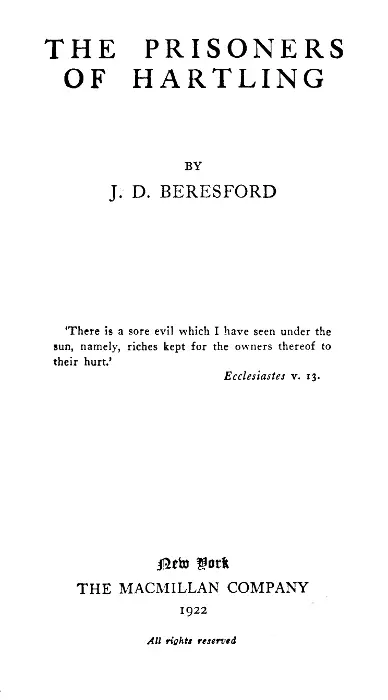
THE CLASSIC COLLECTION · 1922
"The Prisoners of Hartling" by J. D. Beresford is a novel written in the early 20th century. The story revolves around Arthur Woodroffe, a young general practitioner who feels discontented with his life treating patients in a poor neighborhood. The narrative begins with his thoughts on seeking a more fulfilling existence, which is sparked by an invitation to visit his wealthy relatives at Hartling, who embody the life he dreams of—a stark contrast to his current drudgery. The opening of the novel introduces us to Arthur as he shares his frustrations about his medical practice with his colleague, Somers. Their conversation reveals Arthur's yearning for change and a deeper significance in life, prompting him to consider visiting his affluent relatives after receiving an invitation. Through Arthur's eyes, we see his inner conflict between wanting a more luxurious lifestyle and the calling of meaningful work. The transition to Hartling hints at potential adventures and self-discovery, setting the stage for the exploration of class, purpose, and the complexities of human relationships that will likely unfold as the story progresses.
Introduction adapted from the source catalogue; source summaries may be automatically generated.
Free to read · English · 68,470 words · No account needed
MAKE TIME FOR A GOOD BOOK
On by default. Untick to stop anonymous reading totals. Each page counts after 10 seconds in view. How this works.
Anonymous counting is on unless you have switched it off.
She looked at him out of the corners of her eyes and softly blew her relief. "We got a good dose to-night," she whispered, and continued, "That means there's going to be a fuss."
"About young Turner and Eleanor?" he tried.
"Eleanor? Where does Eleanor come in?" was her surprised response.
"I don't know. I thought possibly...." He hesitated, finding an unexpected difficulty in putting his guess into words.
"Nothing whatever to do with Eleanor," Elizabeth said, without waiting for him to finish his sentence.
"What is it, then?" he insisted.
"About him," she said, indicating Kenyon Turner. "I can't possibly tell
you now."
But after dinner he received enlightenment as to the cause of the impending "fuss" from the prime disturber of the peace himself.
"Care to have a game of pills?" he asked, coming over to Arthur as they were leaving the dining-room.
His first instinct was to refuse. The conceit of the fellow annoyed him--he had two lines of braid down his dress trousers--but Arthur was on the top of his form just then, and was spurred by a desire to beat him at what was, no doubt, his own game. He had been so cursedly supercilious about playing golf for "medical reasons."
"Don't mind," he said in the true Hartling manner of one condescending to a casual visitor from the outside.
But although he did, in fact, beat young Turner, he realised that his victory was due to the fact that his opponent was "off his game," and could probably give him twenty in a hundred on ordinary occasions. Young Turner's touch was almost as delicate as his father's.
"I'm no earthly good to-night," he said, putting down his cue at the conclusion of the game. "All this business is such an infernal worry."
As he spoke he looked at Hubert--who had been exercising his predestinate function of marker--rather than at Arthur.
"You're not the only one," Hubert commented morosely.
Arthur, who had been continuing a break that had not been completed when he reached game, straightened his back and faced his cousin. "What is this business?" he asked.
Hubert, who had got into that uneasy-looking pose of his, looked down
at his crossed ankles.
"The old man's so infernally difficult," he said.
"So cursedly tight with the money-bags," Turner explained.
"Have you been trying to milk him, then?" Arthur asked.
"Oh, well! the fact is I'm in a hole, on the rocks," Turner admitted. "I've put it off as long as I can, but something has cursedly well got to be done now."
Your reading position is saved on this browser. Take it to another device with a library code. Reading pages adapt to text, rather than matching a printed edition.
J. D. (John Davys) Beresford
BEHIND THE BOOK
This eBook is for the use of anyone anywhere in the United States and most other parts of the world at no cost and with almost no restrictions whatsoever. You may copy it, give it away or re-use it under the terms of the Project Gutenberg License included with this eBook or online at www.gutenberg.org. If you are not located in the United States, you will have to check the laws of the country where you are located before using this eBook. Read the source licence.
The original source file, including credits and licence, is retained by this library. Request an original-format copy at no charge. Please include the book title and Project Gutenberg identifier #61246.
KEEP YOUR CURIOSITY GOING
Coulson Kernahan

Maurice Baring
Frances Wright
Cécile Tormay

Frederic Jesup Stimson

W. H. P. (William Henry Pope) Jarvis