THE CLASSIC COLLECTION✦The WonderCLASSIC FREE BOOKS
The Wonder
J. D. (John Davys) Beresford
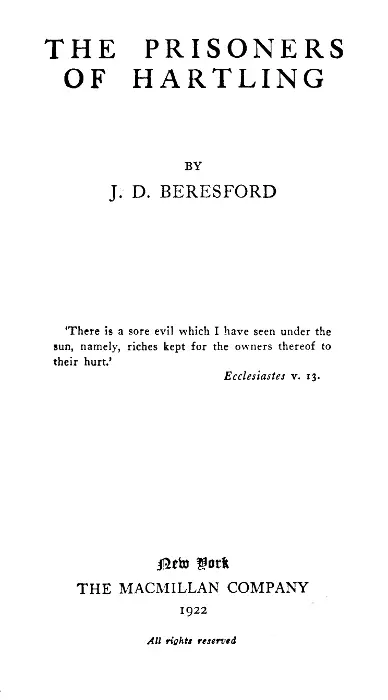
THE CLASSIC COLLECTION · 1922
"The Prisoners of Hartling" by J. D. Beresford is a novel written in the early 20th century. The story revolves around Arthur Woodroffe, a young general practitioner who feels discontented with his life treating patients in a poor neighborhood. The narrative begins with his thoughts on seeking a more fulfilling existence, which is sparked by an invitation to visit his wealthy relatives at Hartling, who embody the life he dreams of—a stark contrast to his current drudgery. The opening of the novel introduces us to Arthur as he shares his frustrations about his medical practice with his colleague, Somers. Their conversation reveals Arthur's yearning for change and a deeper significance in life, prompting him to consider visiting his affluent relatives after receiving an invitation. Through Arthur's eyes, we see his inner conflict between wanting a more luxurious lifestyle and the calling of meaningful work. The transition to Hartling hints at potential adventures and self-discovery, setting the stage for the exploration of class, purpose, and the complexities of human relationships that will likely unfold as the story progresses.
Introduction adapted from the source catalogue; source summaries may be automatically generated.
Free to read · English · 68,470 words · No account needed
MAKE TIME FOR A GOOD BOOK
On by default. Untick to stop anonymous reading totals. Each page counts after 10 seconds in view. How this works.
Anonymous counting is on unless you have switched it off.
"And are you?" she asked.
"Different from the others?" he repeated, staggered by the suggestion that he could be thought to resemble, in any particular, the other members of the Hartling circle.
"Yes," she prompted him quietly.
He stared at her frowning. "Am I the least like them?" he inquired with a faint trepidation in his voice.
"Not yet, perhaps; but you will be," she said.
"But they aren't like each other," he remonstrated. "Which of them shall I be like if I stay long enough, Uncle Joe, or Mr Turner, or Hubert ...?"
"Aren't they all rather alike in one way?" she asked.
He saw at once that they were; that there was some characteristic common to every one of them, even Miss Kenyon. Seen as individuals they were as different from each other as are the ears of wheat in a cornfield, but they all bowed the same way to the prevailing wind. In their attitude towards the head of the house they could all be relied upon to present the same face.
"But you've been here fourteen years," he said, "and you're still
different. Or do you think it takes longer than that to get
assimilated?"
"I'm not different," she replied. "Or I shouldn't be here still."
"Of course, I don't know you," he said. "I've hardly seen you since the first three or four days I was here. But--well--I can't agree with you about that."
She just perceptibly shrugged her shoulders.
"You haven't said whether you will let me come with you on your walk," he began again, after a short pause.
"I would sooner you didn't," she told him. "It can't do any good. There can be nothing new that you want to ask my advice about. I said all I had to say to you about that five weeks ago, and you took no notice. I can only repeat what I said then."
"But I can't go now," he protested. "I've given my promise. I made a
sort of bargain in fact."
She shook her head impatiently. "You needn't keep it," she said.
"That's absurd," he remonstrated, getting to his feet. "Of course I must keep my promise in any circumstances."
"I suppose you do really believe that?" she asked, looking up at him. "Would you keep it just the same, for instance, if you knew for certain that it meant staying on here for ten years and getting nothing, absolutely nothing, at the end of it? Would you, honestly? Or don't you think you'd ask to be let off?"
"I might ask to be let off," he admitted, after a few seconds' thought.
Your reading position is saved on this browser. Take it to another device with a library code. Reading pages adapt to text, rather than matching a printed edition.
J. D. (John Davys) Beresford
BEHIND THE BOOK
This eBook is for the use of anyone anywhere in the United States and most other parts of the world at no cost and with almost no restrictions whatsoever. You may copy it, give it away or re-use it under the terms of the Project Gutenberg License included with this eBook or online at www.gutenberg.org. If you are not located in the United States, you will have to check the laws of the country where you are located before using this eBook. Read the source licence.
The original source file, including credits and licence, is retained by this library. Request an original-format copy at no charge. Please include the book title and Project Gutenberg identifier #61246.
KEEP YOUR CURIOSITY GOING
Coulson Kernahan

Maurice Baring
Frances Wright
Cécile Tormay

Frederic Jesup Stimson

W. H. P. (William Henry Pope) Jarvis