THE CLASSIC COLLECTION✦Hawthorne (English Men of Letters Series)CLASSIC FREE BOOKS
Hawthorne (English Men of Letters Series)
Henry James

THE CLASSIC COLLECTION · 1886
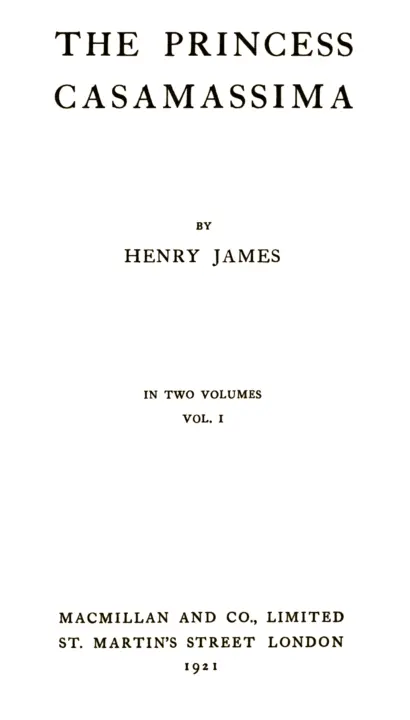
"The Princess Casamassima (Volume 2 of 2)" by Henry James is a novel published in 1886. It follows Hyacinth Robinson, a young London bookbinder who discovers his tragic parentage and becomes entangled in radical politics and a terrorist plot. Torn between his attraction to beauty and culture and his commitment to revolutionary justice, Hyacinth must navigate conflicting loyalties that pull him toward an inevitable reckoning with his dangerous vow.
Introduction adapted from the source catalogue; source summaries may be automatically generated.
Free to read · English · 115,761 words · No account needed
MAKE TIME FOR A GOOD BOOK
On by default. Untick to stop anonymous reading totals. Each page counts after 10 seconds in view. How this works.
Anonymous counting is on unless you have switched it off.
“You couldn’t discover much. You saw, after all, very little of me,”
Hyacinth said.
“I made what I could of that little. It was better than nothing.”
Hyacinth laid his hand gently on the old man’s arm; he had never felt so acute a kindness for him, not even when accepting his thirty pounds before going abroad. “Certainly I’ll come to see you.”
“I was much obliged to you for your letters,” Mr. Vetch observed without heeding these words but continuing to scrape. He had always, even into the shabbiness of his old age, kept that mark of English good-breeding (which is composed of some such odd elements) that there was a shyness, an aversion to possible phrase-making, in his manner of expressing gratitude for favours, and that in spite of this cursory tone his acknowledgment had ever the accent of sincerity.
Hyacinth took little interest in the piece, which was an inanimate revival; he had been at the Théâtre Français and the tradition of that house was still sufficiently present to him to make any other style of interpretation of comedy appear at the best but a confident form of horseplay. He sat in one of the front stalls, close to the orchestra; and while the thing went forward—or backward, ever backward, as it seemed to him—his thoughts wandered far from the shabby scene and the dusty boards, revolving round a question which had come up immensely during the last few hours. The Princess was a capricciosa—this at least had been Madame Grandoni’s account of her; and was that blank, expressionless house in South Street a sign that an end had come to the particular caprice in which he had happened to be involved? On his return to London the desire to be with her again on the same terms as at Medley had begun to ache in him like a sorrow or a dreaded wrong—so sharp was his sense that if he mightn’t absolutely count upon her she had been all cruelly, all abominably dishonest. Yet the wonder of the other time remained, in the great silence that had come, altogether a wonder. Circumstances had favoured in an extraordinary degree his visit to her, and it was by no means clear that they would again be so accommodating or that what had been possible for a few days should be possible with continuity and in the midst of the ceremonies and complications of London. Hyacinth felt poorer than he had ever felt before, inasmuch as he had had money and spent it, whereas in previous times he had never had it to spend. He never for an instant regretted his squandered wealth, for he said to himself that he had made a good bargain and become master of a precious equivalent. The equivalent was a rich experience—an experience that would grow richer still as he should talk it over, in the right conditions that she would find again, with the one person in the world to whom he was now interesting. His poverty would be no obstacle to their friendship so long as he should have a pair of legs to carry him to her door; for she liked him better shabby than furbished up, and she had given him too many pledges, they had taken together too many appointments, worked out too many ideas, to be disconcerted on either side by obstacles that were merely a part of the general conventionality. He was to go with her into the slums, to introduce her to the worst that London contained—he should have precisely to make acquaintance with it first—to show her the reality of the horrors of which she dreamed the world might be purged. He had ceased himself to care for the slums and had reasons for not wishing to spend his remnant in the study of foul things; but he would go through with his part of the engagement. He might be detached and mechanical, but any dreariness would have a gilding that should involve an association with her. What indeed if she should have changed, have availed herself of that great right of unapologetic inconsequence which he believed to be, at least in their relation with nobodies, the highest luxury of the happy? What if, from a high insolence which he thought of as lurking somewhere in the side-scenes of her nature, though he had really not once seen it step to the front, she should toss back her perfect head with a movement signifying that he was too basely literal and that she knew him no more? His imagination represented her this evening in places where a barrier of dazzling light shut her out from access or even from any appeal. He saw her with other people, in splendid rooms where “the dukes” had possession of her, smiling, satisfied, surrounded, covered with jewels. When this vision grew intense he found a reassurance in reflecting that after all she would be unlikely to throw him personally over so long as she should remain as deeply compromised, subterraneously speaking, as she had—successfully it seemed—tried to become, and that it would not be easy for her to liberate herself from that entanglement. She had of course told him more, at Medley, of the manner in which she had already committed herself, and he remembered with a strange perverse elation that she had gone very far indeed.
Your reading position is saved on this browser. Take it to another device with a library code. Reading pages adapt to text, rather than matching a printed edition.
Henry James
Henry James
Henry James
Henry James
BEHIND THE BOOK
This eBook is for the use of anyone anywhere in the United States and most other parts of the world at no cost and with almost no restrictions whatsoever. You may copy it, give it away or re-use it under the terms of the Project Gutenberg License included with this eBook or online at www.gutenberg.org. If you are not located in the United States, you will have to check the laws of the country where you are located before using this eBook. Read the source licence.
The original source file, including credits and licence, is retained by this library. Request an original-format copy at no charge. Please include the book title and Project Gutenberg identifier #69629.
KEEP YOUR CURIOSITY GOING
Coulson Kernahan

Maurice Baring
Frances Wright
Cécile Tormay

Frederic Jesup Stimson

W. H. P. (William Henry Pope) Jarvis