THE CLASSIC COLLECTION✦Hawthorne (English Men of Letters Series)CLASSIC FREE BOOKS
Hawthorne (English Men of Letters Series)
Henry James

THE CLASSIC COLLECTION · 1886
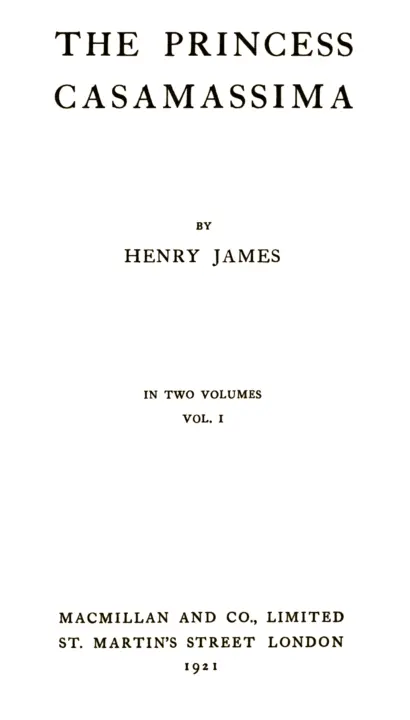
"The Princess Casamassima (Volume 2 of 2)" by Henry James is a novel published in 1886. It follows Hyacinth Robinson, a young London bookbinder who discovers his tragic parentage and becomes entangled in radical politics and a terrorist plot. Torn between his attraction to beauty and culture and his commitment to revolutionary justice, Hyacinth must navigate conflicting loyalties that pull him toward an inevitable reckoning with his dangerous vow.
Introduction adapted from the source catalogue; source summaries may be automatically generated.
Free to read · English · 115,761 words · No account needed
MAKE TIME FOR A GOOD BOOK
On by default. Untick to stop anonymous reading totals. Each page counts after 10 seconds in view. How this works.
Anonymous counting is on unless you have switched it off.
There was a light in the lower region which tempered the gloom of the staircase—as high, that is, as the first floor; the ascent the rest of the way was so dark that the pair went slowly and Schinkel led his companion by the hand. She gave a suppressed exclamation as she rounded a sharp turn in the second flight. “Good God, is that his door—with the light?”
“Yes, you can see under it. There was a light before,” he said without
confusion.
“And why in heaven’s name didn’t you tell me?”
“Because I thought it would worry you.”
“And doesn’t it worry you?”
“A little, but I don’t mind,” Schinkel professed. “Very likely he may
have left it.”
“He doesn’t leave candles!” she returned with vehemence. She hurried up the few remaining steps to the door and paused there with her ear against it. Her hand grasped the handle and turned it, but the door resisted. Then she panted to her companion: “We must go in—we must go in!”
“But what will you do when it’s locked?” he contended.
“You must break it down.”
“It’s very expensive,” said Schinkel.
“Don’t be abject!” cried the Princess. “In a house like this the fastenings are worth nothing; they’ll easily yield.”
“And if he’s not there—if he comes back and finds what we’ve done?”
She looked at him a moment through the darkness, which was mitigated only by the small glow proceeding from the chink. “He is there! Before God he’s there!”
“Schön, schön,” said her friend as if he felt the contagion of her own dread but was deliberating and meant to remain calm. She assured him that one or two vigorous thrusts with his shoulder would burst the bolt—certain to be some wretched morsel of tin—and she made way for him to come close. He did so, he even leaned against the door, but he gave no violent push, and the Princess waited with her hand against her heart. Schinkel apparently was still deliberating. At last he gave a low sigh. “I know they find him the pistol, it’s only for that,” he mumbled; and the next moment she saw him sway sharply to and fro in the gloom. She heard a crack and saw the lock had yielded. The door collapsed: they were in the light; they were in a small room which looked full of things. The light was that of a single candle on the mantel; it was so poor that for a moment she made out nothing definite. Before that moment was over, however, her eyes had attached themselves to the small bed. There was something on it—something black, something ambiguous, something outstretched. Schinkel held her back, but only an instant; she saw everything and with the very vision flung herself, beside the bed, upon her knees. Hyacinth lay there as if asleep, but there was a horrible thing, a mess of blood, on the counterpane, in his side, in his heart. His arm hung limp beside him, downwards, off the narrow couch; his face was white and his eyes were closed. So much Schinkel saw, but only for an instant; a convulsive movement of the Princess, bending over the body while a strange low cry came from her lips, covered it up. He looked about him for the weapon, for the pistol, but in her rush at the bed she had pushed it out of sight with her knees. “It’s a pity they found it—if he hadn’t had it here!” he wailed to her under his breath. He had determined to remain calm, so that, on turning round at the quick advent of the little woman of the house, who had hurried up, white, staring, scared by the sound of the smashed door, he was able to say very quietly and gravely: “Mr. Robinson has shot himself through the heart. He must have done it while you were fetching the milk.” The Princess rose, hearing another person in the room, and then Schinkel caught sight of the small revolver lying just under the bed. He picked it up and carefully placed it on the mantel-shelf—keeping all to himself, with an equal prudence, the reflexion that it would certainly have served much better for the Duke.
Your reading position is saved on this browser. Take it to another device with a library code. Reading pages adapt to text, rather than matching a printed edition.
Henry James
Henry James
Henry James
Henry James
BEHIND THE BOOK
This eBook is for the use of anyone anywhere in the United States and most other parts of the world at no cost and with almost no restrictions whatsoever. You may copy it, give it away or re-use it under the terms of the Project Gutenberg License included with this eBook or online at www.gutenberg.org. If you are not located in the United States, you will have to check the laws of the country where you are located before using this eBook. Read the source licence.
The original source file, including credits and licence, is retained by this library. Request an original-format copy at no charge. Please include the book title and Project Gutenberg identifier #69629.
KEEP YOUR CURIOSITY GOING
Coulson Kernahan

Maurice Baring
Frances Wright
Cécile Tormay

Frederic Jesup Stimson

W. H. P. (William Henry Pope) Jarvis