THE CLASSIC COLLECTION✦Hawthorne (English Men of Letters Series)CLASSIC FREE BOOKS
Hawthorne (English Men of Letters Series)
Henry James

THE CLASSIC COLLECTION · 1886
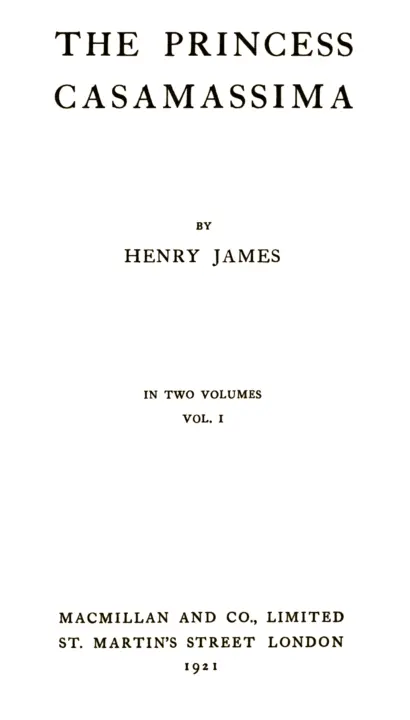
"The Princess Casamassima (Volume 2 of 2)" by Henry James is a novel published in 1886. It follows Hyacinth Robinson, a young London bookbinder who discovers his tragic parentage and becomes entangled in radical politics and a terrorist plot. Torn between his attraction to beauty and culture and his commitment to revolutionary justice, Hyacinth must navigate conflicting loyalties that pull him toward an inevitable reckoning with his dangerous vow.
Introduction adapted from the source catalogue; source summaries may be automatically generated.
Free to read · English · 115,761 words · No account needed
MAKE TIME FOR A GOOD BOOK
On by default. Untick to stop anonymous reading totals. Each page counts after 10 seconds in view. How this works.
Anonymous counting is on unless you have switched it off.
He offered himself after tea the choice between a visit to Lady Aurora and a pilgrimage to Lisson Grove. He was a little in doubt about the former experiment, having an idea her ladyship’s family might be reinstalled in Belgrave Square. He reflected, however, that he couldn’t recognise this as a reason for not going to see her; his relations with her had nothing of the underhand, and she had given him the kindest general invitation. If her haughty parents were at home she was probably at dinner with them: he would take that risk. He had taken it before without disastrous results. He was determined not to spend the evening alone, and he would keep the Poupins as a more substantial alternative in case Lady Aurora shouldn’t be able to receive him.
As soon as the great portal in Belgrave Square was drawn open before him he saw the house was occupied and animated—if animation might be talked about in a place which had hitherto mainly answered to his idea of a magnificent mausoleum. It was pervaded by subdued light and tall domestics; he found himself looking down a kind of colonnade of colossal footmen, an array more imposing even than the retinue of the Princess at Medley. His inquiry died away on his lips and he stood there struggling with dumbness. It was manifest to him that some high festival was taking place, a scene on which his presence could only be a blot; and when a large official, out of livery, bending over him for a voice that didn’t issue, suggested, not unencouragingly, that it might be Lady Aurora he wished to see, he replied with detachment and despair: “Yes, yes, but it can’t be possible!” The butler took no pains to controvert this proposition verbally; he merely turned round with a majestic air of leading the way, and as at the same moment two of the footmen closed the wings of the door behind the visitor Hyacinth judged it his cue to follow. In this manner, after crossing a passage where, in the perfect silence of the servants, he heard the shorter click of his plebeian shoes upon a marble floor, he found himself ushered into a small room, lighted by a veiled lamp, which, when he had been left there alone, without further remark on the part of his conductor, he recognised as the place—only now more amply decorated—of one of his former interviews. Lady Aurora kept him waiting a little, but finally fluttered in with an anxious, incoherent apology. The same transformation had taken place in her own aspect as in that of her parental halls: she had on a light-coloured, crumpled-looking, faintly-rustling dress; her head was adorned with a languid plume that flushed into little pink tips, and in her hand she carried a pair of white gloves. All her repressed eagerness was in her face, and she smiled as if wishing to anticipate any scruples or embarrassments on the part of her visitor; frankly admitting herself disguised and bedizened and the shock the fact might convey. Hyacinth said to her that, no doubt, on inferring the return of her family to town, he ought to have backed out; he knew this must make a difference in her life. But he had been marched in, for all his protest, and now it was clear he had interrupted her at dinner. She answered that no one who asked for her at any hour was ever turned away; she had managed to arrange that and was very happy in her success. She didn’t usually dine—there were so many of them and it took so long. Most of her friends couldn’t come at visiting-hours and it wouldn’t be right she shouldn’t ever receive them. On that occasion she had been dining, but it was all over; she was only sitting there because she was going to a party. Her parents were dining out and she was just in the drawing-room with some of her sisters. When they were alone it wasn’t so long, though it was rather long afterwards, when they went up again. It wasn’t time yet: the carriage wouldn’t come for nearly half an hour. She hadn’t been to an evening thing for months and months, but—didn’t he know?—one sometimes had to do it. Lady Aurora expressed the idea that one ought to be fair all round and that one’s duties were not all of the same species; some of them would come up from time to time that were quite different from the others. Of course it wasn’t just unless one did all, and that was why she was in for something to-night. It was nothing of consequence; only the family meeting the family, as they might do of a Sunday, at one of their houses. It was there that papa and mamma were dining. Since they had given her that room for any hour she wanted—it was really tremendously convenient—she had resolved to do a party now and then, like a respectable young woman, because it pleased them: though why it should create even that thrill to see her at a place was more than she could imagine. She supposed it was because it would perhaps keep some people, a little, from thinking she was mad and not safe to be at large—which was of course a sort of thing that people didn’t like to have thought of their belongings. Lady Aurora explained and expatiated with a kind of yearning superabundance; she talked more continuously than Hyacinth had ever heard her do before, and the young man made out that she was not, so to speak, in equilibrium. He thought it scarcely probable she was excited by the simple prospect of again dipping into the great world she had forsworn, and he soon became aware of his having himself in a manner upset her. His senses were fine enough to hint to him that there were associations and wounds he revived and quickened. She suddenly stopped talking and the two sat there looking at each other in an odd, an occult community of suffering. He made mechanical remarks, explaining insufficiently why he had come, and in the course of a very few moments, quite independently of these observations, it seemed to him there was a deeper, a measurelessly deep, confidence between them. A tacit confession passed and repassed, and each understood the situation of the other. They wouldn’t speak of it—it was very definite they would never do that; for there was something in their common consciousness that was inconsistent with the grossness of accusation. Besides, the grievance of each was an apprehension, an instinct of the soul—not a sharp, definite wrong supported by proof. It was in the air and in their restless pulses, and not in anything they could exhibit or complain of for comfort. Strange enough it seemed to him that the history of each should be the counterpart of that of the other. What had each done but lose that which he or she had never so much as had? Things had gone ill with them; but even if they had gone well, even if the Princess had not combined with his friend in that manner which made his heart sink and produced an effect exactly corresponding on Lady Aurora’s—even in this case what would felicity, what would success, have amounted to? They would have been very barren. He was sure the singular creature before him would never have had a chance to take the unprecedented social step for the sake of which she was ready to go forth from Belgrave Square for ever; Hyacinth had judged the smallness of Paul Muniment’s appetite for that complication sufficiently to have begun really to pity her ladyship long ago. And now, even when he most felt the sweetness of her sympathy, he might wonder what she could have imagined for him in the event of his not having been supplanted—what security, what completer promotion, what honourable, satisfying sequel. They were unhappy because they were unhappy, and they were right not to rail about that.
Your reading position is saved on this browser. Take it to another device with a library code. Reading pages adapt to text, rather than matching a printed edition.
Henry James
Henry James
Henry James
Henry James
BEHIND THE BOOK
This eBook is for the use of anyone anywhere in the United States and most other parts of the world at no cost and with almost no restrictions whatsoever. You may copy it, give it away or re-use it under the terms of the Project Gutenberg License included with this eBook or online at www.gutenberg.org. If you are not located in the United States, you will have to check the laws of the country where you are located before using this eBook. Read the source licence.
The original source file, including credits and licence, is retained by this library. Request an original-format copy at no charge. Please include the book title and Project Gutenberg identifier #69629.
KEEP YOUR CURIOSITY GOING
Coulson Kernahan

Maurice Baring
Frances Wright
Cécile Tormay

Frederic Jesup Stimson

W. H. P. (William Henry Pope) Jarvis