THE CLASSIC COLLECTION✦Hawthorne (English Men of Letters Series)CLASSIC FREE BOOKS
Hawthorne (English Men of Letters Series)
Henry James

THE CLASSIC COLLECTION · 1886
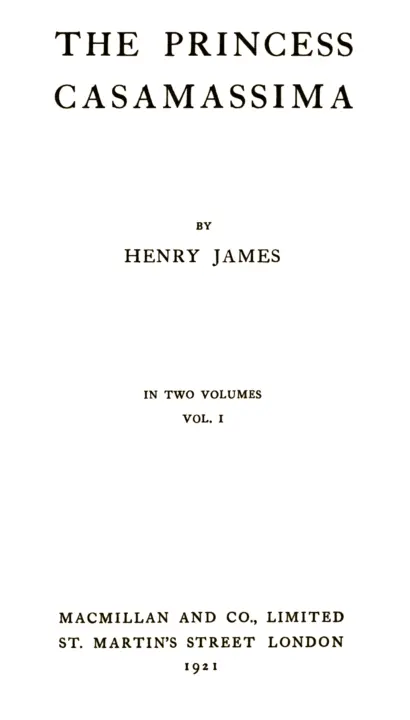
"The Princess Casamassima (Volume 2 of 2)" by Henry James is a novel published in 1886. It follows Hyacinth Robinson, a young London bookbinder who discovers his tragic parentage and becomes entangled in radical politics and a terrorist plot. Torn between his attraction to beauty and culture and his commitment to revolutionary justice, Hyacinth must navigate conflicting loyalties that pull him toward an inevitable reckoning with his dangerous vow.
Introduction adapted from the source catalogue; source summaries may be automatically generated.
Free to read · English · 115,761 words · No account needed
MAKE TIME FOR A GOOD BOOK
On by default. Untick to stop anonymous reading totals. Each page counts after 10 seconds in view. How this works.
Anonymous counting is on unless you have switched it off.
“You make me glad then that I haven’t a family,” said the young man.
“And the Princess—has she no one?”
“Ah yes, she has a husband. But she doesn’t live with him.”
“Is he one of the bad persons?” asked Lady Aurora as earnestly as a child listening to a tale.
“Well, I don’t like to abuse him—he’s down.”
“If I were a man I should be in love with her,” said Lady Aurora. Then she added: “I wonder if we might work together.”
“That’s exactly what she hopes.”
“I won’t show her the worst places,” her ladyship maliciously protested.
To which her visitor returned: “I expect you’ll do what every one else has done—which is exactly what she wants!” Before he took leave he said to her: “Do you know if Paul Muniment also liked the Princess?”
She meditated a moment, apparently with some intensity. “I think she struck him as extraordinarily beautiful—as the most beautiful person he had ever seen.”
“Does he still believe her a humbug?”
“Still?” asked Lady Aurora as if she didn’t understand.
“I mean that that was the impression apparently made upon him last winter by my description of her.”
“Oh I’m sure he thinks her tremendously plucky!” Which was all the satisfaction Hyacinth got just then as to Muniment’s estimate of the Princess.
A few days later he returned to Madeira Crescent in the evening, the only time he was free, the Princess having given him a general invitation to take tea with her. He felt he ought to be discreet in acting on it, though he was not without reasons that would have warranted him in going early and often. He had a peculiar dread of her growing used to him and tired of him—boring herself in his society; yet at the same time he had rather a sharp vision of her boring herself without him during the dull summer evenings when even Paddington was out of town. He wondered what she did, what visitors dropped in, what pastimes she cultivated, what saved her from the sudden vagary of throwing up the whole of her present game. He remembered that there was a complete side of her life with which he was almost unacquainted—Lady Marchant and her daughters, at Medley, and three or four other persons who had called while he was there being, in his experience, the only illustrations of it—and didn’t know, by the same token, to what extent she had in spite of her transformation preserved relations with her old friends; but he made out as looming the day she would discover that what she found in Madeira Crescent was less striking than what she missed. Going thither a second time he noted, for all this, that he had done her great injustice: she was full of resources, she had never been so happy, she found time to read, to write, to commune with her piano and above all to think—a delightful detachment from the invasive, vulgar, gossiping, distracting world she had known hitherto. The only interruption to her felicity was that she received quantities of notes from her former acquaintance, endless appeals to give some account of herself, to say what had become of her, to come and stay with them in the country. With these survivals of her past she took a very short way, she simply burned them without answering. She told Hyacinth immediately that Lady Aurora had called two days before, at an hour when she was not in, and that she had straightway addressed her in return an invitation to come to tea any evening at eight o’clock. That was the way the people in Madeira Crescent entertained each other—the Princess knew everything about them now and was eager to impart her knowledge; and the evening, she was sure, would be much more convenient to Lady Aurora, whose days were filled with good works, with peregrinations of charity. Her ladyship arrived ten minutes after Hyacinth; she assured the Princess her invitation had been expressed in a manner so flattering that she was unwilling to wait more than a day to respond. She was introduced to Madame Grandoni and tea all bustlingly served; Hyacinth being gratefully conscious the while of the “considerate” way in which Lady Aurora forbore to appear bewildered at meeting him in such society. She knew he frequented it, having been witness of his encounter with their high personage in Audley Court; but it might have startled her to have ocular evidence of the footing on which he stood. Everything the Princess did or said at this time had for effect, whatever its purpose, to make her seem more rare and fine; and she had seldom given him greater pleasure than by the exquisite art she put forth to win Lady Aurora’s confidence, to place herself under the pure and elevating influence of the noble spinster. She made herself small and simple; she spoke of her own little aspirations and efforts; she appealed and persuaded; she laid her white hand on her gentle guest’s, gazing at her with an interest all visibly sincere but which yet derived half its effect from the contrast between the quality of her beauty, the whole air of her person, and the hard, dreary problems of misery and crime. It was touching and Lady Aurora was touched; that was quite clear as they sat together on the sofa after tea and the Princess protested that she only wanted to know what her new friend was doing—what she had done for years—in order that she might go and do likewise. She asked personal questions with a directness that was sometimes embarrassing to the subject—he had seen that habit in her from the first—and her yearning guest, though charmed and excited, was not quite comfortable at being so publicly probed and sounded. The public was formed of Madame Grandoni and Hyacinth; but the old lady—whose intercourse with the visitor had consisted almost wholly of watching her with a deep, speculative anxiety—presently shuffled away and was heard, through the thin partitions that prevailed in Madeira Crescent, to ascend to her own apartment. It seemed to Hyacinth that he ought also in delicacy to retire, and this was his intention from one moment to the other; to him certainly—and the very second time she met him—Lady Aurora had made as much of her confession as he had a right to look for. After that one little flash of egotism he had never again heard her refer to her own feelings or conditions.
Your reading position is saved on this browser. Take it to another device with a library code. Reading pages adapt to text, rather than matching a printed edition.
Henry James
Henry James
Henry James
Henry James
BEHIND THE BOOK
This eBook is for the use of anyone anywhere in the United States and most other parts of the world at no cost and with almost no restrictions whatsoever. You may copy it, give it away or re-use it under the terms of the Project Gutenberg License included with this eBook or online at www.gutenberg.org. If you are not located in the United States, you will have to check the laws of the country where you are located before using this eBook. Read the source licence.
The original source file, including credits and licence, is retained by this library. Request an original-format copy at no charge. Please include the book title and Project Gutenberg identifier #69629.
KEEP YOUR CURIOSITY GOING
Coulson Kernahan

Maurice Baring
Frances Wright
Cécile Tormay

Frederic Jesup Stimson

W. H. P. (William Henry Pope) Jarvis