THE CLASSIC COLLECTION✦Hawthorne (English Men of Letters Series)CLASSIC FREE BOOKS
Hawthorne (English Men of Letters Series)
Henry James
THE CLASSIC COLLECTION · 1886
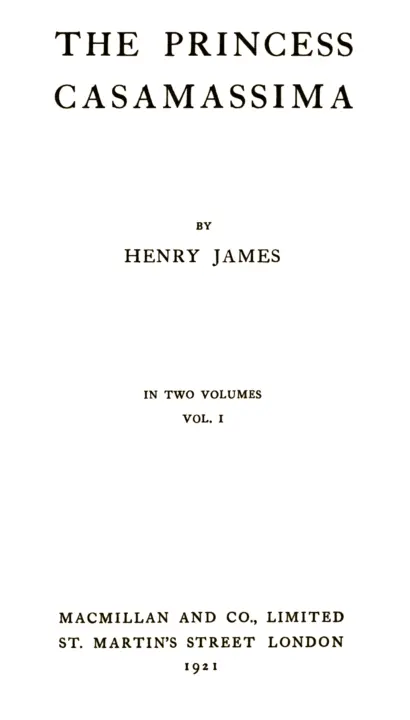
"The Princess Casamassima (Volume 1 of 2)" by Henry James is a novel published in 1886. It follows Hyacinth Robinson, a London bookbinder who becomes entangled in radical politics and a terrorist assassination plot. Torn between the beauty of aristocratic culture and the suffering of the poor, Hyacinth must navigate revolutionary circles while grappling with his own divided loyalties and a dangerous commitment he cannot escape.
Introduction adapted from the source catalogue; source summaries may be automatically generated.
Free to read · English · 105,802 words · No account needed
MAKE TIME FOR A GOOD BOOK
On by default. Untick to stop anonymous reading totals. Each page counts after 10 seconds in view. How this works.
Anonymous counting is on unless you have switched it off.
He laid his violin-case on the table, which was covered with a confusion of fashion-plates and pin-cushions, and glanced toward the fire where a kettle was gently hissing. Miss Pynsent, who had put it on half an hour before, read his glance and reflected with complacency that Mrs. Bowerbank had not absolutely drained the little bottle in the cheffoneer. She placed it on the table again, this time with a single glass, and told her visitor that, as a great exception, he might light his pipe. In fact she always made the exception, and he always replied to the gracious speech by inquiring whether she supposed the greengrocers’ wives, the butchers’ daughters, for whom she worked had fine enough noses to smell in the garments she sent home the fumes of his tobacco. He knew her “connexion” was confined to small shopkeepers, but she didn’t wish others to know it and would have liked them to believe it important the poor little stuffs she made up (into very queer fashions I am afraid) should not surprise the feminine nostril. But it had always been impossible to impose on Mr. Vetch; he guessed the truth, the treacherous untrimmed truth, about everything in a moment. She was sure he would do so now in regard to this solemn question that had come up for Hyacinth; he would see that, though agreeably flurried at finding herself whirled in the last eddies of a case that had been so celebrated in its day, her secret wish was to shirk her duty—if it was a duty; to keep the child from ever knowing his mother’s unmentionable history, the shame that attached to his origin, the opportunity she had had of letting him see the wretched woman before it was too late. She knew Mr. Vetch would read her troubled thoughts, but she hoped he would say they were natural and just: she reflected that as he took an interest in Hyacinth he wouldn’t desire him to be subjected to a mortification that might rankle for ever and perhaps even crush him to the earth. She related Mrs. Bowerbank’s visit while he sat on the sofa in the very place where that majestic woman had reposed and puffed his smoke-wreaths into the dusky little room. He knew the story of the child’s birth, had known it years before, so that she had no startling revelation to make. He was not in the least agitated to hear of Florentine’s approaching end in prison and of her having managed to get a message conveyed to Amanda; he thought this so much in the usual course that he said to Miss Pynsent: “Did you expect her to live on there for ever, working out her terrible sentence, just to spare you the annoyance of a dilemma, to save you a reminder of her miserable existence, which you have preferred to forget?” That was just the sort of question Mr. Vetch was sure to ask, and he inquired further of his dismayed hostess if she were sure her friend’s message (he called the unhappy creature her friend) had come to her in the regular way. The warders surely had no authority to introduce visitors to their captives, and was it a question of her going off to the prison on the sole authority of Mrs. Bowerbank? The little dressmaker explained that this lady had merely come to sound her: Florentine had begged so hard. She had been in Mrs. Bowerbank’s ward before her removal to the infirmary, where she now lay ebbing away, and she had communicated her desire to the Catholic chaplain, who had undertaken that some satisfaction—of inquiry, at least—should be given her. He had thought it best to ascertain first whether the person in charge of the child would be willing to bring him, such a course being perfectly optional, and he had had some talk with Mrs. Bowerbank on the subject, in which it was agreed between them that if she would approach Miss Pynsent and explain to her the situation, leaving her to do what she thought best, he would answer for it that the consent of the governor of the prison should be given to the interview. Miss Pynsent had lived for fourteen years in Lomax Place, and Florentine had never forgotten that this was her address at the time she came to her at Newgate (before her dreadful sentence had been commuted) and promised, in an outgush of pity for one whom she had known in the days of her honesty and brightness, that she would save the child, rescue it from the workhouse and the streets, keep it from the fate that had swallowed up the mother. Mrs. Bowerbank had had a half-holiday, and she also rejoiced in a sister living in the north of London, to whom she had been for some time intending a visit; so that after her domestic duty had been performed it had been possible for her to drop in on Miss Pynsent in an informal, natural way and put the case before her. It would be just as she might be disposed to view it. She was to think it over a day or two, but not long, because the woman was so ill, and then write to Mrs. Bowerbank at the prison. If she should consent Mrs. Bowerbank would tell the chaplain, and the chaplain would obtain the order from the governor and send it to Lomax Place; after which Amanda would immediately set out with her unconscious victim. But should she—must she—consent? That was the terrible, the heart-shaking question, with which Miss Pynsent’s unaided wisdom had been unable to grapple.
Your reading position is saved on this browser. Take it to another device with a library code. Reading pages adapt to text, rather than matching a printed edition.
Henry James
Henry James
Henry James

Henry James
BEHIND THE BOOK
This eBook is for the use of anyone anywhere in the United States and most other parts of the world at no cost and with almost no restrictions whatsoever. You may copy it, give it away or re-use it under the terms of the Project Gutenberg License included with this eBook or online at www.gutenberg.org. If you are not located in the United States, you will have to check the laws of the country where you are located before using this eBook. Read the source licence.
The original source file, including credits and licence, is retained by this library. Request an original-format copy at no charge. Please include the book title and Project Gutenberg identifier #69628.
KEEP YOUR CURIOSITY GOING
Coulson Kernahan

Maurice Baring
Frances Wright
Cécile Tormay

Frederic Jesup Stimson

W. H. P. (William Henry Pope) Jarvis