THE CLASSIC COLLECTION✦Hawthorne (English Men of Letters Series)CLASSIC FREE BOOKS
Hawthorne (English Men of Letters Series)
Henry James
THE CLASSIC COLLECTION · 1886
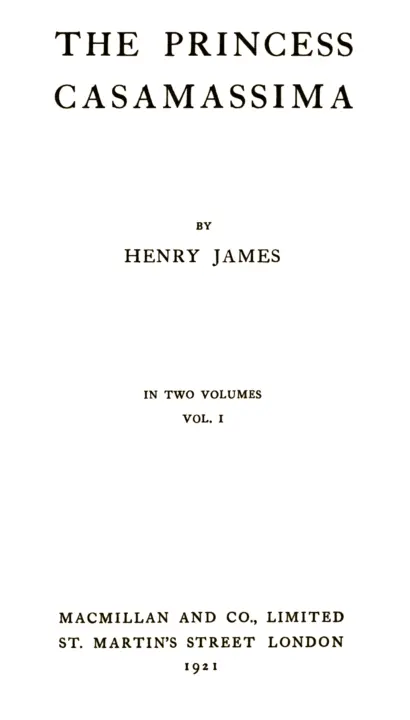
"The Princess Casamassima (Volume 1 of 2)" by Henry James is a novel published in 1886. It follows Hyacinth Robinson, a London bookbinder who becomes entangled in radical politics and a terrorist assassination plot. Torn between the beauty of aristocratic culture and the suffering of the poor, Hyacinth must navigate revolutionary circles while grappling with his own divided loyalties and a dangerous commitment he cannot escape.
Introduction adapted from the source catalogue; source summaries may be automatically generated.
Free to read · English · 105,802 words · No account needed
MAKE TIME FOR A GOOD BOOK
On by default. Untick to stop anonymous reading totals. Each page counts after 10 seconds in view. How this works.
Anonymous counting is on unless you have switched it off.
These remarks were received with a differing demonstration: some of the company declaring that if the Dutchman cared to come round and smoke a pipe they’d be glad to see him—perhaps he’d show where the thumbscrews had been put on; others being strongly of the opinion that they didn’t want any more advice—they had already had advice enough to turn a donkey’s stomach. What they wanted was to put forth their might without any more palaver; to do for something or for some one; to go out somewhere and smash something on the spot—why not?—smash it that very night. While they sat still and talked there were about half a million of people in London that didn’t know where the hell the morrow’s meal was to come from; what they wanted to do, unless they were just a collection of pettifogging old women, was to show them where to get it, to take it to them with heaped-up hands. Hyacinth listened, with a divided attention, to interlaced iterations, while the talk blew hot and cold; there was a genuine emotion, a quick pulse of high fever, to-night in the rear of the “Sun and Moon,” and he felt the contagion of excited purpose. But he was following a train of his own; he was wondering what Muniment had in reserve (for certainly Paul but played with the company), and his imagination, quickened by the sense of impending relations with the heroic Hoffendahl and the discussion as to the alternative duty of escaping or of facing one’s fate, had launched itself into possible perils—into the idea of how he might in a given case settle for himself that question of paying for the lot. The loud, contradictory, vain, unpractical babble went on about him, but he was definitely conscious only that the project of breaking into the bakers’ shops was well before the assembly and was receiving a vigorous treatment, and that there was likewise a good deal of reference to the butchers and grocers and even to the fishmongers. He was in a state of inward exaltation, possessed by an intense desire to stand face to face with the sublime Hoffendahl, to hear his voice and touch his mutilated hand. He was ready for anything: he knew he was himself safe to breakfast and dine, if poorly still sufficiently, and that his colleagues were perhaps even more crude and clumsy than usual; but a breath of popular passion had warmed his cheek and his heart, and he seemed to see, immensely magnified, the monstrosity of the great ulcers and sores of London—the sick, eternal misery crying out of the darkness in vain, confronted with granaries and treasure-houses and places of delight where shameless satiety kept guard. In such a mood as this he felt there was no need to consider, to reason: the facts themselves were as imperative as the cry of the drowning, since while pedantry gained time didn’t starvation and anguish gain it too? He knew Muniment disapproved of delay, that he held the day had come for a forcible rectification of horrible inequalities. In the last conversation they had had together his judicious friend had given him a more definite warrant than ever before for numbering him in the party of immediate action, though indeed he remarked on this occasion, once more, that that particular formula the little bookbinder appeared to have taken such a fancy to was mere gibberish. He hated this sort of pretentious label; it was fit only for politicians and amateurs. None the less he had been as plain as possible on the point that their game must be now to frighten society, and frighten it effectually; to make it believe that the swindled classes were at last fairly in league—had really grasped the idea that, closely combined, they would be irresistible. They were not in league and they hadn’t in their totality grasped any idea at all—Muniment was not slow to make that equally plain. All the same society was scareable, and every great scare was a gain for the people. If Hyacinth had needed warrant to-night for a faith transcending logic he would have found it in his recall of this quiet profession; but his friend’s words came back to him mainly to make him wonder what that friend had in his head just now. He took no part in any vociferation; he had called Schinkel to come round and sit beside him, and the two appeared to confer together in honest ease while the brown atmosphere grew denser, the passing to and fro of firebrands more lively and the flush of faces more portentous. What Hyacinth would have liked to know most of all was why Muniment had not mentioned to him first that Hoffendahl was in London and that he had seen him; for he had seen him, though he had dodged Schinkel’s question—of that Hyacinth instantly felt sure. He would ask for more information later; and meanwhile he wished, without resentment, but with a patient conscious ache, that Muniment would treat him with a little more confidence. If there were a secret in regard to Hoffendahl—and there evidently was: Muniment, quite rightly, though he had dropped the announcement of his arrival for a certain effect, had no notion of sharing the rest of what he knew with that raw roomful—if there were something to be silent and devoted about Hyacinth ardently hoped that to him in particular would a chance be given to show how he could practise this superiority. He felt hot and nervous; he got up suddenly and, through the dark tortuous greasy passage communicating with the outer world, went forth into the street. The air was foul and sleety but refreshed him, and he stood in front of the public-house and smoked another pipe. Bedraggled figures passed in and out and a damp tattered wretched man with a spongy purple face, who had been thrust suddenly across the threshold, stood and whimpered in the brutal blaze of the row of lamps. The puddles glittered roundabout and the silent vista of the street, bordered with low black houses, stretched away in the wintry drizzle to right and left, losing itself in the huge tragic city where unmeasured misery lurked beneath the dirty night, ominously, monstrously still, only howling, for its pain, in the heated human cockpit behind him. Ah what could he do? What opportunity would rise? The blundering divided counsels he had been listening to but made the helplessness of every one concerned more abject. If he had a definite wish while he stood there it was that that exalted deluded company should pour itself forth with Muniment at its head and surge through the sleeping world and gather the myriad miserable out of their slums and burrows, should roll into the selfish squares and lift a tremendous hungry voice and awaken the gorged indifferent to a terror that would bring them down. He lingered a quarter of an hour, but this grand treat gave no sign of coming off, and he finally returned to the noisy club-room in a state of tormented wonder as to what better idea than this very bad one (which seemed to our young man to have at the least the merit that it was an idea) Muniment could be revolving in that too-comprehensive brain of his.
Your reading position is saved on this browser. Take it to another device with a library code. Reading pages adapt to text, rather than matching a printed edition.
Henry James
Henry James
Henry James

Henry James
BEHIND THE BOOK
This eBook is for the use of anyone anywhere in the United States and most other parts of the world at no cost and with almost no restrictions whatsoever. You may copy it, give it away or re-use it under the terms of the Project Gutenberg License included with this eBook or online at www.gutenberg.org. If you are not located in the United States, you will have to check the laws of the country where you are located before using this eBook. Read the source licence.
The original source file, including credits and licence, is retained by this library. Request an original-format copy at no charge. Please include the book title and Project Gutenberg identifier #69628.
KEEP YOUR CURIOSITY GOING
Coulson Kernahan

Maurice Baring
Frances Wright
Cécile Tormay

Frederic Jesup Stimson

W. H. P. (William Henry Pope) Jarvis