THE CLASSIC COLLECTION✦Hawthorne (English Men of Letters Series)CLASSIC FREE BOOKS
Hawthorne (English Men of Letters Series)
Henry James
THE CLASSIC COLLECTION · 1886
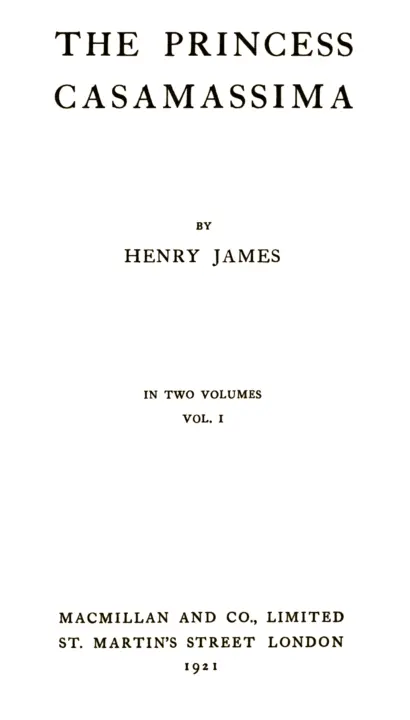
"The Princess Casamassima (Volume 1 of 2)" by Henry James is a novel published in 1886. It follows Hyacinth Robinson, a London bookbinder who becomes entangled in radical politics and a terrorist assassination plot. Torn between the beauty of aristocratic culture and the suffering of the poor, Hyacinth must navigate revolutionary circles while grappling with his own divided loyalties and a dangerous commitment he cannot escape.
Introduction adapted from the source catalogue; source summaries may be automatically generated.
Free to read · English · 105,802 words · No account needed
MAKE TIME FOR A GOOD BOOK
On by default. Untick to stop anonymous reading totals. Each page counts after 10 seconds in view. How this works.
Anonymous counting is on unless you have switched it off.
After paying him that visit at his rooms Hyacinth lost sight of Captain Sholto, who had not again reappeared at the “Sun and Moon,” the little tavern which presented so common and casual a face to the world, but offered in its unsuspected rear a security still unimpugned to machinations going down to the very bottom of things. Nothing was more natural than that the Captain should be engaged at this season in the recreations of his class; and our young man took for granted that if he were not hanging about the Princess on that queer footing as to which one had a secret hope one should some day command more light, he was probably buffeting breezy northern seas on a yacht or creeping after stags in the Highlands; our hero’s acquaintance with the light literature of his country being such as to assure him that in one or other of these occupations people of leisure, during the autumn, were necessarily immersed. If the Captain were giving his attention to neither he must have started for Albania, or at least for Paris. Happy Captain, Hyacinth mused, while his imagination followed him through vivid exotic episodes and his restless young feet continued to tread, through the stale flat weeks of September and October, the familiar pavements of Soho, Islington and Pentonville, and the shabby sinuous ways that unite these regions of labour. He had told the Princess he sometimes had a holiday at this period and that there was a chance of his escorting his respectable companion to the seaside; but as it turned out at present the spare cash for such an excursion was wanting. Hyacinth had indeed for the moment an exceptionally keen sense of the lack of this convenience and was forcibly reminded that the society of agreeable women was a direct and constant appeal to the pocket. He not only hadn’t a penny, but was much in debt, owed pence and shillings, as he would have largely put it, all over the place, and the explanation of his pinched feeling was in a vague half-remorseful, half-resigned reference to the numerous occasions when he had had not to fail of funds under penalty of disappointing a young lady whose needs were positive, and especially to a certain high crisis (as it might prove to be) in his destiny when it had come over him that one couldn’t call on a princess just as one was. So this year he didn’t ask old Crook for the week which some of the other men took—Eustache Poupin, who had never quitted London since his arrival, launched himself precisely that summer, supported by his brave wife, into the British unknown on the strength of a return ticket to Worthing—simply because he shouldn’t know what to do with it. The best way not to spend money, though no doubt not the best in the world to make it, was still to take one’s daily course to the old familiar shabby shop, where, as the days shortened and November thickened the air to a livid yellow, the uncovered flame of the gas, burning often from the morning on, lighted up the ugliness in which the hand of practice endeavoured to disengage a little beauty—the ugliness of a dingy belittered interior, of battered dispapered walls, of work-tables stained and hacked, of windows opening into a foul drizzling street, of the bared arms, the sordid waistcoat-backs, the smeared aprons, the personal odour, the patient obstinate irritating shoulders and vulgar narrow inevitable faces of his fellow-labourers. Our young friend’s relations with his comrades would form a chapter by itself, but all that may be said of the matter here is that the clever little operator from Lomax Place had in a manner a double identity and that much as he lived in Mr. Crookenden’s establishment he lived out of it still more. In this busy, pasty, sticky, leathery little world, where wages and beer were the main objects of consideration, he played his part in a way that marked him as a queer lot, but capable of queerness in the line of equanimity too. He hadn’t made good his place there without discovering that the British workman, when animated by the spirit of mirth, has rather a heavy hand, and he tasted of the practical joke in every degree of violence. During his first year he dreamed, with secret passion and suppressed tears, of a day of bliss when at last they would let him alone—a day which arrived in time, for it is always an advantage to be clever if one be only clever enough. Hyacinth was sufficiently so to have invented a modus vivendi in respect to which M. Poupin said to him, “Enfin vous voilà ferme!” (the Frenchman himself, terribly éprouvé at the beginning, had always bristled with firmness and opposed to insular grossness a refined dignity) and under the influence of which the scenery of Soho figured a daily dusky exhibition of projected shadows, confined to the passive part of life and giving no hostages to reality, or at least to ambition, save an insufficient number of shillings on Saturday night and stray spasmodic reminiscences of delicate work that might have been more delicate still, as well as of such applications of the tool as he flattered himself unsurpassed unless by the supreme Eustache.
Your reading position is saved on this browser. Take it to another device with a library code. Reading pages adapt to text, rather than matching a printed edition.
Henry James
Henry James
Henry James

Henry James
BEHIND THE BOOK
This eBook is for the use of anyone anywhere in the United States and most other parts of the world at no cost and with almost no restrictions whatsoever. You may copy it, give it away or re-use it under the terms of the Project Gutenberg License included with this eBook or online at www.gutenberg.org. If you are not located in the United States, you will have to check the laws of the country where you are located before using this eBook. Read the source licence.
The original source file, including credits and licence, is retained by this library. Request an original-format copy at no charge. Please include the book title and Project Gutenberg identifier #69628.
KEEP YOUR CURIOSITY GOING
Coulson Kernahan

Maurice Baring
Frances Wright
Cécile Tormay

Frederic Jesup Stimson

W. H. P. (William Henry Pope) Jarvis