
Last letters from the living dead man
David Patterson (Spirit) Hatch
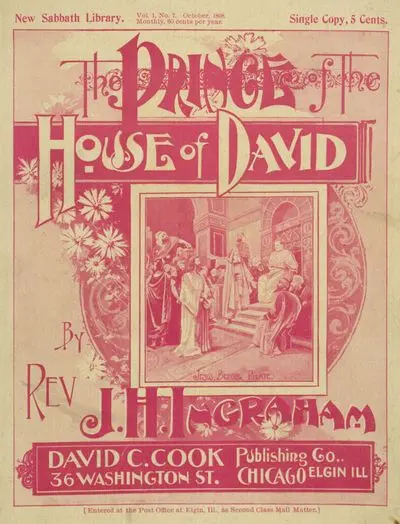
THE CLASSIC COLLECTION · 1898
"The Prince of the House of David" by J. H. Ingraham is a historical novel written in the late 19th century. The narrative unfolds in ancient Jerusalem during a pivotal era, focusing on the Jewish people and their anticipation of the Messiah. The central character is Adina, a Jewish girl from Alexandria, who travels to Jerusalem and chronicles her experiences through letters to her father, revealing her reflections on faith, prophecy, and the socio-political landscape of her time. At the start of the novel, Adina arrives in Jerusalem, filled with reverence and awe for the Holy City and the Temple. She describes her journey and the sights along the way, detailing her emotional response upon entering the city. Adina writes about observing the sacrifices in the Temple, the corrupt priesthood, and the prophetic figure John the Baptist, who captures the attention of the people with his call for repentance. As she learns about John's prophecies regarding the approaching Messiah, her letters convey her growing curiosity and hope for a divine savior, all set against the backdrop of Roman rule and cultural tension in Jerusalem. This opening establishes the spiritual and historical context crucial to understanding Adina's evolving beliefs and the larger narrative of the coming of Christ.
Introduction adapted from the source catalogue; source summaries may be automatically generated.
Free to read · English · 78,854 words · No account needed
MAKE TIME FOR A GOOD BOOK
On by default. Untick to stop anonymous reading totals. Each page counts after 10 seconds in view. How this works.
Anonymous counting is on unless you have switched it off.
"'It is Jesus of Nazareth, the son of Joseph,' Philip answered.
"Upon hearing this answer, the countenance of Nathaniel fell, and he
replied:
"'Can there any good thing come out of Nazareth?'
"'Come thou and see for thyself,' answered Philip.
"Nathaniel then went with him where Jesus was. When Jesus saw him approaching, he said to those about him:
"'Behold an Israelite indeed, in whom there is no guile!'
"'Whence knowest thou me?' asked Nathaniel, with surprise, for he had heard the words which were spoken. Jesus answered and said:
"'Before Philip called thee, when thou wast under the fig tree, I saw
thee.'
"Upon hearing this Nathaniel, who knew that he was all alone in his garden and unseen at prayer when his brother came, regarded the serene face of Jesus steadfastly, and then, as if he beheld therein the expression of omnipresence, he cried before all the people:
"'Rabbi, thou art the Son of God! Thou art the King of Israel!'
"Jesus looked upon him as if pleased at his confession, and said:
"'Because I said unto thee, I saw thee under the fig tree, believest thou? Thou shalt see greater things than these. Verily, verily, I say unto you, hereafter ye shall see heaven open, and the angels of God ascending and descending upon the Son of man.'
"The next day James, my brother, and I went to the sea of Tiberias, but two hours distant, to see our father Zebedee, and transfer our interests to him; and, during the afternoon, Jesus passed near the shore on his way to Cana, when, calling us, we forever left our ships and our father and joined him. His mother and many of her kinsfolk were of the company, all going to a marriage of the cousin of the family. Upon our arrival at Cana, we were ushered into the guest chamber.
"The marriage feast at length commenced. The wine which should have come from Damascus had not arrived, the caravan having been delayed by the insurrection near Cesarea, and the chief ruler of the town, presiding at the feast, seeing that the wine had given out, bade the servants to place more upon the board. The mother of Jesus, who knew that the wine was out, and that, looking upon this as an ill omen, the family of the bride were in great distress, turned to Jesus and said, 'They have no wine.'
"The holy Prophet of God looked grave and said, applying to her the title which we deem most honorable of all others, 'Woman, what have I to do with thee? Mine hour is not yet come.'
Your reading position is saved on this browser. Take it to another device with a library code. Reading pages adapt to text, rather than matching a printed edition.
BEHIND THE BOOK
This eBook is for the use of anyone anywhere in the United States and most other parts of the world at no cost and with almost no restrictions whatsoever. You may copy it, give it away or re-use it under the terms of the Project Gutenberg License included with this eBook or online at www.gutenberg.org. If you are not located in the United States, you will have to check the laws of the country where you are located before using this eBook. Read the source licence.
The original source file, including credits and licence, is retained by this library. Request an original-format copy at no charge. Please include the book title and Project Gutenberg identifier #53795.
KEEP YOUR CURIOSITY GOING
David Patterson (Spirit) Hatch

David Patterson (Spirit) Hatch

David Patterson (Spirit) Hatch
Cécile Tormay

Moritz Busch
Coulson Kernahan