
Last letters from the living dead man
David Patterson (Spirit) Hatch
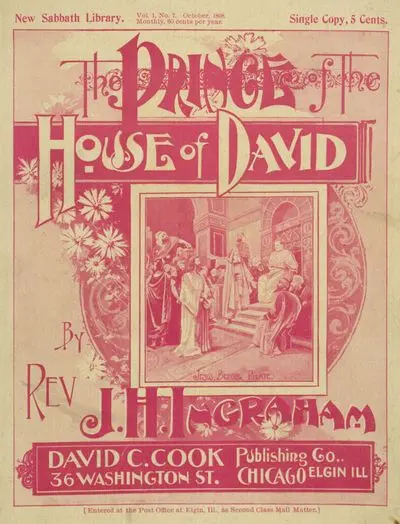
THE CLASSIC COLLECTION · 1898
"The Prince of the House of David" by J. H. Ingraham is a historical novel written in the late 19th century. The narrative unfolds in ancient Jerusalem during a pivotal era, focusing on the Jewish people and their anticipation of the Messiah. The central character is Adina, a Jewish girl from Alexandria, who travels to Jerusalem and chronicles her experiences through letters to her father, revealing her reflections on faith, prophecy, and the socio-political landscape of her time. At the start of the novel, Adina arrives in Jerusalem, filled with reverence and awe for the Holy City and the Temple. She describes her journey and the sights along the way, detailing her emotional response upon entering the city. Adina writes about observing the sacrifices in the Temple, the corrupt priesthood, and the prophetic figure John the Baptist, who captures the attention of the people with his call for repentance. As she learns about John's prophecies regarding the approaching Messiah, her letters convey her growing curiosity and hope for a divine savior, all set against the backdrop of Roman rule and cultural tension in Jerusalem. This opening establishes the spiritual and historical context crucial to understanding Adina's evolving beliefs and the larger narrative of the coming of Christ.
Introduction adapted from the source catalogue; source summaries may be automatically generated.
Free to read · English · 78,854 words · No account needed
MAKE TIME FOR A GOOD BOOK
On by default. Untick to stop anonymous reading totals. Each page counts after 10 seconds in view. How this works.
Anonymous counting is on unless you have switched it off.
Mary rose quickly and went out. Certain of her Jewish friends from Jerusalem at that moment met her at the door, and began to comfort her, and to ask her if they also should go with her to weep at the grave of Lazarus, for they said one to another:
"She goes unto the grave to weep there!"
"She goes to see Jesus, the friend of Lazarus, for he calleth her," answered Martha, smiling with eagerness, and speaking with an animation that presented a singular contrast to her late deep grief.
Mary hastened to where Jesus sat by the fountain bathing his dusty and
wounded feet.
"Lord," she said, in her sister's words, and with deep emotion, "if thou, Lord, hadst been here, my brother had not died!"
Then bowing her head to the edge of the marble basin, she wept very heavily. The Jews, men and women, who stood about, being touched with her sorrow, also wept, while glittering tears coursed their way down the face of the beloved John, his disciple, who stood near.
Jesus sighed deeply and groaned in spirit as he beheld her grief and their mourning with her. His sacred countenance was marred with the anguish of his soul.
"Rise, let us go to the grave where he lieth," he said to them. "Where
have ye laid him?"
"Come, dear Lord, and see," answered Mary, holding him reverently by the sleeve of the robe, and gently yet eagerly drawing him towards the place of the tombs in the vale of Olivet.
In the meanwhile, at home, Martha had been diligently, and with strange cheerfulness, getting in readiness the room of Lazarus. She swept and dusted it, and garnished it with fresh flowers, which she gathered in the little garden.
"This is the rose he set out and loved. This is the violet which blooms immortal. I will place it upon his pillow," she said, with a joyous hilarity softened by the most lovely look of peace, while hope shone in her eyes like twin morning stars ushering in a glorious day. She spoke scarcely above her breath and moved on tiptoe.
"For whom is this preparation, dearest Martha? For Jesus?" I asked.
"Oh, no. The holy Prophet's own room is ready. Mary has prepared that. This is Lazarus' room, and I am decorating it for him."
"Dost thou truly believe that he is coming back from the dead?" I asked, between doubt and strange fear.
Your reading position is saved on this browser. Take it to another device with a library code. Reading pages adapt to text, rather than matching a printed edition.
BEHIND THE BOOK
This eBook is for the use of anyone anywhere in the United States and most other parts of the world at no cost and with almost no restrictions whatsoever. You may copy it, give it away or re-use it under the terms of the Project Gutenberg License included with this eBook or online at www.gutenberg.org. If you are not located in the United States, you will have to check the laws of the country where you are located before using this eBook. Read the source licence.
The original source file, including credits and licence, is retained by this library. Request an original-format copy at no charge. Please include the book title and Project Gutenberg identifier #53795.
KEEP YOUR CURIOSITY GOING
David Patterson (Spirit) Hatch

David Patterson (Spirit) Hatch

David Patterson (Spirit) Hatch
Cécile Tormay

Moritz Busch
Coulson Kernahan