
Last letters from the living dead man
David Patterson (Spirit) Hatch
THE CLASSIC COLLECTION · 1894
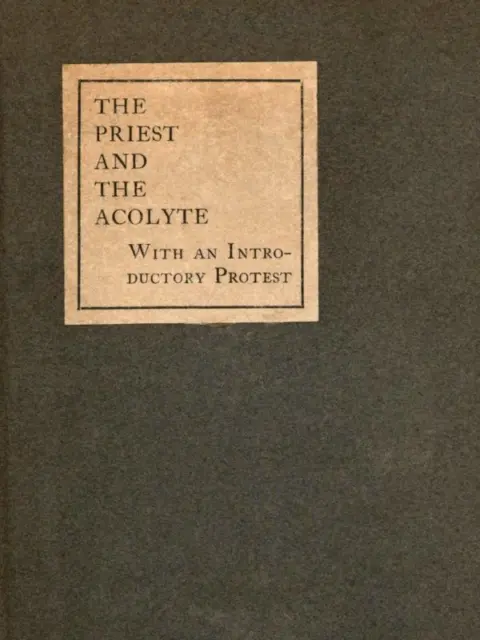
"The Priest and the Acolyte" by John Francis Bloxam is a controversial novella written in the late 19th century. This work explores complex themes of forbidden love and moral conflict within the confines of a religious backdrop, focusing on the tumultuous relationship between a priest and his young acolyte. The narrative is set during a time when societal norms were much stricter regarding such relationships, which adds layers of tension and tragedy to the story. The plot revolves around Ronald Heatherington, a young priest grappling with his feelings for Wilfred, a beautiful 14-year-old acolyte. As their bond intensifies, they share moments of deep affection that challenge the priest's commitment to his vocation and the conventions of society. Together, they navigate their passionate relationship in secret, both elated and tortured by their love. However, the story takes a dark turn when their closeness attracts scrutiny, leading to a confrontation with the outside world that threatens to expose them. Ultimately, the novella culminates in a tragic ending, questioning the nature of love, sin, and societal judgment against the backdrop of religious fervor.
Introduction adapted from the source catalogue; source summaries may be automatically generated.
Free to read · English · 7,374 words · No account needed
MAKE TIME FOR A GOOD BOOK
On by default. Untick to stop anonymous reading totals. Each page counts after 10 seconds in view. How this works.
Anonymous counting is on unless you have switched it off.
Ronald Heatherington sank into a chair, hiding his face in his hands, and the rector left the room in silence.
For some minutes the young priest sat with his face buried in his hands. Then with a sigh he rose and crept across the garden till he stood beneath the open window of his darling.
“Wilfred,” he called very softly.
The beautiful face, pale and wet with tears, appeared at the window.
“I want you, my darling; Will you come?” he whispered.
“Yes, father,” the boy softly answered.
The priest led him back to his room; then, taking him very gently in his arms, he tried to warm the cold little feet with his hands.
“My darling, it is all over.” And he told him as gently as he could all that lay before them.
The boy hid his face on his shoulder, crying softly.
“Can I do nothing for you, dear father?”
He was silent for a moment. “Yes, you can die for me; you can die with
me.”
The loving arms were about his neck once more, and the warm, loving lips were kissing his own. “I will do any thing for you. O father, let us die together!”
“Yes, my darling, it is best: we will.”
Then very quietly and very tenderly he prepared the little fellow for his death; he heard his last confession and gave him his last absolution. Then they knelt together, hand in hand, before the crucifix.
“Pray for me, my darling.”
Then together their prayers silently ascended that the dear Lord would have pity on the priest who had fallen in the terrible battle of life. There they knelt till midnight, when Ronald took the lad in his arms and carried him to the little chapel.
“I will say mass for the repose of our souls,” he said.
Over his night-shirt the child arrayed himself in his little scarlet cassock and tiny lace cotta. He covered his naked feet with the scarlet sanctuary shoes; he lighted the tapers and reverently helped the priest to vest. Then before they left the vestry the priest took him in his arms and held him pressed closely to his breast; he stroked the soft hair and whispered cheeringly to him. The child was weeping quietly, his slender frame trembling with the sobs he could scarcely suppress. After a moment the tender embrace soothed him, and he raised his beautiful mouth to the priest’s. Their lips were pressed together, and their arms wrapped one another closely.
“Oh, my darling, my own sweet darling!” the priest whispered tenderly.
“We shall be together for ever soon; nothing shall separate us now,”
the child said.
Your reading position is saved on this browser. Take it to another device with a library code. Reading pages adapt to text, rather than matching a printed edition.
BEHIND THE BOOK
This eBook is for the use of anyone anywhere in the United States and most other parts of the world at no cost and with almost no restrictions whatsoever. You may copy it, give it away or re-use it under the terms of the Project Gutenberg License included with this eBook or online at www.gutenberg.org. If you are not located in the United States, you will have to check the laws of the country where you are located before using this eBook. Read the source licence.
The original source file, including credits and licence, is retained by this library. Request an original-format copy at no charge. Please include the book title and Project Gutenberg identifier #60229.
KEEP YOUR CURIOSITY GOING
David Patterson (Spirit) Hatch

David Patterson (Spirit) Hatch

David Patterson (Spirit) Hatch
Coulson Kernahan

Maurice Baring
Frances Wright