Pomona’s Travels A Series of Letters to the Mistress of Rudder Grange from her Former Handmaiden
Frank R. Stockton

THE CLASSIC COLLECTION · 1927
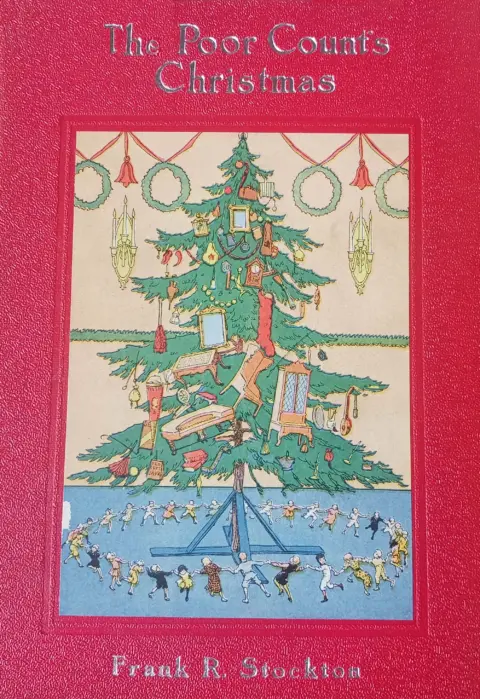
"The Poor Count's Christmas" by Frank R. Stockton is a charming children's story written in the early 20th century. This heartwarming tale revolves around the themes of kindness, generosity, and the spirit of Christmas, set against the backdrop of a noble Count who, despite his dwindling wealth, strives to ensure that every child in his neighborhood experiences joy during the festive season. The story follows Count Cormo, who lovingly hosts Christmas celebrations for the local children, sacrificing his own comfort to maintain the tradition. With his resources nearly exhausted, he plans to sell valuable heirlooms to fund the festivities. Meanwhile, a young giant named Feldar and a fairy named Tillette come into the picture, culminating in a delightful twist as they bring gifts and a grand Christmas tree for the Count and his wife. The giant, feeling compelled by the Counts’ selflessness, devises a way to ensure the children have a joyful celebration, ultimately leading to unexpected connections and the adoption of Feldar by the Count and Countess. This enchanting narrative beautifully conveys the message that the true joy of Christmas lies not in material wealth but in love, community, and sharing.
Introduction adapted from the source catalogue; source summaries may be automatically generated.
Free to read · English · 5,786 words · No account needed
MAKE TIME FOR A GOOD BOOK
On by default. Untick to stop anonymous reading totals. Each page counts after 10 seconds in view. How this works.
Anonymous counting is on unless you have switched it off.
“I guess not,” said the giant, laughing. “But you can come along with me, and we’ll see how things stand.”
Before very long, they came to a great castle, and a warder stood
before the gate.
“Ho, warder!” cried the giant when he came up. “How goes it with my grandfather’s uncle, the old giant Omscrag?”
“He has been dead a month,” said the warder, “and his property is all divided among his heirs.”
“That is not so,” roared the giant. “I am one of his heirs, and I haven’t got anything.”
“I don’t know anything about it,” said the warder. “I was told to give that message to every one who came, and I’ve given it to you.”
“Who told you to give it?” cried the giant.
“My master, Katofan, who is the old giant’s principal heir, and who now
owns the castle.”
“Katofan!” exclaimed the giant. “What impudence! He’s a ninth cousin by marriage. Where is he? I want to see him.”
“I don’t think he is well enough to see anybody to-day,” said the
warder.
“Open that gate!” the giant roared, “or I shall plunge your family into
woe!”
The warder turned pale, and opened the gate as wide as it would go, while the giant, with the fairy on his finger, walked boldly in.
In a large inner hall, sitting before a great fire, they saw a giant so tall and thin that he looked as if he had been made of great fishing-poles. He turned uneasily in his chair when he saw his visitor, and was going to say something about being too unwell to receive company, when our young giant, whose name was Feldar, interrupted him by calling out, in a tremendous voice:
“Well, now, Katofan, I should like to know what all this means! How did you come to be heir to this castle?”
“Because it descended to me from my good old relative and friend,” said
the other.
“I expect there are a hundred heirs, who have a better right to it than you,” said our giant. “The truth is, no doubt, that you were here when my grandfather’s uncle died, and that you took possession, and have since kept everybody out.”
“Oh, no,” said the thin giant, “the other heirs have had a share of the
fortune.”
“How many of them?” said Feldar, “and how much did they get?”
“As many as two or three of them,” said the other, “and they got some very nice things in the way of ornaments and curiosities.”
Your reading position is saved on this browser. Take it to another device with a library code. Reading pages adapt to text, rather than matching a printed edition.
Frank R. Stockton

Frank R. Stockton
Frank R. Stockton

Frank R. Stockton
BEHIND THE BOOK
This eBook is for the use of anyone anywhere in the United States and most other parts of the world at no cost and with almost no restrictions whatsoever. You may copy it, give it away or re-use it under the terms of the Project Gutenberg License included with this eBook or online at www.gutenberg.org. If you are not located in the United States, you will have to check the laws of the country where you are located before using this eBook. Read the source licence.
The original source file, including credits and licence, is retained by this library. Request an original-format copy at no charge. Please include the book title and Project Gutenberg identifier #74633.
KEEP YOUR CURIOSITY GOING
Coulson Kernahan

Maurice Baring
Frances Wright
Cécile Tormay
Francis Greenleaf Allinson & Anne C. E. (Anne Crosby Emery) Allinson

Frederic Jesup Stimson