THE CLASSIC COLLECTION✦Young India An interpretation and a history of the nationalist movement from withinCLASSIC FREE BOOKS
Young India An interpretation and a history of the nationalist movement from within
Lala Lajpat Rai
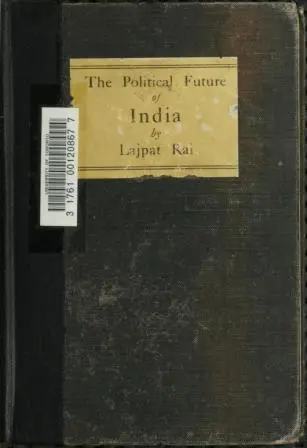
THE CLASSIC COLLECTION · 1919
"The Political Future of India" by Lala Lajpat Rai is a political treatise written in the early 20th century. The book discusses the prospects for India's governance and self-determination during the aftermath of World War I, as well as the intricate relationship between India and British colonial rule. It aims to outline the political aspirations of the Indian people, against a backdrop of widespread discontent with British governance and the desire for autonomy and reform. The opening of the book sets the stage for a discussion on the significant contributions of India during the war, emphasizing the sacrifices made by its people, which were largely ignored by the British authorities. Lajpat Rai highlights the growing dissatisfaction among Indians with the existing political structure, calling for responsible governance and the introduction of reforms to empower local populations. He argues that both the British government and the Indian populace must take steps toward establishing a more representative and accountable system, as movements for autonomy and greater self-determination begin to take shape. This opening establishes a sense of urgency and raises critical questions about the future political landscape of India.
Introduction adapted from the source catalogue; source summaries may be automatically generated.
Free to read · English · 74,592 words · No account needed
MAKE TIME FOR A GOOD BOOK
On by default. Untick to stop anonymous reading totals. Each page counts after 10 seconds in view. How this works.
Anonymous counting is on unless you have switched it off.
But even assuming that the official Government has so far done all that for the ryot, what reason is there to insinuate that the Government of the people will fail to do it for him in the future or will not do it so well as or even better, than has been heretofore done by the bureaucracy? It is quite a gratuitous assumption that in future he will be required to do all these things for himself. Even in the most advanced democracies in the world the peasantry or the masses of the people do not do these things for themselves. Most of these things are done by officials. The only difference is that in a responsible government the officials are the servants of the people while in an absolute government they are their masters. We are really surprised at the presumption of the British bureaucrat, in posing as the special friend of the Indian masses as against their own educated countrymen. The experience of the past does not support the claim and there is absolutely no reason to assume that it will be different in the future. A mere cursory glance at the resolutions of the Indian National Congress passed continuously for a period of thirty years, will show how persistently and earnestly the educated classes have been pleading inter alia for (a) compulsory and free education, (b) for technical instruction in vocations, (c) for the reduction of the salt tax and the land tax, (d) for the raising of the minimum incomes liable to income tax, (e) for the provision of pasture lands, (f) for the comforts of the third-class railway travelling public, (g) for the milder administration of the forest laws, (h) for the reform of the Police, etc. All these years the bureaucracy did nothing for the ryot and now they pose as his special friends, whose continuance in power and in office is necessary for his protection from the politically minded middle classes. We are a friend neither of the landlord nor of the capitalist. We believe that the ryot and the working men in India as elsewhere are being exploited and robbed by the classes in possession of the means of production and distribution. We would wholeheartedly support any scheme which would open a way to a just and righteous distribution of wealth and land in India and which would insure the ryot and the working man his rightful place in the body politic. We would not mind the aid of the foreign bureaucracy toward that end if we could be sure that the bureaucracy would or could do it. But we have no doubts in the matter that it cannot be done. The bureaucracy has so far played into the hands of the plutocrat. They have served first their own capitalists and then the capitalists and landlords of India. Some among them have tried to do a little for the submerged classes, the poor ryot and the ill-paid sweated laborer, but their efforts were of no consequence. They have failed and their failure is writ large on the face of the ryot. We are not sanguine that the politically minded classes when they get power will immediately rehabilitate the ryot and give him his due. We have no hope of that kind. Yet we unhesitatingly support the demand of the politically minded classes for a responsible government in India. In our judgment, that is the only way to raise the masses to a consciousness of their rights and responsibilities. The experience of the West tells us that in that way and in that way alone lies salvation. Political consciousness must travel from the classes to the masses and the longer the inauguration of popular Government is delayed, the greater the delay in the awakening of the ryot and the working man. Absolutism must first give way and transfer its power to the politically minded classes, then will come the turn of the masses to demand their rights and compel compliance. We can see no risk of a greater harm or injury to the masses of India from the transference of power from the hands of a close bureaucracy of foreigners into the hands of the educated and propertied oligarchy of their own countrymen. Even in countries like Great Britain, America and France it is the educated and the propertied classes who rule. Why then this hubbub about the impropriety and danger of giving power to the same classes in India? Why are the representatives of landlordism and capitalism in the British House of Lords and among the ranks of Imperial Anglo-Indians so solicitous of the welfare of the Indian masses, when they have for so long persistently denied justice to the proletariat of their own country? It is a strange phenomenon to see the champions of privilege and status, the defenders of capitalism and landlordism, the advocates of the rights of property, the upholders of caste in Great Britain, spending so much powder and shot to protect the Indian ryot from the prospective exploitation of him by the Indian Brahmin and the Indian Banya[6] (the priest and the capitalist). Let the British Brahmin and the British Banya first begin by doing justice to the proletariat of their own country and then it will be time for them to convince the Indian of their altruism and honesty of purpose in obstructing the inauguration of responsible government in India in the interests of the Indian proletariat. In this connection the authors of the Report make some pertinent observations which deserve to be quoted. After speaking of "religious animosities and social cleavages" and the duty of discouraging them the authors say:
Your reading position is saved on this browser. Take it to another device with a library code. Reading pages adapt to text, rather than matching a printed edition.
Lala Lajpat Rai
Lala Lajpat Rai
BEHIND THE BOOK
This eBook is for the use of anyone anywhere in the United States and most other parts of the world at no cost and with almost no restrictions whatsoever. You may copy it, give it away or re-use it under the terms of the Project Gutenberg License included with this eBook or online at www.gutenberg.org. If you are not located in the United States, you will have to check the laws of the country where you are located before using this eBook. Read the source licence.
The original source file, including credits and licence, is retained by this library. Request an original-format copy at no charge. Please include the book title and Project Gutenberg identifier #41819.
KEEP YOUR CURIOSITY GOING
Cécile Tormay

Moritz Busch
John L. Ransom
Frances Wright
Cécile Tormay

Mabel Potter Daggett