THE CLASSIC COLLECTION✦Young India An interpretation and a history of the nationalist movement from withinCLASSIC FREE BOOKS
Young India An interpretation and a history of the nationalist movement from within
Lala Lajpat Rai
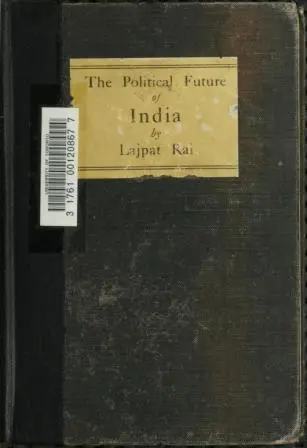
THE CLASSIC COLLECTION · 1919
"The Political Future of India" by Lala Lajpat Rai is a political treatise written in the early 20th century. The book discusses the prospects for India's governance and self-determination during the aftermath of World War I, as well as the intricate relationship between India and British colonial rule. It aims to outline the political aspirations of the Indian people, against a backdrop of widespread discontent with British governance and the desire for autonomy and reform. The opening of the book sets the stage for a discussion on the significant contributions of India during the war, emphasizing the sacrifices made by its people, which were largely ignored by the British authorities. Lajpat Rai highlights the growing dissatisfaction among Indians with the existing political structure, calling for responsible governance and the introduction of reforms to empower local populations. He argues that both the British government and the Indian populace must take steps toward establishing a more representative and accountable system, as movements for autonomy and greater self-determination begin to take shape. This opening establishes a sense of urgency and raises critical questions about the future political landscape of India.
Introduction adapted from the source catalogue; source summaries may be automatically generated.
Free to read · English · 74,592 words · No account needed
MAKE TIME FOR A GOOD BOOK
On by default. Untick to stop anonymous reading totals. Each page counts after 10 seconds in view. How this works.
Anonymous counting is on unless you have switched it off.
"Nothing will ever be the same," said Sir Harcourt Butler; "this much is certain, that we shall have to shake up all our old ideals and begin afresh ... we have crossed the watershed and are looking down on new plains. The old oracles are dumb. The old shibboleths are no more heard. Ideals, constitutions, rooted ideas are being shovelled away without argument or comment or memorial.... Our administrative machine belongs to another age. It is top-heavy. Its movements are cumbrous, slow, deliberate. It rejoices in delay. It grew up when time was not the object, when no one wanted change, when financial economy was the ruling passion of Governments, imperial and provincial. Now there are the stirrings of young national life, and economic springtime, a calling for despatch, quick response, bold experiment. Secretariats with enormous offices overhang the administration. An eminent ecclesiastic once told me that Rome had, by centuries of experience, reduced delay to a science; he used to think her mistress of postponement and procrastination, but the Government of India beat Rome every time. Only ecclesiatics could dare so to speak of the Government of India. I, for one, will not lay audacious hands on the chariot of the sun."
Coming, as it does, from a member of the Anglo-Indian bureaucracy, this statement means much more to the Indian people than even the words of the British Premier. If this statement is not mere camouflage, but represents a genuine change of heart on the part of the British bureaucracy in India, then it is all the more inexplicable to us why the new scheme of the Secretary for India and the Viceroy should breathe so much distrust of the educated classes of India. Any way, we have nothing but praise for the spirit of frankness and fairness which generally characterizes the report. However we might disagree with the conclusions arrived at, it is but right to acknowledge that the analysis of the problem and its constituting elements is quite masterly and the attempt to find a solution which will meet the needs of the situation as understood by them absolutely sincere and genuine. This fact makes it all the more necessary that Indian Nationalists of all classes and all shades of opinion should give their best thought to the consideration of the problem in a spirit of construction and coöperation, as distinguished from mere fault-finding. Nor should it be forgotten for a moment that Mr. Montagu and Lord Chelmsford were all the time, when drawing their scheme, influenced by considerations of what, under the circumstances, is practicable and likely to be accepted, not only in India by the Anglo-Indian bureaucracy and the non-official European community, but by the conservative British opinion at home. It is the latter we have to convince and win over before the scheme has a ghost of a chance of being improved upon. When we say conservative opinion we include in that expression the Liberal and Labour Imperialists also. We should never forget that it is hard to part with power, however idealistic the individual vested with power may be, and it is still harder to throw away the chances of profit which one (and those in whom one is interested) have gained by efforts extending over a century and a half, and in the exercise of which one sees no immediate danger. I am of the opinion that hitherto Indian representation in England has been extremely meagre, spasmodic and inadequate to the needs of the situation. Outside England, India's voice has been altogether unheard. We have so far displayed an almost unpardonable simplicity in failing to recognise that the world is so situated these days that public opinion in one country sometimes reacts quite effectively on public opinion in another. It is our duty, therefore, to increase our representation in England and to keep our case before the world with fresh energy and renewed vigour, not in a spirit of carping denunciation of the British Government of India, but with a desire to educate and enlist liberal and right-minded opinion all over the world in our favor. In the following pages an attempt is made to examine the Montagu-Chelmsford report in a spirit of absolute candour and fairness, with practical suggestions for the improvement of the scheme in the light of Indian and British criticism thereupon.
Your reading position is saved on this browser. Take it to another device with a library code. Reading pages adapt to text, rather than matching a printed edition.
Lala Lajpat Rai
Lala Lajpat Rai
BEHIND THE BOOK
This eBook is for the use of anyone anywhere in the United States and most other parts of the world at no cost and with almost no restrictions whatsoever. You may copy it, give it away or re-use it under the terms of the Project Gutenberg License included with this eBook or online at www.gutenberg.org. If you are not located in the United States, you will have to check the laws of the country where you are located before using this eBook. Read the source licence.
The original source file, including credits and licence, is retained by this library. Request an original-format copy at no charge. Please include the book title and Project Gutenberg identifier #41819.
KEEP YOUR CURIOSITY GOING
Cécile Tormay

Moritz Busch
John L. Ransom
Frances Wright
Cécile Tormay

Mabel Potter Daggett