THE CLASSIC COLLECTION✦Young India An interpretation and a history of the nationalist movement from withinCLASSIC FREE BOOKS
Young India An interpretation and a history of the nationalist movement from within
Lala Lajpat Rai
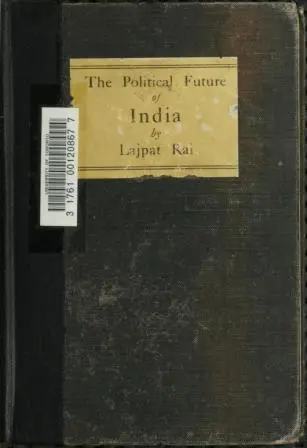
THE CLASSIC COLLECTION · 1919
"The Political Future of India" by Lala Lajpat Rai is a political treatise written in the early 20th century. The book discusses the prospects for India's governance and self-determination during the aftermath of World War I, as well as the intricate relationship between India and British colonial rule. It aims to outline the political aspirations of the Indian people, against a backdrop of widespread discontent with British governance and the desire for autonomy and reform. The opening of the book sets the stage for a discussion on the significant contributions of India during the war, emphasizing the sacrifices made by its people, which were largely ignored by the British authorities. Lajpat Rai highlights the growing dissatisfaction among Indians with the existing political structure, calling for responsible governance and the introduction of reforms to empower local populations. He argues that both the British government and the Indian populace must take steps toward establishing a more representative and accountable system, as movements for autonomy and greater self-determination begin to take shape. This opening establishes a sense of urgency and raises critical questions about the future political landscape of India.
Introduction adapted from the source catalogue; source summaries may be automatically generated.
Free to read · English · 74,592 words · No account needed
MAKE TIME FOR A GOOD BOOK
On by default. Untick to stop anonymous reading totals. Each page counts after 10 seconds in view. How this works.
Anonymous counting is on unless you have switched it off.
In the Punjab, again, the first revolutionary crime took place in December, 1912, and the second in 1913 and the rest all during the War. Cases of seditious utterances and writings are not included in the term "revolutionary crime" used in the above paragraphs. It was from Bengal, then, that before the War revolutionary propaganda was carried on to any large extent, revolutionary movements organized and revolutionary crimes committed. About half of the Report deals with Bengal and the general findings of the committee may be thus summarized:
(1) That the object of the movement was the overturning of "the British government in India by violent means" (p. 15 and also p. 19).
(2) That the class among whom the movement spread was comprised of the Bhadralok (the respectable middle class). The committee says:
"The people among whom he (i.e., Barendra, the first Bengali revolutionary propagandist) worked, the bhadralok of Bengal, have been for centuries peaceful and unwarlike, but, through the influence of the great central city of Calcutta, were early in appreciating the advantages of Western learning. They are mainly Hindus and their leading castes are Brahmins, Kayasthas and Vaidyas; but with the spread of English education some other castes too have adopted bhadralok ideals and modes of life. Bhadralok abound in villages as well as in towns, and are thus more interwoven with the landed classes than are the literate Indians of other provinces. Wherever they live or settle, they earnestly desire and often provide English education for their sons. The consequence is that a number of Anglo-vernacular schools, largely maintained by private enterprise, have sprung up throughout the towns and villages of Bengal. No other province of India possesses a network of rural schools in which English is taught. These schools are due to the enterprise of the bhadralok and to the fact that, as British rule gradually spread from Bengal over Northern India, the scope of employment for English-educated Bengalis spread with it. Originally they predominated in all offices and higher grade schools throughout Upper India. They were also, with the Parsees, the first Indians to send their sons to England for education, to qualify for the Bar, or to compete for the higher grades of the Civil and Medical services. When, however, similar classes in other provinces also acquired a working knowledge of English, the field for Bengali enterprise gradually shrank. In their own province bhadralok still almost monopolize the clerical and subordinate administrative services of Government. They are prominent in medicine, in teaching and at the Bar. But, in spite of these advantages, they have felt the shrinkage of foreign employment; and as the education which they receive is generally literary and ill-adapted to incline the youthful mind to industrial, commercial or agricultural pursuits, they have not succeeded in finding fresh outlets for their energies. Their hold on land, too, has weakened, owing to increasing pressure of population and excessive sub-infeudation. Altogether their economic prospects have narrowed, and the increasing numbers who draw fixed incomes have felt the pinch of rising prices. On the other hand, the memories and associations of their earlier prosperity, combined with growing contact with Western ideas and standards of comfort, have raised their expectations of the pecuniary remuneration which should reward a laborious and, to their minds, a costly education. Thus as bhadralok learned in English have become more and more numerous, a growing number have become less and less inclined to accept the conditions of life in which they found themselves on reaching manhood. Bhadralok have always been prominent among the supporters of Indian political movements; and their leaders have watched with careful attention events in the world outside India. The large majority of the people of Bengal are not bhadralok but cultivators, and in the eastern districts mainly Muhammadans; but the cultivators of the province are absorbed in their own pursuits, in litigation, and in religious and caste observances. It was not to them but to his own class that Barendra appealed. When he renewed his efforts in 1904, the thoughts of many members of this class had been stirred by various powerful influences." [The italics are ours.]
Your reading position is saved on this browser. Take it to another device with a library code. Reading pages adapt to text, rather than matching a printed edition.
Lala Lajpat Rai
Lala Lajpat Rai
BEHIND THE BOOK
This eBook is for the use of anyone anywhere in the United States and most other parts of the world at no cost and with almost no restrictions whatsoever. You may copy it, give it away or re-use it under the terms of the Project Gutenberg License included with this eBook or online at www.gutenberg.org. If you are not located in the United States, you will have to check the laws of the country where you are located before using this eBook. Read the source licence.
The original source file, including credits and licence, is retained by this library. Request an original-format copy at no charge. Please include the book title and Project Gutenberg identifier #41819.
KEEP YOUR CURIOSITY GOING
Cécile Tormay

Moritz Busch
John L. Ransom
Frances Wright
Cécile Tormay

Mabel Potter Daggett