
Last letters from the living dead man
David Patterson (Spirit) Hatch
THE CLASSIC COLLECTION · 1848
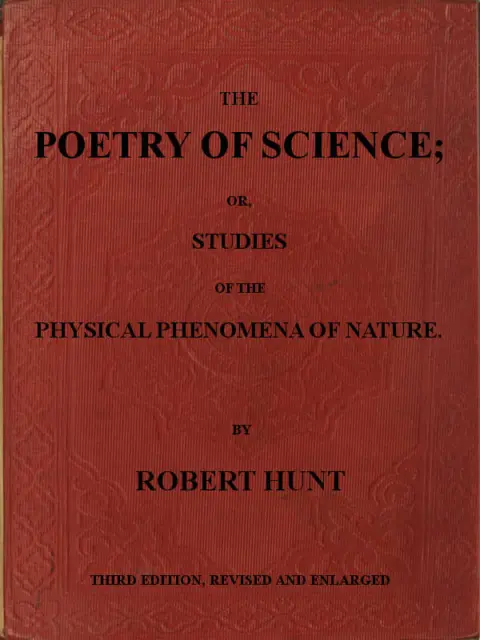
"The Poetry of Science; or, Studies of the Physical Phenomena of Nature" by Robert Hunt is a scientific publication written in the mid-19th century. The book explores the intersection of science and poetry, particularly focusing on the physical phenomena of nature and their beauty. Hunt aims to elevate scientific truths to an aesthetic level, suggesting that there is inherent beauty in the laws of nature, making science appealing to a broader audience. The opening of the work sets a philosophical tone, encouraging readers to contemplate existence and the forces of nature that shape our world. Hunt introduces the concept that everything in the universe, from rocks to living beings, is constituted of atoms and is subject to continual change. He reflects on the transmutation of matter, wherein different states and forms arise from the same fundamental particles, suggesting a unifying principle in the diverse phenomena of nature. The text emphasizes that while science has uncovered many truths, it also highlights the mystery that remains, inviting us to appreciate the beauty and complexity of the physical world.
Introduction adapted from the source catalogue; source summaries may be automatically generated.
Free to read · English · 144,154 words · No account needed
MAKE TIME FOR A GOOD BOOK
On by default. Untick to stop anonymous reading totals. Each page counts after 10 seconds in view. How this works.
Anonymous counting is on unless you have switched it off.
Mammalia, fossil, 343.
Man, temperature of, 105.
Manganesiate of potash, 171.
Mantell, Dr., on the iguanodon, 343.
Mariotte on seat of vision, 149.
Matter, its general conditions, 1.
----, forms of, 21.
----, transmutation of, 37.
----, divisibility of, 38.
----, solid, absorption of heat by, 75.
----, influence of, on light, 162.
----, polarity of, 265.
---- and its properties, 409.
----, entity of, 410.
----, varied condition of, 36.
Mayer’s hypothesis of three colours, 138.
Mechanical force and heat, 103.
Mechanism of the eye, 149.
Media, influence of, on light, 128.
Medusæ, phosphorescence of, 159.
Melloni on coloured heat rays, 85.
---- on new nomenclature for heat, 95.
Mesmer and electricity, 222.
Metamorphic rocks, 336.
Metamorphoses of animals, 389.
Mexico, Gulf of, warmth of the, 81.
Mica, black, transparency to heat, 66.
Miller, Dr., on dark lines of the spectrum, 126.
Mineral veins, electricity of, 225.
Mines, Cornish, temperature of, 91.
Miocene formations, 346.
Mirrors, magic, 191.
Mitscherlich on expansion of crystals by heat, 257.
Molecular forces, 35, 40.
----, compound action of, 279.
Molecules, Dumas on, 39.
---- combination, 277.
Morichini and Carpi on magnetism of violet rays of light, 263.
Moser on invisible light, 189.
Motion, 7.
---- a property of matter, 8.
----, principles of, 10.
---- of the earth, 12.
---- round an axis shows the earth’s motion, 18.
----, influence of, on form, 32.
Mountain ranges probably determined by magnetic force, 262.
Multiplication of life, 399.
Musical notes produced by heat, 97.
Muscular contraction by electricity, 202.
Musschenbroek of Leyden, 198.
Mythology, ancient, probable origin of, 353.
Natural polarization, 145.
Nebulous state of matter, 23.
Neptune, discovery of, 32.
Newton on gravitating force, 49.
Newton on motion, 9.
Newton’s hypothesis of matter, 4.
---- theory of heat, 115.
---- theory of light, 120.
---- theory of colours, 135.
Niepce on the chemical radiations, 168.
Nitrogen, magnetic neutrality of, 259.
----, combinations of, 324.
----, supposed metallic nature of, 325.
Nocturnal radiation, 83.
Northern lights, the, 268.
Obsidian transparency to heat, 66.
Ocean, waters of, 303.
Oersted discovers electro-magnetism, 238.
Orders of animals, 386.
Organic creation, influence, 185.
---- compounds, 283.
---- compounds, influence of light on them, 181.
---- chemistry, 331.
---- cell, 360.
---- remains, 337.
Organized forms, varieties of, 35.
---- bodies, heat of, 104.
Organization, progress of, 385.
Oxides, metallic, 326.
Oxidizable metals, 305.
Oxygen gas magnetic, 259.
---- and nitrogen, uses of, 321.
---- and carbon in animals, 396.
Ozone, 299.
---- and electricity, 217.
Palladium maintaining slow combustion, 309.
Parathermic rays, 74.
---- rays, influence in nature, 377.
Particles, Dumas on, 39.
Peach on phosphorescence of the sea, 159.
Pearsall on phosphorescence, 160.
Pendulum, oscillation of, indicates the earth’s motion, 13.
Perkins on repulsion of heat, 108.
Permeation of heat, 96.
Perturbations of Uranus, 31.
Pestilential diseases, 216.
Phenomena of vision, 148.
----, natural, of electricity, 194.
----, recent geological, 349.
Phosphorescence of animals, 154.
---- of plants, 156.
Phosphorescent spectrum, 184.
Phosphoric acid detected in the oldest rocks, 337.
Photosphere of the sun, 123.
Photography, 170.
----, its importance, 180.
Physiological influences of electricity, 219.
Physical forces, action of, 4, 45.
---- forces, modes of motion, 7.
---- properties of polarized light, 142.
Physiological influences of magnetism, 268.
Pilchard, on the, by Couch, 315.
Plants, distribution of, dependent on light, 133.
----, phosphorescence of, 156.
----, respiration of, 312.
Your reading position is saved on this browser. Take it to another device with a library code. Reading pages adapt to text, rather than matching a printed edition.
BEHIND THE BOOK
This eBook is for the use of anyone anywhere in the United States and most other parts of the world at no cost and with almost no restrictions whatsoever. You may copy it, give it away or re-use it under the terms of the Project Gutenberg License included with this eBook or online at www.gutenberg.org. If you are not located in the United States, you will have to check the laws of the country where you are located before using this eBook. Read the source licence.
The original source file, including credits and licence, is retained by this library. Request an original-format copy at no charge. Please include the book title and Project Gutenberg identifier #51897.
KEEP YOUR CURIOSITY GOING
David Patterson (Spirit) Hatch
Coulson Kernahan

Ralph Waldo Emerson
Frances Wright

Edwin Abbott Abbott

Joseph Droz