
Last letters from the living dead man
David Patterson (Spirit) Hatch
THE CLASSIC COLLECTION · 1848
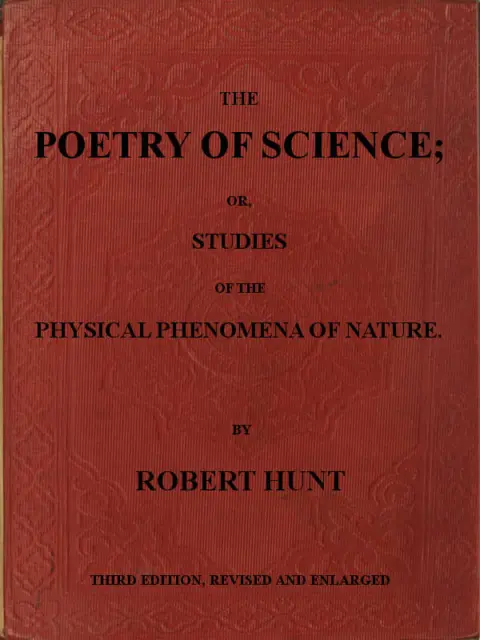
"The Poetry of Science; or, Studies of the Physical Phenomena of Nature" by Robert Hunt is a scientific publication written in the mid-19th century. The book explores the intersection of science and poetry, particularly focusing on the physical phenomena of nature and their beauty. Hunt aims to elevate scientific truths to an aesthetic level, suggesting that there is inherent beauty in the laws of nature, making science appealing to a broader audience. The opening of the work sets a philosophical tone, encouraging readers to contemplate existence and the forces of nature that shape our world. Hunt introduces the concept that everything in the universe, from rocks to living beings, is constituted of atoms and is subject to continual change. He reflects on the transmutation of matter, wherein different states and forms arise from the same fundamental particles, suggesting a unifying principle in the diverse phenomena of nature. The text emphasizes that while science has uncovered many truths, it also highlights the mystery that remains, inviting us to appreciate the beauty and complexity of the physical world.
Introduction adapted from the source catalogue; source summaries may be automatically generated.
Free to read · English · 144,154 words · No account needed
MAKE TIME FOR A GOOD BOOK
On by default. Untick to stop anonymous reading totals. Each page counts after 10 seconds in view. How this works.
Anonymous counting is on unless you have switched it off.
[268] “As to the polishing and grooving of hard rocks, it has lately been ascertained that glaciers give rise to these effects when pushing forward sand, pebbles, and rocky fragments, and causing them to grate along the bottom. Nor can there be any doubt that icebergs, when they run aground on the floor of the ocean, imprint similar marks upon it.”--Principles of Geology, or the modern changes of the Earth and its Inhabitants considered as illustrative of Geology: by Charles Lyell, M.A., F.R.S. Travels through the Alps of Savoy, and other parts of the Pennine Chain, with Observations on the Phenomena of Glaciers: by James D. Forbes, F.R.S.
[269] This may be readily proved by the following simple but instructive experiment:--Take two pairs of watch-glasses; into one pair put a solution of nitrate of silver, into the other a weak solution of iodide of potassium; connect the silver solution of each pair with the potash one by a film of cotton, and carry a platina wire from one glass into the other. Place one series in sunshine, and the other in a dark place. After a few hours it will be found that the little galvanic arrangement in the dark will exhibit, around the platina wire, a very pretty crystallization of metallic silver, but no such change is observable in the other exposed to light. If a yellow glass is interposed between the glass and the sunshine, the action proceeds as when in the dark. This experiment is naturally suggestive of many others, and it involves some most important considerations.
[270] In cases of violent death it is often found the gastric juice has, in a few hours, dissolved portions of the stomach.--Dr. Budd’s Lecture before the College of Physicians.
[271] Faraday’s Experimental Researches, vol. i.; from which a quotation has already been made, showing the enormous quantity of electricity which is latent in matter.
[272] On the Motion of Gases: by Professor Graham, F.R.S.--Phil.
Trans., vol. cxxxvi. p. 573.
Absorption of heat by air, water, and earth, 74.
---- of light, 125.
Acalephæ, or phosphorescent animals, 387.
Actinism, 166.
---- producing chemical change, 174.
---- and light antagonistic, 177.
----, influence of, on plants, 372.
Action of presence--Catalysis, 280.
“Active principles” of Newton, 11.
Adams on planet Neptune, 32.
Adiathermic bodies, 95.
Aërial currents dependent on heat, 80.
---- chemical, 274.
Affinity, 292.
Age of the world, 404.
Aggregation, attraction of, 48.
----, crystalline, 58.
Agonic lines, 244.
Air, absorption of heat by, 74.
---- density of the, 319.
Alchemy, Nature’s, 293.
Aldini on animal electricity, 393.
Allotropic conditions of atoms, 43.
Allotropism, 330.
Allotropy, 291.
Alum, opacity to heat rays, 65.
Alpinus’ theory of matter, 47.
Ammonites of the lias, 341.
Ammoniacal amalgam, 325.
Ampère’s theory of magnetism, 239.
Analogy, dangers of reasoning by, 152.
Your reading position is saved on this browser. Take it to another device with a library code. Reading pages adapt to text, rather than matching a printed edition.
BEHIND THE BOOK
This eBook is for the use of anyone anywhere in the United States and most other parts of the world at no cost and with almost no restrictions whatsoever. You may copy it, give it away or re-use it under the terms of the Project Gutenberg License included with this eBook or online at www.gutenberg.org. If you are not located in the United States, you will have to check the laws of the country where you are located before using this eBook. Read the source licence.
The original source file, including credits and licence, is retained by this library. Request an original-format copy at no charge. Please include the book title and Project Gutenberg identifier #51897.
KEEP YOUR CURIOSITY GOING
David Patterson (Spirit) Hatch
Coulson Kernahan

Ralph Waldo Emerson
Frances Wright

Edwin Abbott Abbott

Joseph Droz