
Last letters from the living dead man
David Patterson (Spirit) Hatch
THE CLASSIC COLLECTION · 1848
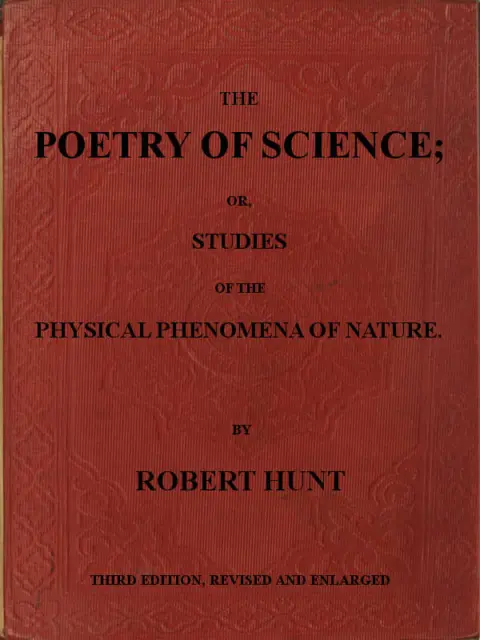
"The Poetry of Science; or, Studies of the Physical Phenomena of Nature" by Robert Hunt is a scientific publication written in the mid-19th century. The book explores the intersection of science and poetry, particularly focusing on the physical phenomena of nature and their beauty. Hunt aims to elevate scientific truths to an aesthetic level, suggesting that there is inherent beauty in the laws of nature, making science appealing to a broader audience. The opening of the work sets a philosophical tone, encouraging readers to contemplate existence and the forces of nature that shape our world. Hunt introduces the concept that everything in the universe, from rocks to living beings, is constituted of atoms and is subject to continual change. He reflects on the transmutation of matter, wherein different states and forms arise from the same fundamental particles, suggesting a unifying principle in the diverse phenomena of nature. The text emphasizes that while science has uncovered many truths, it also highlights the mystery that remains, inviting us to appreciate the beauty and complexity of the physical world.
Introduction adapted from the source catalogue; source summaries may be automatically generated.
Free to read · English · 144,154 words · No account needed
MAKE TIME FOR A GOOD BOOK
On by default. Untick to stop anonymous reading totals. Each page counts after 10 seconds in view. How this works.
Anonymous counting is on unless you have switched it off.
[250] Experiments upon Vegetables, discovering their great power of purifying the common air in the Sunshine, and of injuring it in the Shade and at Night; to which is joined, A new method of examining the accurate degrees of Salubrity of the Atmosphere, by John Ingenhousz, Councillor of the Court, and Body Physician to their Imperial and Royal Majesties, F.R.S., &c. London: printed for P. Elmsley, in the Strand, and H. Payne, Pall Mall, 1779.
[251] The Kingdoms of Nature, their life and affinity: by Dr. C. G. Carus; Scientific Memoirs, vol. i. p. 223.
[252] In Biologie, by G. R. Treviranus, vol. ii. p. 302, the following passage occurs:--“If we expose spring water to the sun in open or even closed transparent vessels, after a few days bubbles rise from the bottom, or from the sides of the vessel, and a green crust is formed at the same time. Upon observing this crust through a microscope, we discover a mass of green particles, generally of a round or oval form, very minute, and overlaid with a transparent mucous covering, some of them moving freely, whilst others, perfectly similar to these, remain motionless and attached to the sides of the vessel. This motion is sometimes greater than at others. The animalcules frequently lie as if torpid, but soon recover their former activity.”
[253] On the Structure of the Vegetable Cell: by Mohl.--Scientific Memoirs, vol. iv. p. 113. Outlines of Structural and Physical Botany: by Henfrey.
[254] Dr. Carus, in the memoir already quoted, says:--“But since, in the organization of the earth, light and air, as constituting a second integrant part, stand opposed to gravitation, and since the plant bears a relation, not only to gravitation, but to light also, when its formation is complete it will necessarily present a second anatomical system, namely, that of the spiral vessels, which have been very justly considered, of late, as the organs that perform in plants the functions of nerves.”
[255] Mr. Crosse’s Experiments in the Journal of the London Electrical Society, and Mr. Weekes in the Electrical Magazine, and a communication appended to Explanations: a Sequel to the Vestiges of the Natural History of Creation.
[256] Die Metamorphose der Pflanzen: Goethe, sect. 78.
[257] Lindley’s Elements of Botany.
[258] See the very curious experiments of C. Matteucci. Traduit et extrait du “Cimento.”--Archives des Sciences Physiques et Naturelles; Quelques Expériences sur la Respiration des Plantes. Nov. 1846.
[259] Consult Rural Economy, by J. B. Boussingault; The Chemical and Physiological Balance of Organic Nature, by Dumas and Boussingault; and Agricultural Chemistry, by Liebig.
[260] The practical value of the discovery now described, will be best understood from the following letter from Mr. Lawson, of Edinburgh:--
Your reading position is saved on this browser. Take it to another device with a library code. Reading pages adapt to text, rather than matching a printed edition.
BEHIND THE BOOK
This eBook is for the use of anyone anywhere in the United States and most other parts of the world at no cost and with almost no restrictions whatsoever. You may copy it, give it away or re-use it under the terms of the Project Gutenberg License included with this eBook or online at www.gutenberg.org. If you are not located in the United States, you will have to check the laws of the country where you are located before using this eBook. Read the source licence.
The original source file, including credits and licence, is retained by this library. Request an original-format copy at no charge. Please include the book title and Project Gutenberg identifier #51897.
KEEP YOUR CURIOSITY GOING
David Patterson (Spirit) Hatch
Coulson Kernahan

Ralph Waldo Emerson
Frances Wright

Edwin Abbott Abbott

Joseph Droz