
Last letters from the living dead man
David Patterson (Spirit) Hatch
THE CLASSIC COLLECTION · 1848
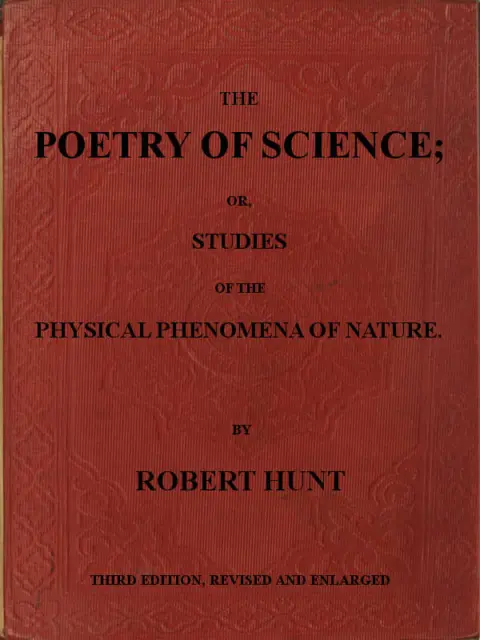
"The Poetry of Science; or, Studies of the Physical Phenomena of Nature" by Robert Hunt is a scientific publication written in the mid-19th century. The book explores the intersection of science and poetry, particularly focusing on the physical phenomena of nature and their beauty. Hunt aims to elevate scientific truths to an aesthetic level, suggesting that there is inherent beauty in the laws of nature, making science appealing to a broader audience. The opening of the work sets a philosophical tone, encouraging readers to contemplate existence and the forces of nature that shape our world. Hunt introduces the concept that everything in the universe, from rocks to living beings, is constituted of atoms and is subject to continual change. He reflects on the transmutation of matter, wherein different states and forms arise from the same fundamental particles, suggesting a unifying principle in the diverse phenomena of nature. The text emphasizes that while science has uncovered many truths, it also highlights the mystery that remains, inviting us to appreciate the beauty and complexity of the physical world.
Introduction adapted from the source catalogue; source summaries may be automatically generated.
Free to read · English · 144,154 words · No account needed
MAKE TIME FOR A GOOD BOOK
On by default. Untick to stop anonymous reading totals. Each page counts after 10 seconds in view. How this works.
Anonymous counting is on unless you have switched it off.
[213] The discussion of this question, commenced by Arago in his Eloge, was continued by Lord Brougham in his Lives of Watt and Cavendish, and by Mr. Vernon Harcourt, in his address as President of the British Association, and more recently in his Letter to Lord Brougham. Watt’s Letters on the subject have been since published under the superintendence of Mr. Muirhead.
[214] See several papers On Ozone, by Professor Schönbein, in the Philosophical Magazine, and in the Reports of the British Association. Consult a paper by the Author: Athenæum, September, 1849.
[215] Memoire sur l’Ozone; Bàle 1849. Poggendorff’s Annalen, lxxvii., p. 592. Ibid, lxxviii. p. 162.
[216] Chemical Gazette, 1849.
[217] Iodide of silver has been found at Albarradon, near Mazapil, in Mexico. Iodide of mercury, of a fine lemon-yellow colour, has been discovered in the sandstone of Casas, Viegas, Mexico. Algers; Phillips’ Mineralogy.
[218] GENTELE’S Reports of the Stockholm Academy.
[219] Stahl, taking up the obscure notions of Becher and Van Helmont, supposed the phenomena of combustion to be due to phlogiston. He imagined that by combination with phlogiston, a body was rendered combustible, and that its disengagement occasioned combustion, and after its evolution there remained either an acid or an earth: thus sulphur was, by this theory, supposed to be composed of phlogiston and sulphuric acid, and lead of the calx of lead and phlogiston, &c.
[220] Being called upon by the Solicitor for the Admiralty to examine into the causes of the fire which destroyed the Imogene and Talavera, in Devonport Arsenal, I discovered a bin under the roofing which covered these ships, in which there had been accumulating for a long period all the refuse of the wheelwrights’ and painters’ shop; and it was quite evident that spontaneous combustion had taken place in the mass of oiled oakum, sawdust, anti-attrition, and old sail-cloth, there allowed to accumulate.
[221] Researches on Flame: Sir H. Davy’s Collected Works.
[222] See note, ante, On the Chemical Theory of Respiration.
[223] At the request of the British Association, a committee undertook the investigation of this subject. Experiments were carried on by Dr. Daubeny, in the Botanic Gardens at Oxford, and by the Author, at his residence, Stockwell. Dr. Daubeny, in his report made at the meeting of the British Association at Birmingham, appears disposed to consider ten per cent. of carbonic acid in excess as destructive to the growth of ferns. I found, however, that, by gradually increasing the quantity, the ferns would live in an atmosphere still more highly charged with carbonic acid.
[224] See memoir On the Pilchard, by Mr. Couch, in the Reports of the Royal Cornwall Polytechnic Society.
Your reading position is saved on this browser. Take it to another device with a library code. Reading pages adapt to text, rather than matching a printed edition.
BEHIND THE BOOK
This eBook is for the use of anyone anywhere in the United States and most other parts of the world at no cost and with almost no restrictions whatsoever. You may copy it, give it away or re-use it under the terms of the Project Gutenberg License included with this eBook or online at www.gutenberg.org. If you are not located in the United States, you will have to check the laws of the country where you are located before using this eBook. Read the source licence.
The original source file, including credits and licence, is retained by this library. Request an original-format copy at no charge. Please include the book title and Project Gutenberg identifier #51897.
KEEP YOUR CURIOSITY GOING
David Patterson (Spirit) Hatch
Coulson Kernahan

Ralph Waldo Emerson
Frances Wright

Edwin Abbott Abbott

Joseph Droz