
Last letters from the living dead man
David Patterson (Spirit) Hatch
THE CLASSIC COLLECTION · 1848
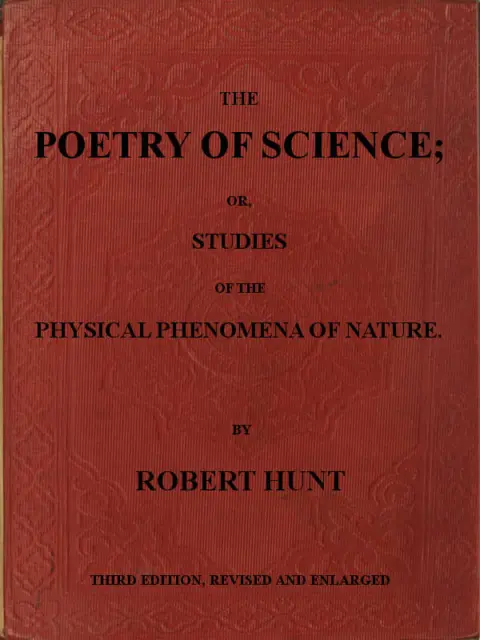
"The Poetry of Science; or, Studies of the Physical Phenomena of Nature" by Robert Hunt is a scientific publication written in the mid-19th century. The book explores the intersection of science and poetry, particularly focusing on the physical phenomena of nature and their beauty. Hunt aims to elevate scientific truths to an aesthetic level, suggesting that there is inherent beauty in the laws of nature, making science appealing to a broader audience. The opening of the work sets a philosophical tone, encouraging readers to contemplate existence and the forces of nature that shape our world. Hunt introduces the concept that everything in the universe, from rocks to living beings, is constituted of atoms and is subject to continual change. He reflects on the transmutation of matter, wherein different states and forms arise from the same fundamental particles, suggesting a unifying principle in the diverse phenomena of nature. The text emphasizes that while science has uncovered many truths, it also highlights the mystery that remains, inviting us to appreciate the beauty and complexity of the physical world.
Introduction adapted from the source catalogue; source summaries may be automatically generated.
Free to read · English · 144,154 words · No account needed
MAKE TIME FOR A GOOD BOOK
On by default. Untick to stop anonymous reading totals. Each page counts after 10 seconds in view. How this works.
Anonymous counting is on unless you have switched it off.
Plato, Aristotle, and the Pythagoreans, supposed that throughout all nature an active principle was diffused, upon which depended all the properties exhibited by matter. This is the same as the “plastic nature” of Cudworth,[6] the “intellectual and artificial fire” of Bishop Berkeley;[7] and to these all modes of motion were referred. Sir Isaac Newton also regards the material universe and its phenomena as dependent upon “active principles”--for instance, the cause of gravity--whereby the planets and comets preserve their motions in their orbits, and all bodies acquire a degree of motion in falling; and the cause of fomentation--whereby the heart and blood of animals preserve a perpetual warmth and motion--the inner parts of the earth are kept constantly warmed--many bodies burn and shine--and the sun himself burns and shines, and with his light warms and cheers all things.
The earth turns on its axis at the rate of more than 1,000 miles an hour, and passes around the sun with the speed of upwards of 68,000 miles in the same time.[8] The earth and the other planets of our system move in ellipses around a common centre: therefore their motion cannot have been originally communicated merely by the impressed force of projection. Two forces, at least, must have operated, one making the planets tend directly to the centre, and the other impelling them to fly off at a tangent to the curve described. Here we have a system of spheres, held by some power to a great central mass, around which they revolve with a fearful velocity. Nor is this all; the Solar System itself, bound by the same mystic chain to an undiscovered centre, moves towards a point in space at the rate of 33,550,000 geographical miles, whilst our earth performs one revolution around the sun.[9]
The evidence of the motion of the Earth around its axis, as afforded by the swinging of a pendulum or the rotation of a sphere, is too interesting to be omitted. In mechanical philosophy, we have two terms of the same general meaning--the conservation of the plane of vibration--and the conservation of the axis of rotation. For the non-scientific reader, these terms require explanation, and in endeavouring to simplify this as much as possible, we must ask the indulgence of the Mechanical Philosopher. Let us fix in the centre of a small round table an upright rod, having an arm extending from its top, to which we can suspend a tolerably heavy weight attached to a string. This is our piece of apparatus: upon the table draw a chalk line, along which line we intend our pendulum to swing, and continuing this line upon the floor, or by a mark on the wall, our arrangements are complete. Raise steadily the bob of our pendulum, and set it free, so that its plane of vibration is along the line which has been marked. As the pendulum is swinging firmly along this line, slowly and steadily turn the table round. It will then be seen that the pendulum will still vibrate in the direction of the line we have continued onward to the wall, but that the line on the table is gradually withdrawn from it. If we had no upright, we might turn the table entirely round, without in the slightest degree altering the line along which the pendulum performs its oscillations. Now, if from some elevated spot, say, from the centre of the dome of St. Paul’s, a long and heavy pendulum is suspended, and if on the floor we mark the line along which we set the pendulum free to vibrate, it will be seen, as in the experiment with the table, that the marked line moves away from under the pendulum. It continues to vibrate in the plane it first described, although the line on the earth’s surface continues to move forward by the diurnal rotation around the axis. Similar to this is the law of the conservation of the axis of rotation. If a common humming-top, the spindle of which is its axis of rotation, is set spinning obliquely, it will be seen that the axis will continue to point along the line it took at the commencement of motion. By placing a heavy sphere in a lathe, resting its projecting axial points on some moveable bearings, and then getting the sphere into extremely rapid motion, one of the bearings may be removed without the mass falling to the ground. The rapidity of motion changes so constantly and quickly the position of the particles which have a tendency to fall, that we have motion balanced against the force of gravitation in a striking manner; and we learn, from this experiment, the explanation of the planetary and stellar masses revolving on their axis at a speed sufficient to maintain them without support in space. A mass of matter, a sphere or a disc, carefully balanced, is fixed in gymbals such as we employ for fixing our compass needles, and it is set by some mechanical contrivance in rapid rotation. The position of the axis of rotation remains unaltered, although the earth is moving; and thus, by this instrument,--called the gyroscope,--we can determine, as with the pendulum, the motion of the earth around its axis; and we learn why, during its movement around the sun, its axis is undeviatingly pointed towards one point in space, marked in our Heavens as the Polar Star.
Your reading position is saved on this browser. Take it to another device with a library code. Reading pages adapt to text, rather than matching a printed edition.
BEHIND THE BOOK
This eBook is for the use of anyone anywhere in the United States and most other parts of the world at no cost and with almost no restrictions whatsoever. You may copy it, give it away or re-use it under the terms of the Project Gutenberg License included with this eBook or online at www.gutenberg.org. If you are not located in the United States, you will have to check the laws of the country where you are located before using this eBook. Read the source licence.
The original source file, including credits and licence, is retained by this library. Request an original-format copy at no charge. Please include the book title and Project Gutenberg identifier #51897.
KEEP YOUR CURIOSITY GOING
David Patterson (Spirit) Hatch
Coulson Kernahan

Ralph Waldo Emerson
Frances Wright

Edwin Abbott Abbott

Joseph Droz