
Last letters from the living dead man
David Patterson (Spirit) Hatch
THE CLASSIC COLLECTION · 1848
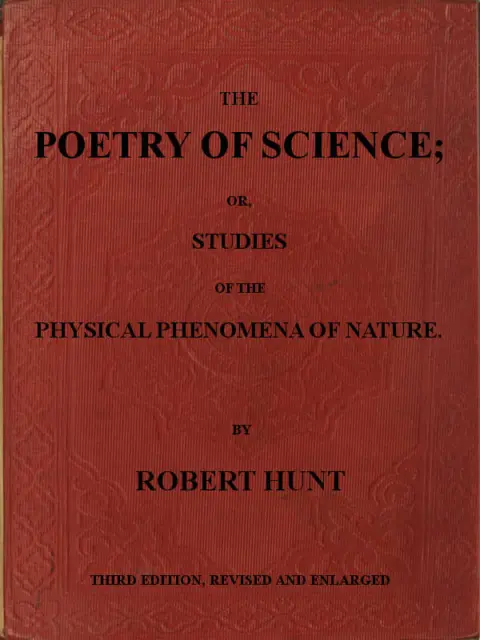
"The Poetry of Science; or, Studies of the Physical Phenomena of Nature" by Robert Hunt is a scientific publication written in the mid-19th century. The book explores the intersection of science and poetry, particularly focusing on the physical phenomena of nature and their beauty. Hunt aims to elevate scientific truths to an aesthetic level, suggesting that there is inherent beauty in the laws of nature, making science appealing to a broader audience. The opening of the work sets a philosophical tone, encouraging readers to contemplate existence and the forces of nature that shape our world. Hunt introduces the concept that everything in the universe, from rocks to living beings, is constituted of atoms and is subject to continual change. He reflects on the transmutation of matter, wherein different states and forms arise from the same fundamental particles, suggesting a unifying principle in the diverse phenomena of nature. The text emphasizes that while science has uncovered many truths, it also highlights the mystery that remains, inviting us to appreciate the beauty and complexity of the physical world.
Introduction adapted from the source catalogue; source summaries may be automatically generated.
Free to read · English · 144,154 words · No account needed
MAKE TIME FOR A GOOD BOOK
On by default. Untick to stop anonymous reading totals. Each page counts after 10 seconds in view. How this works.
Anonymous counting is on unless you have switched it off.
These terrestrial currents, as they have without doubt a very important bearing on the structural conditions of the rock-formations and the distribution of minerals, require an attentive consideration; but we must, in the first place, examine, as far as we know, the influences exerted, or supposed to be exerted, by electricity, in its varied forms.
The phenomena of vitality have, by many, been considered as immediately dependent upon its influence; and a rather extensive series of experiments has been made in support of this hypothesis. The researches of Philip on the action of the organs of digestion, when separated from their connection with the brain, but united with a galvanic battery, have been proved by Dr. Reid to be delusive;[153] since, as the organ is not removed from the influence of the living principle, it is quite evident that the electricity here is only secondary to some more important power. Matteucci has endeavoured to show that nervous action is intimately connected with electric excitation, and that electricity may be made a measurer of nervous irritability.[154] There can be no doubt that a peculiar susceptibility to excitement exists in some systems, and this is very strikingly shown in the disturbances produced by electric action; but in the experiments which have been brought forward we have only the evidence that a certain number of muscular contractions are exhibited in one animal by a current of electricity, giving a measured effect by the voltameter, which are different from those produced upon another by a current of the same power. An attempt has recently been made by Mr. A. Smee to reduce the electrical phenomena connected with vitality to a more exact system than had hitherto been done. We cannot, however, regard the attempt as successful. The author has trusted almost entirely to analogical reasoning, which is in science always dangerous.[155] In the development of electricity during the operation of the vital force, we see only the phenomena produced by the action of any two dissimilar chemical compounds upon each other. It has been thought that the structure of the brain presents an analogy to that of the galvanic battery, and the nerves represent the conducting wires. Although, however, some of the conditions appear similar, there are many which have no representatives in either the mechanical structure or the physical properties of the brain, so far as we know it. That the brain is the centre, the source, and termination of sensation is very clearly proved by physiological investigations. That the nerves are the media by which all sensation is conveyed to the brain, and also the instruments by which the will exerts its power over the muscles, is equally well established. But to say that we have any evidence to support the idea that electricity has aught to do directly with these great physiological phenomena, would be a bold assertion, betraying a want of due caution on the part of the investigator. That electric effects are developed during the operations of vitality is most certain. Such must be the case, from the chemical changes taking place during respiration and digestion, and the mechanical movements by which, even during external repose, the necessary functions of the body are carried on. Whether electricity is the cause of these, or an effect arising from them, we need not stop to examine, as this is, in the present state of our knowledge, a mere speculation. We have no evidence that electricity is an exciting power, but rather that it is one of those forces which tend to establish the equilibrium of matter. When disturbed--when its equilibrium is overset--it does, in its efforts to regain its stability, produce most remarkable effects. An electrical machine must be rubbed to exhibit any force. In all galvanic arrangements, even the most simple, dissimilar bodies are brought together, and the latent electricity of both is disturbed; and, even in the magnet, it is only when this takes place that its electrical powers are developed. In the Gymnotus, electricity appears to be dependent upon the power of the will of the animal; but even in this extraordinary fish, it is only under peculiar conditions that the electrical excitement takes place, and “what they inflict, they feel” during the restoration of that equilibrium which is necessary to their healthy state. In every case, therefore, we see that some power far superior to this is the ultimate cause; indeed, light and heat, and probably actinism, appear to stand superior to this principle; and on these, in some combined mode of action, in all probability, sensible electricity is dependent. Beyond even these elements, largely as they are engaged in the organic and inorganic changes of this world, there are occult powers which may never be understood by finite beings. We advance step by step from the most solid to the most ethereal of material creations, and we examine a series of extraordinary effects produced by powers which we know not whether to regard as material or immaterial, so subtile are they. On these, it appears, we may exhaust our inductive investigations--we may discover the laws by which these principles act upon the grosser elements, and develope phenomena of a very remarkable kind which have been unobserved or misunderstood. Whether light, heat, and electricity are modifications of one power, or different powers very closely united in action, is a problem we may possibly solve; but to know what they are, appears to be beyond the hopes of science; and it were idle to dream of elucidating the causes hidden beyond these forces, and by which they are regulated in all their actions on dead or living matter.
Your reading position is saved on this browser. Take it to another device with a library code. Reading pages adapt to text, rather than matching a printed edition.
BEHIND THE BOOK
This eBook is for the use of anyone anywhere in the United States and most other parts of the world at no cost and with almost no restrictions whatsoever. You may copy it, give it away or re-use it under the terms of the Project Gutenberg License included with this eBook or online at www.gutenberg.org. If you are not located in the United States, you will have to check the laws of the country where you are located before using this eBook. Read the source licence.
The original source file, including credits and licence, is retained by this library. Request an original-format copy at no charge. Please include the book title and Project Gutenberg identifier #51897.
KEEP YOUR CURIOSITY GOING
David Patterson (Spirit) Hatch
Coulson Kernahan

Ralph Waldo Emerson
Frances Wright

Edwin Abbott Abbott

Joseph Droz