
Love Letters of a Violinist, and Other Poems
Eric Mackay
THE CLASSIC COLLECTION · 1800
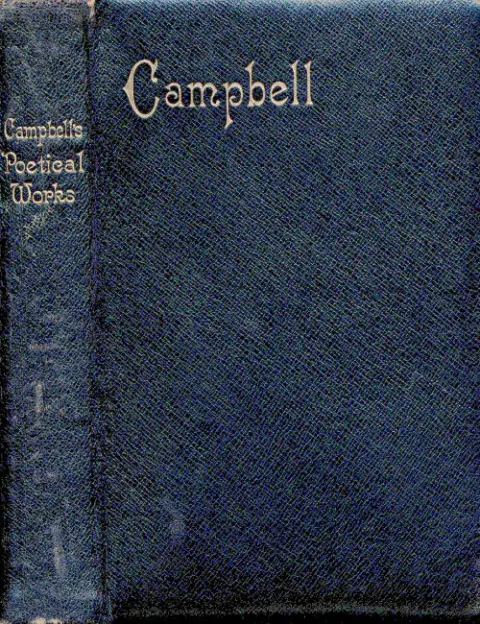
"The Poetical Works of Thomas Campbell" by Thomas Campbell is a collection of poetry written in the early 19th century. This work features a variety of poems, notable among them "The Pleasures of Hope," "Gertrude of Wyoming," and other lyrical pieces, reflecting on themes of love, nature, human experience, and social commentary. The collection highlights Campbell's concern for humanity, hope, and the human condition, often expressed through vivid imagery and emotive language. At the start of the collection, the prefatory memoir provides insight into Campbell's early life, education, and the influences that shaped his poetic career. It outlines his beginnings in Glasgow, his formative experiences with nature, and his introduction to literature. The opening poem, "The Pleasures of Hope," establishes the central theme of the importance of hope in navigating life's hardships. It juxtaposes the beauty of distant landscapes with the promise of love and humanity's potential for growth, addressing personal and political struggles while celebrating the enduring power of aspiration. Through poignant reflections, the early verses set the tone for the collection, evoking a sense of nostalgia and yearning for connection in both love and life.
Introduction adapted from the source catalogue; source summaries may be automatically generated.
Free to read · English · 69,844 words · No account needed
MAKE TIME FOR A GOOD BOOK
On by default. Untick to stop anonymous reading totals. Each page counts after 10 seconds in view. How this works.
Anonymous counting is on unless you have switched it off.
“Some of the French missionaries have supposed that the Indians are guided by instinct, and have pretended that Indian children can find their way through a forest as easily as a person of maturer years; but this is a most absurd notion. It is unquestionably by a close attention to the growth of the trees, and position of the sun, that they find their way. On the northern side of a tree there is generally the most moss; and the bark on that side, in general, differs from that on the opposite one. The branches towards the south are, for the most part, more luxuriant than those on the other sides of trees, and several other distinctions also subsist between the northern and southern sides, conspicuous to Indians, being taught from their infancy to attend to them, which a common observer would, perhaps, never notice. Being accustomed from their infancy likewise to pay great attention to the position of the sun, they learn to make the most accurate allowance for its apparent motion from one part of the heavens to another; and in every part of the day they will point to the part of the heavens where it is, although the sky be obscured by clouds or mists.
“An instance of their dexterity in finding their way through an unknown country came under my observation when I was at Staunton, situated behind the Blue Mountains, Virginia. A number of the Creek nation had arrived at that town on their way to Philadelphia, whither they were going upon some affairs of importance, and had stopped there for the night. In the morning, some circumstance or other, which could not be learned, induced one half of the Indians to set off without their companions, who did not follow until some hours afterwards. When these last were ready to pursue their journey, several of the towns-people mounted their horses to escort them part of the way. They proceeded along the high road for some miles, but, all at once, hastily turning aside into the woods, though there was no path, the Indians advanced confidently forward. The people who accompanied them, surprised at this movement, informed them that they were quitting the road to Philadelphia, and expressed their fear lest they should miss their companions who had gone on before. They answered that they knew better, that the way through the woods was the shortest to Philadelphia, and that they knew very well that their companions had entered the wood at the very place where they did. Curiosity led some of the horsemen to go on; and to their astonishment, for there was apparently no track, they overtook the other Indians in the thickest part of the wood. But what appeared most singular was, that the route which they took was found, on examining a map, to be as direct for Philadelphia as if they had taken the bearings by a mariner’s compass. From others of their nation, who had been at Philadelphia at a former period, they had probably learned the exact direction of that city from their villages, and had never lost sight of it, although they had already travelled three hundred miles through the woods, and had upwards of four hundred miles more to go before they could reach the place of their destination.—Of the exactness with which they can find out a strange place to which they have been once directed by their own people, a striking example is furnished, I think, by Mr. Jefferson, in his account of the Indian graves in Virginia. These graves are nothing more than large mounds of earth in the woods, which, on being opened, are found to contain skeletons in an erect posture: the Indian mode of sepulture has been too often described to remain unknown to you. But to come to my story. A party of Indians that were passing on to some of the sea-ports on the Atlantic, just as the Creeks, above mentioned, were going to Philadelphia, were observed, all on a sudden, to quit the straight road by which they were proceeding, and without asking any questions, to strike through the woods, in a direct line, to one of these graves, which lay at the distance of some miles from the road. Now very near a century must have passed over since the part of Virginia, in which this grave was situated, had been inhabited by Indians, and these Indian travellers, who were to visit it by themselves, had unquestionably never been in that part of the country before: they must have found their way to it simply from the description of its situation, that had been handed down to them by tradition.”—Weld’s Travels in North America, vol. ii.
Your reading position is saved on this browser. Take it to another device with a library code. Reading pages adapt to text, rather than matching a printed edition.
BEHIND THE BOOK
This eBook is for the use of anyone anywhere in the United States and most other parts of the world at no cost and with almost no restrictions whatsoever. You may copy it, give it away or re-use it under the terms of the Project Gutenberg License included with this eBook or online at www.gutenberg.org. If you are not located in the United States, you will have to check the laws of the country where you are located before using this eBook. Read the source licence.
The original source file, including credits and licence, is retained by this library. Request an original-format copy at no charge. Please include the book title and Project Gutenberg identifier #59788.
KEEP YOUR CURIOSITY GOING
Eric Mackay
Edmund Gosse
Sophia Margaretta Hensley
Gilbert Parker
George MacDonald

Elizabeth Bibesco